
 Worksheets
Early American Settlement
Total questions: 52
Worksheet time: 26mins


The exchange of goods, animals, and diseases between the New and Old World is commonly referred to as what?
The Market Exchange
The Continental Exchange
The Cortes Exchange
The Columbian Exchange
Who was the Spanish Conquistadores that conquered the Aztec?
Hernan Cortes
Francisco Pizarro
Hernando de Soto
Francisco Coronado
By 1600, which European nation had the largest empire in the Americas?
Portugal
England
France
Spain
England's first attempt at a colony was...
Jamestown, Virginia
Roanoke, North Carolina
Richmond, Virginia
Raleigh, North Carolina
England's first successful colony was located in ___ in the year ___.
Roanoke 1609
Jamestown 1607
Roanoke 1607
Jamestown 1907
Which best describes the type of government established by Jamestown?
Rule by president
Rule by dictator
Self-government
No government
What was the name of the joint-stock company that was attempting profit from the settlement at Jamestown?
The Virginia Company
The East India Company
The James Company
The New World Company
Which of the following European nations had colonial settlements in what would become the United States?
England, Spain, France
Poland, Russia, Hungary
Italy, Portugal, Spain
Netherlands, England, Russia
What led to the success of Jamestown?
gold
tobacco
oil
sugar cane
Christopher Columbus never reached the mainland of ____________________________.
Indies
Spain
North America
Italy
Why was tobacco important to Jamestown?
It was a cash crop and it was grown for profit
It was a plant and it helped balance the carbon dioxide-oxygen cycle
It was the colony's official state plant
It helped enrich the soil so corn could be grown
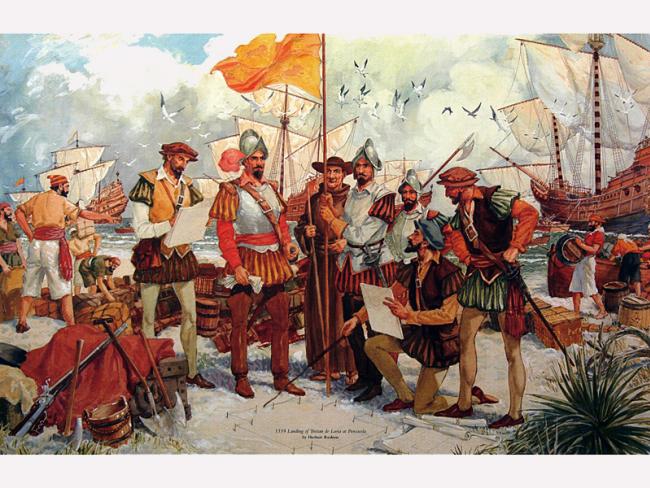
Which grouping lists the main reasons for Spanish exploration of the "New World"?
"God, glory, and gold"
"Salt, silk, and spices"
"Rum, slaves, and molasses"
"Trade, silver, and jewels"


The Spanish established ____, hoping to convert Indians to their religion.
missions
authentic restaurants
mosques
private schools

What did Christopher Columbus want to find?
Spain
shortcut to Asia for trade so Spain could become wealthy
North America
Russia

What did Christopher Columbus actually find?
United States of America
Canada
Spain
An island chain now called the Bahamas
Which event encouraged the English to keep trying to plant permanent colonies in North America?
the discovery of the Hudson River
the fate of the Roanoke Colony
the defeat of the Spanish Armada
the discovery of gold
During the first summer at Jamestown, many colonists were killed by .
spoiled food supplies
Spanish sailors
floods
diseases from mosquitoes
What religion were the missions trying to push on the Native Americans
Catholic
Buddhist
Methodist
Russian
What were the Native Americans promised by the missions
Gold, glory, God
marriage for their young women
Presents
land to use for farming and living on
What were three reasons for French exploration in North America?
Friends, Fish, Fur
Fur, God, Glory
Friends, God, Gold
God, Glory, Fish
What is the definition of encomienda?
Person from Spain who held a position of power in a Spanish colony
Large estate farmed by many workers
Land granted to Spanish settlers that included the right to demand labor or taxes from Native Americans
How did the introduction of the horse in North America change the lives of the Indians living on the Great Plains?
The horse allowed the Indians of the Great Plains to become sedentary farming societies.
The horse allowed the Indians of the Great Plains to become highly mobile, hunting societies.
The horse allowed the Indians of the Great Plains to become skilled trading societies.
The horse allowed the Indians of the Great Plains to become warlike societies.
Who was the Spanish Conquistadores that conquered the Aztec?
Hernan Cortes
Francisco Pizarro
Hernando de Soto
Francisco Coronado
By 1600, which European nation had the largest empire in the Americas?
Portugal
England
France
Spain
Why did Europeans want to come to the new world?
To gain basic freedoms such as thought and religion
To escape the grips of feudal Europe
For more opportunities in life
All of the above
What PUSH factors swayed Europeans to travel to the colonies? Select MULTIPLE answers.
a. Increasing poverty because of increasing taxes that went to government reform programs
b. A desire to start a new lifestyle
c. Exploration, since people wanted to discover new trade routes
d. Dissatisfaction with the corruption of the Church of England and its incomplete Reformation
Choose ALL the answers that help explain the PULL factors of American colonization.
a. People desired new land to gain power and also because it could be cultivated/developed more efficiently than in Europe.
b. Settlers wanted to explore new trade routes and hoped to weaken monopolies on trade.
c. European immigrants wanted to gain wealth from trade, with goods like sugars, spices, and silk.
d. Increasing homelessness pulled people into the colonies so they could help the poor.
If the Magna Carta was a symbol for something, it would be _____. (Choose All That Apply)
The King is not above the law
The English people do have rights
The King has absolute power
All of These
If the Magna Carta gave some protection to the English, it would also _________. (Choose All That Apply):
Give power to elected officials to protect the rights of the English
Limit the power of the King
Create a legislative body for elected officials to serve
Allow elected noblemen & church officials to make decisions for the English people
The English Bill of Right of 1689 (Choose ALL that Apply)
Protected the Rights of English Citizens
Protected King James II
Helped balance power among the King, common people, and nobles
Protected the rights of Parliament
Before the Magna Carta was signed, King John had ______
limited power
a democracy
justice power
absolute power
Group of people that advise the king and makes the laws in England is the __________________.
Constitution
Nobles
Parliament
Democracy

