
Font size
 Worksheets
Wave introduction
Total questions: 25
Worksheet time: 17mins
Which term describes the number of waves passing a point during a certain period of time?
Crest
Frequency
Range
Wavelength

What is the wavelength of this wave?
1.5m
3.0m
5.0m
6.5m
A local surf report provides the height of the wave from the trough to the crest of the wave. How does this relate to the wave’s amplitude?
It is less than the wave’s amplitude.
It is equal to the wave’s amplitude.
It is about twice the wave’s amplitude.
It is about half of the wave’s amplitude.
What measurement is usually determined by measuring the crest of one wave to the crest of another wave?
amplitude
frequency
range
wavelength

What is the amplitude of the wave?
2m
4m
6m
8m
What is frequency?
The number of waves that pass a given point in one second.
The distance measured from a crest to a crest or trough to trough.
The distance from a trough to a crest
The distance from the resting point to the top of a crest or bottom of a trough.
What is amplitude?
The number of waves that pass a given point in one second.
The distance measured from a crest to a crest or trough to trough.
The distance from a trough to a crest
The distance from the resting point to the top of a crest or bottom of a trough.
What is a wave?
a disturbance that transfers energy
a disturbance that transfers matter
any type of energy that makes particles move
any type of matter that vibrates back and forth

What does point B represent?
Crest
Trough
Rarefaction
Compression
Transverse waves have
Crest
Trough
Rarefaction
Compression
Longitudinal waves have
Crest
Trough
Rarefaction
Compression
How are frequency and energy related?
lower frequency = more energy
lower frequency = less energy
Frequency and energy are the same
Frequency and energy are not related

All waves carry ________ as they travel from one place to another.
matter
space
energy
water
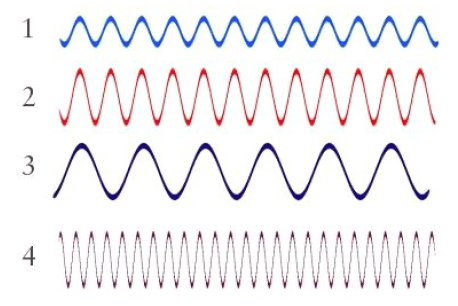
Which wave in the diagram has the greatest wavelength?
1
2
3
4

The period of an ocean wave is 10 s. What is its frequency?
10 cycle/second
1 cycle/second
0.5 cycle/second
0.1 cycle/second
Wavelength= .5m
Frequency= 150 hertz
Wavelength= 2.0m
Frequency= _________
Wavelength= __________
Frequency= 600 hertz
Which description represents a medium?
energy that moves with a wave
midway point through a wave
a wave that can travel through a vacuum
material through which waves can travel
What does point A represent?
Crest
wavelength
Rarefaction
Compression
What does point C represent?
Crest
wavelength
Rarefaction
Compression

