
 Worksheets
MBI CSEC Chemistry States of Matter
Total questions: 27
Worksheet time: 16mins
Matter in a ...... has a ...... volume and ...... shape
gaseous state ___ no definite ___ no definite
liquid state _____ no definite ___ definite
a. solid state _____ no definite ___ no definite
A _______________ is a pure substance that is composed of only one type of atom?
element
mixture
compound
particulate
Which of the following is a homogenous mixture?
baked beans
sugar dissolved in water
chocolate chip ice cream
chicken noodle soup
Anything that has mass and takes up space is an example of
energy
matter
chemical change
temperature
New substances are always formed when matter undergoes a ___.
change in shape
change in temperture
physical change
chemical change
The three states of matter are:
mixture, magnetism, temperature
solid, liquid, gas
physical properties, heat, solid
solid, temperature, sink

The blue molecules are an example of a:
gas
solid
liquid
cup
Which one is NOT an example of a physical property?
magnetism
temperature
sink/float
water

This is an example of a:
nothing
gas
liquid
solid

Matter that expands to take the shape of its container and has molecules that are far apart is a:
gas
solid
liquid
gel

What type of change needs to take place to transform water to ice?
heat energy needs to decrease
heat energy needs to increase
heat energy needs to stay the same
it needs to melt

Matter that has a definite size and shape is a:
gas
solid
liquid
mass

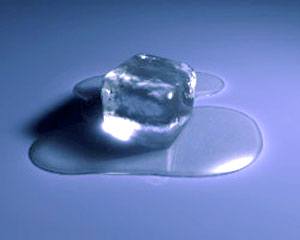
This state of matter is turning from a solid to a ____?
liquid
Freezing
Gas
Solid

This ice in this glass is ___________.
Freezing
Melting
Evaporating
Liquidizing
What happens when salty water is boiled?
The salt becomes a new compound and water evaporates as it has a low boiling point
The water evaporates and the salt remains in the beaker as it has a high melting point
The water becomes a new compound and evaporates while salt remains in the beaker
The water will disappear and the salt remains in the beaker as it is a solid

Matter can be classified by analyzing its composition as it is shown in the diagram. Steel is a material that contains two elements: iron (Fe) and carbon (C). Two different samples of steel have different quantities of these two elements, but both have uniform composition. Using the diagram above, how would you classify steel?
As pure substance, because it has uniform composition and it is a compound
As a heterogeneous mixture, because is formed by two different elements
As a homogeneous mixture, because is formed by two different elements and it is uniform
As pure substance, because different samples have different composition
Freezing is the process of a (a) changing to a solid.
Sublimation is the process of
a gas going to a liquid
a solid going to a gas
a liquid going to a solid
a gas going to a solid

What state of matter is represented in the picture above?
solid
liquid
gas
T or F Condensation is the process of an object moving from the gas phase to the solid phase.
true
false
While an object is melting, what happens to the temperature?
increases
decreases
stays the same
Define a liquid.
Matter that has fixed shape but no fixed volume
Matter that has fixed shape and fixed volume
Matter that has fixed volume, but no fixed shape
CHOOSE THE WRONG ANSWER
when water changes from a liquid to a gas - caused by heat
evaporation
condensation
freezing
melting
what is an atom
smallest part of the universe
smallest part of a substance
smallest part of anything
smallest part of water

