Wayground logo

Free Printable Worksheets

Font size

S
M
L
XL
Worksheets

Force Quiz

Total questions: 45

Worksheet time: 29mins

Name
Class
Date
1.
Force is...
a)
the motion that opposes each other
b)
how quickly an object moves
c)
a push or pull
d)
how much an objects weights
2.
Friction is...
a)
Total forces added or subtracted
b)
force greater than 0 N so  motion happens
c)
 force is equal to 0N so no motion happens
d)
Force that opposes motion (reason everything slows down and comes to a complete stop)
3.
What is Newton's 1st Law of Motion?
a)
Force = Mass x Acceleration
b)
An object at rest stays at rest, an object in motion stays in motion unless acted on by an outside force
c)
For every action their is an equal and opposite reaction
4.
What is Newton's 2nd Law of Motion?
a)
Force = Mass x Acceleration
b)
An object at rest stays at rest, an object in motion stays in motion unless acted on by an outside force
c)
For every action their is an equal and opposite reaction
5.
What is Newton's 3rd Law of Motion?
a)
Force = Mass x Acceleration
b)
An object at rest stays at rest, an object in motion stays in motion unless acted on by an outside force
c)
For every action their is an equal and opposite reaction
6.
Inertia is...
a)
A push and pull 
b)
Objections with opposing forces
c)
An objects resistance to change in motion
d)
An objects change in velocity
7.

Force that holds the nuclei of atoms together:

a)

Strong Nuclear

b)

Weak Nuclear

c)

electromagnetic

d)

gravity

8.

Force that cause radio active decay:

a)

Strong Nuclear

b)

Weak Nuclear

c)

electromagnetic

d)

gravity

9.

Force responsible for electricity:

a)

Strong Nuclear

b)

Weak Nuclear

c)

electromagnetic

d)

gravity

10.

Force that holds the Earth in orbit around the sun:

a)

Strong Nuclear

b)

Weak Nuclear

c)

electromagnetic

d)

gravity

11.

Weakest of the for natural forces:

a)

Strong Nuclear

b)

Weak Nuclear

c)

electromagnetic

d)

gravity

12.

Strongest of the for natural forces:

a)

Strong Nuclear

b)

Weak Nuclear

c)

electromagnetic

d)

gravity

13.
Fill in the blank...
_________________ is the measure of the pull of gravity on the matter in an object.
a)
mass
b)
weight
c)
gravity
d)
space-time
14.
When the weight of an object is greater than the buoyant force, the object will ... 
a)
Sink
b)
Float 
c)
Expand
d)
Shrink
15.
If the weight of the water displaced is the same as the weight of the object placed in the water, the object will sink.
a)
True
b)
False
16.

A climber climbs up a hill. He uses a rope. The rope stretches as he climbs. What is the force in the rope that balances the climber's weight?

a)

Tension

b)

Friction

c)

Gravity

d)

Thrust

17.

The tendency of an object to maintain a constant velocity

a)

Inertia

b)

Force

c)

Weight

d)

Tension

18.

A force exerted by a surface perpendicular to the surface.

a)

Normal

b)

Friction

c)

Gravity

d)

Tension

19.

A pulling force exerted along a rope, string, wire, cable...

a)

Friction

b)

Gravity

c)

Normal

d)

Tension

20.

Which of Newton's Laws describes the relationships between Force, mass and acceleration.

a)

1st

b)

2nd

c)

3rd

21.

Which of Newton's Laws says that objects tend to maintain a constant velocity unless acted on by an unbalanced force.

a)

1st

b)

2nd

c)

3rd

22.

Which of Newton's Laws states that forces always come in pairs that are equal and opposite to one another.

a)

1st

b)

2nd

c)

3rd

23.

A swimmer pushes backward on the water in order to move forward. This is an example of Newton's ________ Law.

a)

1st

b)

2nd

c)

3rd

24.

A shopping cart accelerates more slowly when full. This is an example of Newton's ________ Law.

a)

1st

b)

2nd

c)

3rd

25.

When a driver slams on the brakes, passengers fly forward. This is an example of Newton's ________ Law.

a)

1st

b)

2nd

c)

3rd

26.
What type of force is holding this balloon to the wall?
a)
Applied
b)
Gravitational
c)
Magnetic
d)
Electrical
27.
What force holds the planets in motion around the sun?
a)
Magnetic
b)
Electrical
c)
Gravitational
d)
Air Resistance
28.
What force ultimately slows the roller coaster to a stop?
a)
Applied
b)
Normal
c)
Friction
d)
Magnetic
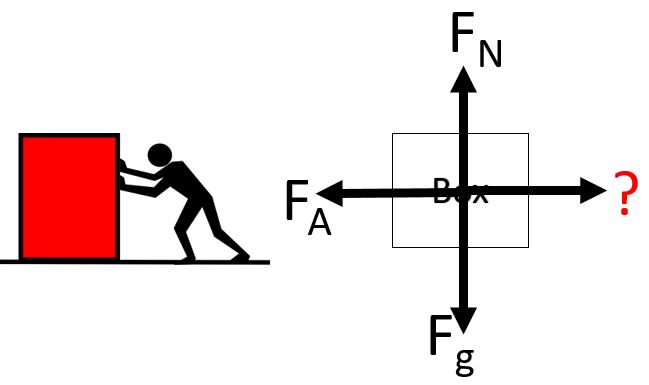
29.
Name the missing force....
a)
weight force
b)
normal force
c)
frictional force
d)
tension force
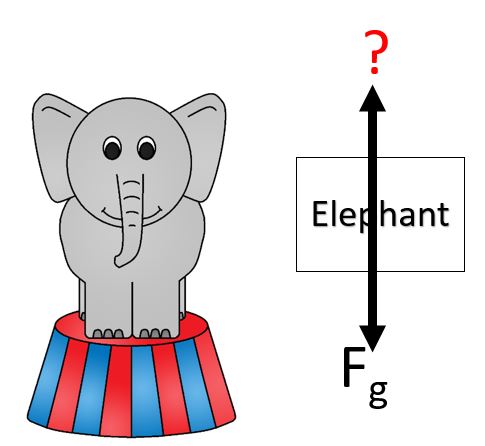
30.
Name the missing force...
a)
frictional force
b)
weight force
c)
thrust
d)
buoyant force
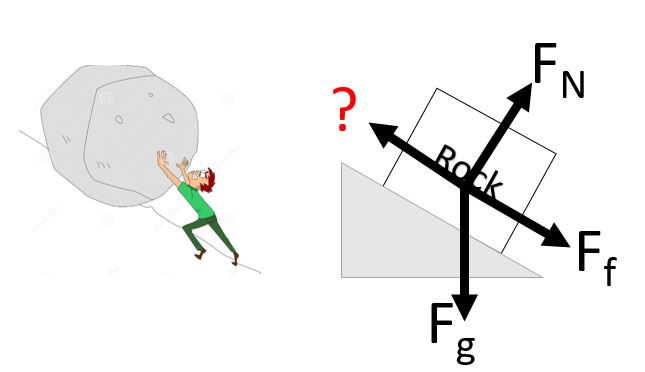
31.
Name the missing force...
a)
weight force
b)
normal force
c)
applied force
d)
frictional force
32.
Name the missing force...
a)
applied force
b)
weight force
c)
lift
d)
normal force
33.
Name the missing force...
a)
applied force
b)
weight force
c)
tension force
d)
drag
34.
Friction acts in a direction __________ to the direction of the object’s motion.   
a)
Side By Side
b)
Parallel Directions
c)
 Opposite
d)
The Same Direction
35.

The support force exerted upon an object that is in contact with another stable object.

a)

Gravity

b)

Electrical Force

c)

Normal Force

36.

Acceleration can be... (select all that apply)

a)

speeding up

b)

slowing down

c)

staying at constant speed

d)

changing directions

37.

Velocity is different from speed because...

a)

Velocity is distance/time. Speed is displacement/time.

b)

Velocity is speed in a certain direction and can be positive or negative.

c)

Speed is velocity in a certain direction. Both can only be positive.

d)

Velocity is how much speed changes over time.

38.

What is the equation for velocity?

a)
b)
c)
d)
39.

Select the equation for acceleration.

a)
b)
c)
d)
40.

An Arrow with a Magnitude and Direction

a)

Scalar

b)

Vector

c)

Refractor

d)

Tip to Tail

41.

Velocity is an example of a

a)

Vector

b)

Scalar

42.

Time is an example of a

a)

Vector

b)

Scalar

43.

What is the sum of multiple vectors called?

a)

Scalar

b)

Vector Combination

c)

Resultant Vector

d)

Force

44.

Find the magnitude of this vector (each square is 1 unit long)

a)

4

b)

5

c)

3

d)

square root of 5

45.

Who wrote the laws of motion and invented calculus to describe them?

a)

Einstein

b)

Hawking

c)

Nye

d)

Newton

e)

Session