
 Worksheets
Unit 2.2 The Law of Demand
Total questions: 20
Worksheet time: 40mins
Q1: The desire to have some good or service and the ability to pay for it
supply
equilibrium
demand
quantity demanded
Q2: Which of these best describes the law of demand?
If prices go up, quantity demanded will fall and if prices go down, quantity demanded will go up
If prices go up, quantity demanded will also go up and if prices go down, quantity demanded will also go down
There is no law of demand, each situation is unique and demand and prices cannot be predicted
Prices will go up for certain goods when quantity demanded goes up and vice versa
Q3: The quantity demanded of a good or service changes at all price levels best describes the concept of
change in quantity demanded
elasticity
change in demand
demand curve

Q4: The diagram represents a
increase in demand
decrease in demand
Q5: According to the Law of Demand, when prices drop ___.
demand will also drop.
demand will increase.
quantity demanded is unchanged.
supply increases.
Q6: The phrase "a change in demand" most directly implies a ___.
movement along the curve.
movement along the price curve.
change in quantity demanded of a good.
shift in the demand curve.
Q7: Demand means
the amount of a good or service that consumers are willing to buy.
is the amount of a good or service produced.
is the price that is demanded by consumers.
None of the above.
Q8: What does the law of demand say?
Consumers will buy less of something when price goes down.
Consumers will buy more of something when price increases.
Consumers will buy more of something when prices go down.
None of the above.
Q9: If the price of a good or service decreases what will happen to the demand for it?
increase
decrease
stay the same
who knows
Q10: If the price of a good or service increases what will happen to the demand for it?
increase
decrease
stay the same
moves away
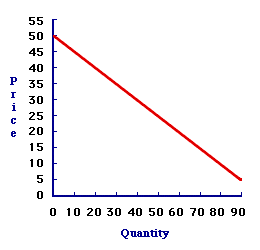
Q11: What does this curve represent?
supply
equilibrium
demand
surplus
Q: 12 What goes on the horizontal axis (x axis) of a demand graph?
price
quantity demanded
quantity supplied
change in demand
Q13: Price goes on ________.
the vertical axis.
the horizontal axis.
at the origin.
the z axis.
Q14: In a market economy, who decides on the prices of goods and services?
government
producers and consumers
firms
local leaders
Q15: Market demand curves are obtained by
determining the price each consumer is willing to pay for the good & summing those prices across all consumers.
observing the prices and quantities sold in a market over time and plotting those price-quantity combinations in a graph.
summing the quantities every consumer is willing to buy at each different price.
observing the behavior of an individual consumer in a market.
Q16: According to the law of demand, price and quantity move
in the same direction.
in opposite directions.
towards one another.
away from one another.

Q17: The chart compares the price of graphic t-shirts to the quantity demanded. This chart shows the link between ___.
interest in a product and the price a consumer pays.
interest in a product and the price a producer pays.
amount of a product and the price a consumer pays.
amount of a product and the price a producer pays.
Q18: How do lower prices tend to affect demand?
They tend to increase the availability of a product.
They tend to decrease the availability of a product.
The tend to increase the interest in a product.
They tend to decrease the interest in a product.
Q19: A factor that most directly affects the demand for automobiles ___.
the individual tastes and preferences of consumers.
the cost of factors of production (land, labor, capital).
the availability of workers in automobile factories.
a company's ability to respond to buyers' interest.
Q20: The amount of goods and services consumers want is called the ___.
count
demand
number
supply

