

wayground logo

Free Printable Worksheets

NEW

Font size

S
M
L
XL
Worksheets

Grade 6 Chemistry

Total questions: 21

Worksheet time: 19mins
Name
Class
Date
1.
Which of these is an example of precipitation?
a)
snow
b)
air
c)
clouds
d)
vapor
2.
Which is the opposite of condensation?
a)
runoff
b)
evaporation
c)
precipitation
d)
transpiration
3.
Snow, sleet, hail, and rain are all examples of  ________________. 
a)
evaporation
b)
condensation
c)
accumulation
d)
precipitation
4.
What happens after groundwater at the very end/beginning of the water cycle?
a)
Evaporation
b)
Transpiration
c)
Condensation
d)
Groundwater
5.
When water _________, dew forms.
a)
Melts
b)
Evaporates
c)
Condenses
d)
Precipitates
6.
What is the water cycle?
a)
the 3 forms of water
b)
the movement of water on, above, or below the surface of the Earth
c)
when water melts
d)
when clouds form
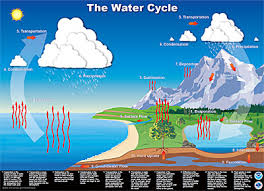
7.
What does this illustration show?
a)
Sunrise
b)
The Water Cycle
c)
Sunset
d)
the recycling of snow
8.
This is what heats up the water to start the  water cycle. 
a)
sun
b)
moon
c)
stars
d)
Mars
9.
What is water doing when it is changed to water vapor?
a)
evaporating
b)
condensing
c)
transpiring
d)
freezing
10.

How is transpiration important to the water cycle?

a)

It is the evaporation of water from the leaves of plants back into the atmosphere allowing the cycle to continue.

b)

It results in the deposition of water vapor directly as ice, so water changes states causing the cycle to move to the next phase.

c)

It allows plants to absorb water through their roots which is then precipitated back into the atmosphere.

d)

It permits the diffusion of water from the surface to water tables deep underground which restores groundwater supplies.
11.
During which stage do clouds form?
a)
condensation
b)
evaporation
c)
precipitation
12.

What are formed when water vapor condenses and come together?

a)

Clouds

b)

Mountains

c)

Transpiration

d)

Valleys

13.
People must have _______ to drink in order to survive.
a)
frozen water
b)
clean water
c)
contaminated water
d)
polluted water
14.

What is the best way to purify water?

a)

Add salt

b)

Put inside the refrigerator

c)

Filtration or Boiling

d)

Find a very clean stream of water

15.

Can sand pass through filter paper?

a)

Yes

b)

No

16.

During the purification process, filtration separates the

a)

Solid purities

b)

Solid impurities

17.

Th components of filtration are separated based on

a)

boiling point

b)

solubility

c)

particle size

18.
What does chlorination do to the water?
a)
Removes microorganisms
b)
Cleans the water
c)
Makes the water taste nice
d)
Removes twigs and sediment
19.

Used to separate an insoluble solid from liquid or soluble solid

a)

Filtration

b)

Distillation

c)

Crystallisation

d)

Evaporation

20.

Used to separate a dissolved solid from its solution

a)

Filtration

b)

Evaporation

c)

Crystallisation

d)

Sublimation

21.

Used to separate liquid from a solution

a)

Filtration

b)

Sublimation

c)

Distillation

d)

Fractional distillation
