wayground logo

Free Printable Worksheets

Font size

S
M
L
XL
Worksheets

Unit 1 Exam

Total questions: 32

Worksheet time: 1hrs 7mins

Name
Class
Date
1.

What is Geography?

a)

The study of physical features.

b)

The study of where things are and why.

c)

The study of the distribution and interaction of physical & human features of the Earth.

d)

The study of physical and human features.

2.
What do we use to find absolute location?
a)
latitude and longitude
b)
the equator and international dateline
c)
a GPS and an XLP
d)
landmarks and distances
3.

The transportation of goods, people, diseases, and ideas.

a)

Location

b)

Place

c)

Human-environment interaction

d)

Movement

e)

Region

4.

The description of a location. What is it like there?

a)

Movement

b)

Region

c)

Human Environment Interaction

d)

Location

e)

Place

5.

When places share a common characteristic

or set of characteristics

a)

Location

b)

Place

c)

Human-environment interaction

d)

Movement

e)

Region

6.

The relationship between people and their environment

a)

Movement

b)

Region

c)

Human Environment Interaction

d)

Location

e)

Place

7.

This picture to the right best represents which theme of

a)

Movement

b)

Region

c)

Human Environment Interaction

d)

Location

e)

Place

8.
What city is located at 32 degrees south and 150 degrees east?
a)
Shanghai
b)
Sydney
c)
Durban
d)
Calcutta 
9.
Which city is located at 38 degrees north and 120 degrees west?
a)
San Fransisco 
b)
New York
c)
New Orleans
d)
London
10.
Latitude on a globe run from: 
a)
north to south
b)
north to west
c)
east to south
d)
east to west
11.
When measuring lines of latitude, always start with this line, which represents zero:
a)
North Pole
b)
The Prime Meridian 
c)
The Equator 
d)
South Pole
12.
When measuring lines of longitude, always start with this line, which represents zero:
a)
The Equator
b)
The Prime Meridian 
c)
The North Pole
d)
The South Pole
13.
It is steep on a topographic map where __________.
a)
lines are closest together
b)
a river flows into a lake
c)
contours bend
d)
contours are far apart
14.

Match the topographic map to its profile.

a)
b)
c)
d)
15.
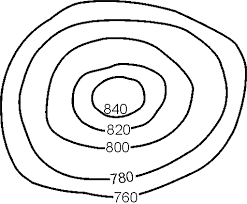
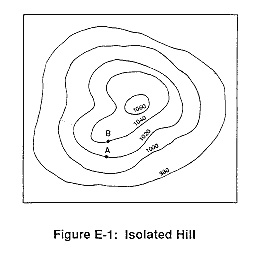
Determine the contour interval:
a)
5 m
b)
10 m
c)
15 m
d)
20 m
16.
What is the contour interval on this map?
a)
100
b)
10
c)
15
d)
20
17.

True or false: All world map projections create distorted images of the Earth to some degree. These distortions relate to size, shape, direction, and distance.

a)

True

b)

False

18.

A way of representing the spherical Earth on a flat surface:

a)

Projection

b)

Distortion

c)

Cartographer

19.

A geographer who makes maps:

a)

Cartographer

b)

Distortion

c)

Projection

20.

Biome with many different species of cacti and reptiles and very little rainfall.

a)

Desert

b)

Temperate Rainforest

c)

Tropical Rainforest

d)

Arctic Tundra

21.

Biome with plants and grasses, but no trees.

a)

grassland

b)

desert

c)

forest

d)

arctic tundra

22.
Type of forest biome near the equator; receives a lot of rain; temperatures are warm all year.
a)
desert
b)
tropical rain forest
c)
arctic
d)
temperate rain forest
23.

What biome is this?

a)

Tundra

b)

Grassland

c)

Rain Forest

d)

Desert

24.

What biome is this?

a)

rain forest

b)

deciduous forest

c)

Taiga

d)

tundra

25.

What biome is this?

a)

deciduous forest

b)

taiga

c)

desert

d)

grassland

26.

This biome has very little rainfall, also extremely cold temperatures for most of the year, and frozen soil makes ponds form.

a)

Deciduous forest

b)

Tundra

c)

rain forest

d)

Grassland

27.
What is weather over a long period of time?
a)
A tropical vacation
b)
Weather
c)
Climate
d)
Science
28.
As you go to the top of a mountain, what happens to temperature?
a)
Nothing
b)
It increases
c)
It decreases
d)
It goes up and down
29.
Large bodies of water affect climate of the land next to them because
a)
water heats up and cools more slowly than land
b)
water heats up and cools faster than land
c)
water and land cool at the same time
d)
water and land heat at the same rate
30.
Two factors to determine climate are
a)
precipitation and temperature
b)
hurricanes and tornadoes
c)
humidity and pressure
31.
The sun’s rays are least direct __________.
a)
near the poles.      
b)
in July.
c)
near the equator.
d)
far from the ocean.
32.

In at least 3 sentences, describe what climate and weather are AND their differences.

4 lines