

wayground logo

Free Printable Worksheets

NEW

Font size

S
M
L
XL
Worksheets

Heat Flow Unit Review

Total questions: 50

Worksheet time: 3hrs 44mins

Name
Class
Date
1.
What do liters and milliliters measure?
a)
Solid Volume
b)
Liquid Mass
c)
Solid Mass
d)
Liquid Volume
2.
The density if ice is ______ than the density of water, which causes it to _____
a)
More, Suspend
b)
Less, Sink
c)
More, Float
d)
Less, Float
3.
The density of an object with a mass of 10 grams and a volume of 2 cm3 would be _____
a)
20 g/cm3
b)
2 g/cm3
c)
5 g/cm3
d)
0.5 g/cm3
4.
What would the mass of an object be if it has a density of 10g/mL and a volume of 5 mL?
a)
50 grams
b)
2 grams
c)
0.5 grams
d)
5 grams
5.
Objects will float if their average density is _________ the density of the liquid they are in.
a)
Less Than
b)
Greater Than
c)
Equal To
6.
______ is the amount of space an object takes up
a)
Weight
b)
Mass
c)
Volume
d)
Density
7.
The metric units for solid volume are _______
a)
Liters
b)
Kilograms
c)
Cubic Meter or Centimeters
d)
Grams
8.
Mass per unit volume is ______
a)
Volume
b)
Density
c)
Mass
d)
Shape
9.
What is the mass of a substance with a volume of 72.5 cm3 and a density of 0.94 g/cm3?
a)
68.15 g
b)
77.13 g
c)
62 g
d)
100 g
10.
What metal do you have if you have a mass of 225 g and a volume of 21.4 cm3?
a)
Zinc- 7.13 g/cm3
b)
Copper- 8.96 g/cm3
c)
Silver- 10.5 g/cm3
d)
Mercury- 13.55 g/cm3
11.

Which object has the greatest density?

a)

Box with blue particles

b)

Box with red particles

c)

The density of both boxes are equal

12.
A bar of copper has a mass of 216g and a volume of 24cm3. What is the density of copper?  
a)
9g/cm3
b)
.11g/cm3
c)
5184g/cm3
d)
322mL
13.
What is the volume of 150 grams of lead if it has a density of 11.3 g/cm3?
a)
13.3 g
b)
13.3 cm3
c)
.075 g
d)
1695 cm3
14.
If a block of wood has a density of 0.6 g/cm3 and a mass of 120 g, what is its volume?
a)
200 cm3
b)
0.005 cm3
c)
200.0 ml
d)
72 ml
15.
Frank has a paper clip. It has a mass of 9g and a volume of 3cm3. What is its density?
a)
3 g/cm3
b)
1/3 g/cm3
c)
27 g/cm3
d)
39 g/cm3
16.
A diamond has a mass of 1.2 g.  If diamond has a density of 3.51 g/mL, what is the volume of the diamond.
a)
0.34 mL
b)
2.9 g/mL
c)
2.3 mL
d)
4.2 mL
17.
Which substance is the MOST dense?  ** Use the key
a)
A
b)
B
c)
C
18.
Which substance is the least dense? **Use the key 
a)
A
b)
B
c)
C
19.

In which state of matter are the particles least able to move?

a)

A

b)

B

c)

C

20.

Which of these three states represents a liquid?

a)

A

b)

B

c)

C

21.

Which model represents gas?

a)

A

b)

B

c)

C

22.
Particles in this state of matter are moving the fastest.
a)
solid
b)
liquid
c)
gas
23.
Particles in this state of matter are moving the slowest.
a)
solid
b)
gas
c)
liquid
24.

Where do convection cycles happen?

a)

core

b)

mantle

c)

crust

25.

Convection cycles move in the mantle. How does this affect the crust?

a)

crust has no motion

b)

crust moves in random direction

c)

crust moves in same direction convection cycle moves

26.

Which state of matter is least dense?

a)

Solid

b)

Liquid

c)

Gas

27.

What layer of earth changes because of the convection cycle?

a)

Crust

b)

Core

c)

Mantle

28.

If magma increases in temperature (get hot) what will happen?

a)

It moves down (sinks)

b)

It moves up (rises)

29.

If magma decreases in temperature (cooler) what will happen to the magma?

a)

It will move down (sink)

b)

It will rise up (float)

30.

Why does hot mantle rise (go/move up)?

a)

hot = less dense

b)

hot = no change

c)

hot = more dense

31.
What is the definition of CONDUCTION?
a)
When heat is transferred from objects like rays of light or electromagnetically.
b)
a  hot liquid or air that  expands, becomes less dense, and rises or becomes more dense, and sinks.
c)
When heat transfers from objects that are touching.
d)
When heat transfers through the heater or AC in your house.
32.

What type of heat transfer takes place when you touch a warm mug of hot chocolate?

a)

Radiation

b)

Convection

c)

Conduction

d)

None of the above

33.

If you walk barefoot on hot asphalt, energy is transferred by which process?

a)

Convection

b)

Radiation

c)

Conduction

d)

Reflection

34.
Which direction is heat flowing in the picture?
a)
from the hand to the ice
b)
from the ice to the hand
c)
heat is not being transferred
d)
there is no way to tell
35.
Compared to the ocean, land heats up and cools down
a)
Faster
b)
 Slower
c)
 Equally
d)
Gradually
36.

Where do we see conduction in a pot of boiling water on the stove?

a)

The water heats up by touching the hot, metal pot.

b)

The steam from the hot water rises out of the pot.

c)

The heat from the fire can be felt on all sides.
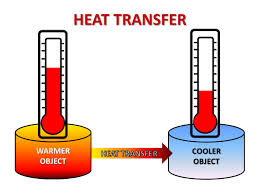
37.
If two objects have different temperatures, heat will flow from the cooler object to the warmer one.
a)
True
b)
False
38.
Heat transfer by conduction occurs when...
a)
particles bump into each other
b)
large numbers of atoms move from place to place
c)
atoms give off heat in the form of electromagnetic waves
d)
electromagnetic waves travel from place to place through a vacuum
39.
Why are gases poor conductors of electricity?
a)
Particles are close together and collisions are more frequent
b)
Particles are far apart and collisions are less frequent
c)
Particles are close together and collisions are less frequent
d)
Particles are far apart and collisions are more frequent
40.
Heat transfers from an area of ____temperature to an area of ___ temperature.
a)
high to low
b)
low to high
c)
high to high
d)
It can travel high to low and low to high. 
41.
What  is the formula to calculate heat energy required to raise the temperature of any substance?
a)
Q = m Cp ∆T
b)
Q = m Cp
c)
Q =  ½ m v
d)
m = Q Cp
42.
If the specific heat of water is 4,186 J/kg∙°C, how much heat is required to increase the temperature of 1.2 kg of water from 23 °C to 39 °C? 
a)
-80,371.2 J
b)
44,938.6 J
c)
80,371.2 J
d)
112,575.9 K
43.
What would be the effect on the particles if more heat is supplied to the system?
a)
They would slow down
b)
They would stop moving
c)
They would speed up
d)
There would be no effect
44.
The specific heat is the amount of energy needed to raise the temperature one degree Celsius of 1 gram of a substance.
a)
True
b)
False
45.
The specific heat(c) of copper is 0.39 J/g °C. What is the temperature change(∆t) when 100 Joules of heat(Q) is added to 20 grams?
a)
12.82 °C
b)
24.12°C
c)
351 °C
46.
Water has a specific heat of 4184 J/KgºC.  Wood has a specific heat of 1760 J/KgºC.  What material needs more energy to raise the temperature 1ºC
a)
Wood
b)
Water
c)
Both are the same
47.
A high specific heat means...
a)
It heats up quickly with energy added
b)
It requires more energy to change temperature
48.
If I heat up 2 pans of water one has 100 mL in it and one has 1000mL. Which one heats up the fastest?
a)
100 mL
b)
1000 mL
c)
They both heat up at the same speed
d)
They cool down.
49.
The temperature of an unknown piece of metal with a mass of 30.00 g changes from 25.0 °C to 35.0 °C when the metal absorbs 350.0 J of energy. What is the specific heat of the metal?
a)
1.17 J/g°C
b)
-1.17 J/g°C
c)
0.857 J/g°C
d)
-0.857 J/g°C
50.

Looking at the graph when does conduction stop happening

a)

When it is all hot

b)

When it is all cold

c)

When it all reaches the same temperature
