wayground logo

Free Printable Worksheets

Font size

S
M
L
XL
Worksheets

Community Interactions and Ecological Succession

Total questions: 20

Worksheet time: 40mins
Name
Class
Date
1.

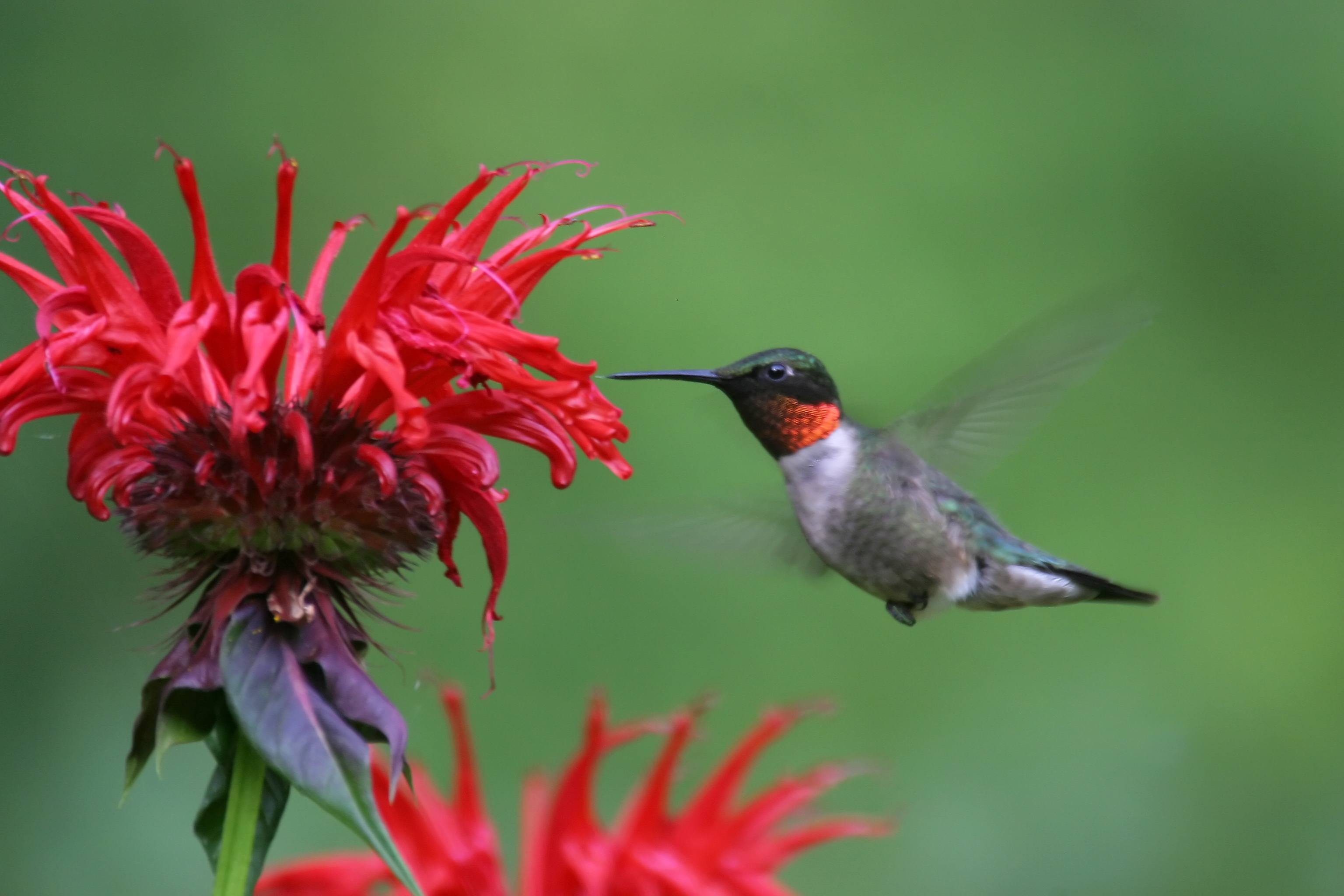
Hummingbirds feed on nectar from flowers. The flowers are pollinated by hummingbirds as they move from flower to flower. This is an example of

a)

commensalism

b)

mutualism

c)

parasitism

d)

predation

2.

Rabbits and deer eat lettuce leaves from a garden.

What ecological interaction describes the relationship between rabbits and deer?

a)

Mutualism

b)

Competition

c)

Commensalism

d)

Predation

3.

The actual role or position a species has in its environment (not it's potential role)

a)

Habitat

b)

Realized niche

c)

Ecosystem

d)

Fundamental Niche

4.

relationship in which two species live closely together

a)

resource

b)

mutualism

c)

succession

d)

symbiosis

5.

Which term best describes two or more predators living in the same habitat who feed on the same prey?

a)

coexistence

b)

competition

c)

mutualism

d)

predatory

6.
The crocodile and bird have a _______________ relationship.  The crocodile benefits by having its teeth cleaned.  The bird benefits by gaining food and protection.  Both animals benefit from this relationship.
a)
parasitism
b)
predator and prey
c)
mutualism
d)
commensalism
7.
What are examples of pioneer species in a primary succession?
a)
Bushes and Shrubs
b)
Oak trees
c)
Mossess and Lichens 
d)
A rose Bush
8.
What is the most important function of pioneer species?
a)
To create rocks
b)
To create soil and add nutrients to the environment 
c)
To look nice
d)
Food for animals 
9.
A climax community is ….
a)
the beginning of a new ecological succession.
b)
the rocks in a new environment.
c)
the fire that will cause destruction.
d)
an area that reaches its greatest growing potential.
10.
Why does primary succession take longer to reach climax community?
a)
Because trees do not perform photosyntheses.
b)
Because climax community is in a forrest.
c)
Because primary succession already has soil
d)
Because primary succession does not have soil
11.

A farmer abandons his farm. A a short time a forest begins to grow on his abandoned farm. What type of succession would this be considered?

a)

Primary Succession

b)

Secondary Succession

c)

Tertiary Succession

d)

This isn't a type of succession

12.

After a volcanic eruption the lava cools and becomes rock. Which succession must take place in order for vegetation (plants) to return?

a)

Primary Succession

b)

Secondary Succession

c)

Tertiary Succession

d)

This isn't a type of succession

13.
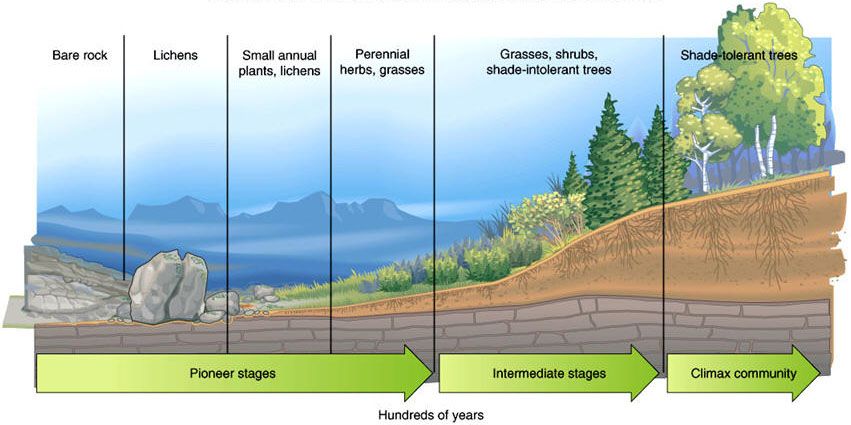
What is the order of succession shown in this figure?
a)
A, B, C, D
b)
B, A, D, C
c)
C, D, A, B
d)
D, A, B, C
14.
The picture shows what type of succession?
a)
primary
b)
secondary
c)
tertiary
d)
quadanary
15.
After a volcanic eruption, lava covers the land. What is the order that plants grow to repopulate the area?
a)
Lichens → Shrubs → Grasses → Trees
b)
Lichens → tree → shrubs→Grasses
c)
Grasses → Lichens → Shrubs → Trees
d)
Lichens → Grasses → Shrubs → Trees
16.
Honey guide birds alert and direct badgers to bee hives.  The badgers then expose the hives and feed on the honey first.  Then the honey guide birds eat.  
a)
mutualism
b)
commensalism
c)
predation
d)
competition
17.
Dwarf mistletoe is a plant that grows into the bark of a tree to obtain water and nutrients. The mistletoe is a ______________
a)
prey
b)
parasite
c)
predator
d)
niche
18.
A species that has a greater impact on the ecosystem than its number would indicate
a)
keystone species
b)
core species
c)
impact species
d)
essential species
19.
the number of different species a community contains
a)
richness
b)
evenness
c)
density
d)
abundance
20.
What is symbiosis?
a)
Two species that never interact
b)
Two similar species that live close together and interact
c)
Two different species that live close together and interact
d)
Symbols created by two species