
 Worksheets
Evolution and Systematics
Total questions: 175
Worksheet time: 7hrs 34mins
Taxonomy is derived from the Greek word __________
taxi and nomos
taxis and nomos
tax and nomoni
taxine and nomos
Which of the following is not with the 7 Component Fields of Systematics?
Evolutionary Biology
Phylogenetics
Geography
Classification
It provides much of the information for the reconstruction of phylogeny
Systematics
Biology
Genetics
Taxonomy
When did Linnaeus published the Systema Naturae?
1757
1758
1759
1780
What does AAZN means?
America Association for Zoological Nomenclature
American Association for Zoology Nomenclature
Animal Association for Zoological Nomenclature
American Association for Zoological Nomenclature
Which of the following is one of the criteria for good publication?
Must have been produced in an edition containing simultaneously obtainable copies by a method that assures numerous identical copies.
Appear in a work published after 1753 for plants and 1758 for most animals.
Must be obtainable, when first issued, free of charge or by purchase.
Must be issued publically for the purpose of providing a permanent scientific record
It is when a new genus and species is described with the same name for the genus and species epithet it becomes the type. An example is Bison bison. This is okay in zoology but not in botany
Subsequent designation
Monotypy
Tautonymy
Indication
This concept relates to the application of different names to the same taxon.
Hononymy
Synonymy
Antonymy
Sanaoilnymy
When using a cladistics approach to systematics, which of the following is considered most important for classification?
Shared primitive characters
Analogous primitive characters
Shared derived characters
The number of homoplasy
Homologous structure
Are found in animals that shares a common ancestor
Share a common function
Are no longer functional (vestigial )
Are limited to vertebrate animals
The four-chambered hearts of birds and the four-chambered hearts of mammals evolved independently of each other. If one were unaware of this independence, then one might logically conclude that
The birds were the first to evolve a 4-chambered heart.
Birds and mammals are more distantly related than is actually the case.
Early mammals possessed feathers.
The common ancestor of birds and mammals had a four-chambered heart
Which of the following animals have wings that are not homologous to the others
Ptersours
Bat
Insects
Bird

The tree below shows the phylogenetic relationships of seven taxa. Which of the following is NOT a clade (a group that includes a common ancestor and all of its descendants)?
A+B + C
B +C
E+F
B+C+E+F+G+H
Scientists found the fossilized remains of a mammal’s jaw and leg. What additional information do scientists need to hypothesize the age of the fossil?
The rest of the skeleton
The continent where the fossils were found
A stratigraphic layer where the fossils were found
The climate at the time the mammal died
Organism sharing analogous structures
have a common ancestor
evolve from the same prototype form
exhibit structures that perform the same function, even if the two forms are not closely related embryologically
None of the above

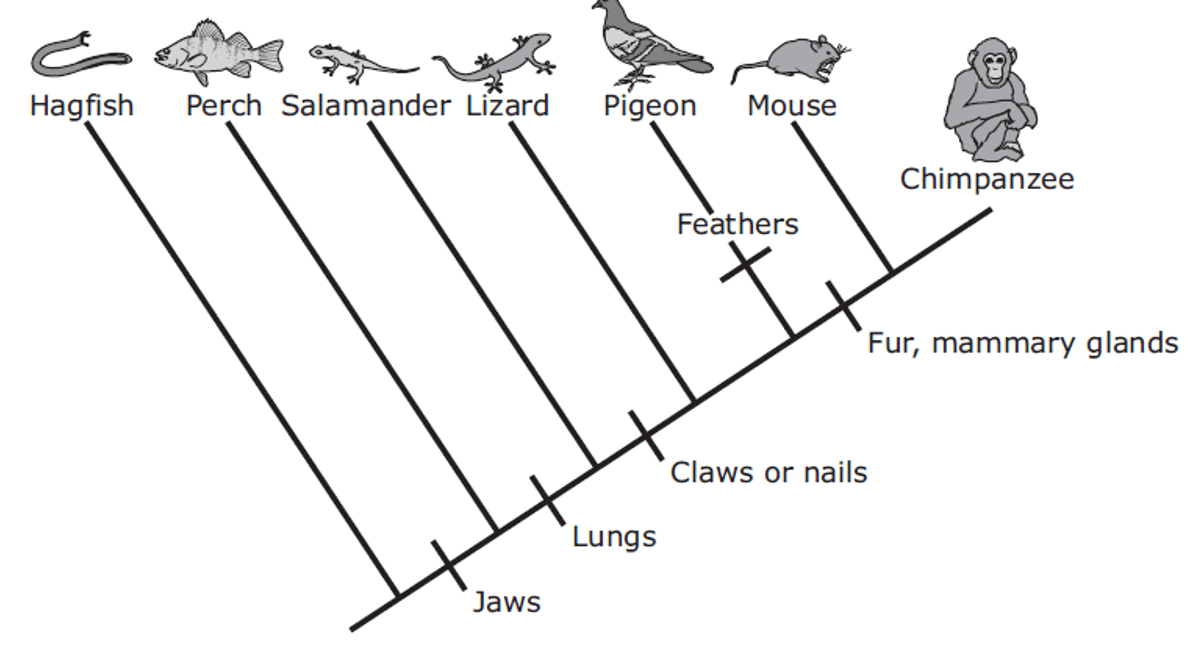
Based on this tree, which of the following statements is not correct?
The lineage leading to salamanders was the first to diverge from the other lineages.
Salamanders are a sister group to the group containing lizards, goats, and humans.
Salamanders are as closely related to goats as they are to humans.
Lizards are more closely related to salamanders than lizards are to humans.
Monkeys and apes have blood proteins more similar to each other than either is to the blood proteins of horses. What does this similarity suggest about monkeys and apes as compared to horses?
Only monkeys and apes can interbreed
Monkeys and apes live in the same habitat
Monkeys and apes share a more recent common ancestor
Monkeys and apes evolved at the same time
Which of the following are homologous organs?
Wings of bird and hands of human
Nails of human being and claws in animals
Wings of bird and wings of insect
Wings of bat and wings cockroach


Which of the following taxa contain the fewest members?
phyllum
family
genus
class
Strains of cultivated rice have accumulated different mutant recessive alleles at two loci in the course of their divergence from a common ancestor. Hybrids between them are vigorous and fertile, but plants in the next generation that carry too many of these recessive alleles are small and sterile. This is an example of
reduced hybrid viability
reduced hybrid fertility
hybrid breakdown
temporal isolation
In North America, the geographic ranges of the western spotted skunk and the eastern spotted skunk overlap, but the western spotted skunk mates in late summer and the eastern spotted skunk mates in late winter. This is an example of
behavioral isolation
habitat isolation
mechanical isolation
temporal isolation
requires geographic isolation
allopatric speciation
sympatric speciation
both
occurs in same geographic area
allopatric speciation
sympatric speciation
both
continued production of hybrid individuals in hybrid zone
fusion
reinforcement
stability
What type of isolation occurs when two species that occupy different habitats within the same area may encounter each other rarely, if at all, even though they are not isolated by obvious physical barriers, such as mountain ranges?
behavioral
habitat
hybrid breakdown
reduced hybrid fertility
The Isthmus of Panama separates two species of fish that are more closely related to each other than they are to the other species of fish in the bodies of water in which they exist. This most likely resulted from
allopatric speciation
sympatric speciation
What did Charles Darwin name his first theory?
Natural Selection
Adaptation Theory
The Changing World
Animals and Plants Adapt Overtime
What is 'evolution'?
Exploring islands for different species
Animals change over time to survive where they live
The amount of different species
Animals reproducing and creating offspring
What did Darwin suggest our 340 different breeds of dog originate from many moons ago?
Cats
Fish
Wolves
Dinosaurs
What was the name of the boat that Darwin travelled the globe on, in search of animals and to collect fossils?
The Antarctic Ship
Natural Selection
HMS Beagle
Titanic
What was the name of the species of bird that Charles Darwin spent a lot of time researching?
Sparrow
Eagle
Falcon
Finch
What does the word 'extinct' mean?
The creation of new species
How animals adapt overtime
When a species are no longer in existence
The evolution of an animal or plant
What was Charles Darwin's occupation?
Naturalist
Marine Biologist
Archeologist
Paleontologist
On which Islands did Darwin research the different species of finch?
Channel Islands
Balearic Islands
Hawaiian Islands
Galapagos Islands
According to the book, how long does it take for adaptations of a species to eventually create a whole new species?
1 year
100 years
Not very long
Tens of thousands of years
Why did Darwin join the voyage of the HMS Beagle?
Because he was interested in trade routes.
Because he needed the money.
Because he wanted to expand on his research as a naturalist/ because a friend of his suggested he join the crew as a naturalist.
Because he was developing new medicines.
Why did Darwin finally publish his results?
He wanted to go on another voyage and the only way to do that was to show he found something during his first one.
He needed to make money and thought that his book would be a huge success.
His daughter found his book and told him that he need to publish it.
A friend of his, Alfred Wallace, sent him a document with similar findings. Also, Captain Fitzroy published his account of the voyage.
What scientist concluded that if the population continued to grow unchecked sooner or later there would be insufficient food/space?
Charles Darwin
Thomas Malthus
James Hutton
Charles Lyell

What tool is used to compare two traits in a step-by-step fashion to help one identify an organism?
Cladogram
Dichotomous Key
Graph
Word classification
Which scientific name is written correctly?
Canis familiaris
Canis familiaris
Canis Familiaris
canis familiaris
Which rule for writing scientific names is incorrect?
the species name begins with a lower case letter
the genus name begins with a lower case letter
both species name and genus name are in italics
the genus is first and the species is second
(The bits don't fit)
(Dance for me)
(You live how far?)
All members of a species in a certain location that are able to mate
Gene Pool
Allele Frequency
Bell Curve
Population
One variation/version of a gene
Allele
Analogous
Homologous
Mutation
All of the alleles of all of the genes within a population
Allele Frequency
Gene Pool
Genetic Drift
Genetic Equilibrium
The mechanism of Evolution (environment will determine who does/does not survive...based on their phenotypes)
Stabilizing Selection
Directional Selection
Disruptive Selection
Natural Selection
The movement of an organism into or out of a population.
The population CANNOT maintain genetic equilibrium if this takes place.
Migration
Genetic Drift
Allele Frequency
Speciation
A change in the base sequence of DNA.
This can cause genetic variation in a population.
Emigation
Immigration
Mutation
Adaptation
This population would have very little genetic variation (more susceptible to genetic drift) .
Large Population
Small Population
Maintained (gene pool does not shift in allele frequencies) IF the population shows all five specific
Hardy-Weinberg requirements:
1) Random mating
2) Large Population
3) No migration
4) No mutations
5) No Natural Selection
Genetic Equilibrium
Stabilizing Selection
Sexual Selection
Disruptive Selection

This is a ________
(a graphical representation of how many individuals express a particular allele in a given population)
Common Curve
Grading Curve
Bell Curve
Weighted Curve
Organisms select mates based on pre-determined factors (color, behavior, etc)
Disruptive Selection
Sexual Selection
Stabilizing Selection
Directional Selection
The most common trait of a population becomes less common, while the extremes become more common.
Disruptive Selection
Sexual Selection
Stabilizing Selection
Directional Selection
A type of selection which eliminates ONE extreme phenotype.
Disruptive Selection
Sexual Selection
Stabilizing Selection
Directional Selection
Selection where the most common trait becomes even more common while the extremes decrease
Disruptive Selection
Sexual Selection
Stabilizing Selection
Directional Selection

This shows: _________________
Directional Selection
Disruptive Selection
Sexual Selection
Stabilizing Selection

This shows: _________________
Directional Selection
Disruptive Selection
Sexual Selection
Stabilizing Selection

This shows: _________________
Directional Selection
Disruptive Selection
Sexual Selection
Stabilizing Selection
What do we call the groups in which we classify organisms?
Categories
Classes
Sets
Taxons
The LARGEST classification group (at the top) is:
Very exclusive
Very inclusive
Very small
Very specific
What is the most exclusive taxon?
Domain
Family
Species
Order
What is the most inclusive taxon?
Phylum
Order
Class
Domain
have the ability to interbreed.
Why are advantageous traits more likely to be passed onto offspring?
Because they are more likely to survive and reproduce.
Because they come from dominant alleles.
Because they come from recessive alleles.
Because the organism knew it needed that trait, survives, and passes it on.
Mutations are important because they bring about
death of the organism in which they develop
genetic variation needed for a population to evolve
benefits for the individual, not for the population
changes in genotype, but not phenotype
Why is competition important for natural selection?
It shows which variations are more successful, allowing the organisms with those variations to survive.
It causes organisms, regardless of which traits they have, to die out, reducing the population size.
It causes organisms to get stronger due to having to outcompete other species.
Competition is not important for natural selection.
1. The process of choosing parent organisms for desired characteristics is called
natural selection
Artificial selection
random selection
genetic manipulation
Which statement is true comparing natural selection and artificial selection?
In natural selection, traits benefit humans and in artificial selection, the traits benefit the species
In natural selection, traits benefit the species and in artificial selection, the traits benefit humans
In natural and artificial selection, the process takes hundreds of years to occur
In natural and artificial selection, nature determines what traits will be passed down to offspring.

This is an example of an:


Mutations cause new traits.
Acquired Characteristics (Lamarck)
Natural Selection (Darwin)
Mutation Theory (De Vries)
Mutation-Selection (Neo-Darwinism)
Inheritance of Acquired Characteristics
Mutations cause new traits.
The environment causes new traits.
Allows only those with the best traits to survive.
Mutations produce new traits and selection allows the best of those to survive.
Mimicry means:
A tree that has pink flowers in the spring
When one living thing looks like a different kind of living thing
A way an animal blends in with its environment
Camouflage means:
A special dessert
When an animal looks like another animal
A way an animal can look like its surroundings
Which is NOT an example of mimicry:
The fur of an arctic fox turns white in winter to match the snow
The tongue of an alligator snapping turtle looks like a worm, so he lures fish to his mouth
A bad tasting butterfly & a good tasting butterfly have similar markings, so birds don't eat either kind
Which picture is an example of mimicry?


Why would a rabbit's fur be brown in the summer and white in the winter?
The rabbit likes to change fur color.
The rabbit learned it from its parents.
The changing of fur color help the bunny blend in with its surroundings.

Some butterflies have spots on their wings that look like snake eyes. This is called
A pretty butterfly
Instinct
camouflage
mimicry
Biomimicry can also be referred to as
bionature
biomimetics
copy cat design
biodesign

Based on the evidence in the diagram below, the taxon that lived the most recently is
A
B
C
D


Cichlid fishes in lakes of the East African Rift. The lakes in this area are believed to support and sustain about 2,000 different species of these fish, each with different ecological and morphological characteristics such as body size. These lakes form a fragmented landscape that bio-geographically isolates the different species of cichlid fish from one another, allowing them, and many of the organisms they live with, to evolve separately.
Phyletic Speciation
Adaptive Radiation
Convergent Evoltion
Co-evolution
An adaptation in which an otherwise harmless animal looks like a harmful animal in order to protect itself
Variation
Trait
Mimicry
Camouflage
A characteristic belonging to an organism
Gene
Innate Behavior
Adaptation
Trait
The process of being or becoming different
Variation
Coevolution
Convergent Evolution
Evolve
When two species evolved together, adapting to ways of life by relying on each other for survival (i.e. bees and flowers)
Adaptive Radiation
Sexual Selection
Convergent Evolution
Coevolution
When several species evolve from a single ancestor (i.e. Darwin's finches)
Adaptive Radiation
Sexual Selection
Coevolution
Convergent Evolution
Traits that are passed on when the female chooses a particular trait in a male (i.e. female birds choosing a particular tail feather in a male)
Sexual Selection
Coevolution
Adaptive Radiation
Convergent Evolution
The number of species on island depends on the size of the island and its distance from mainland. This statement would most likely be made by _______________.
a geologist
an explorer
a philosopher
a biogeographer
The first comprehensive theory of evolution, which proposed that the mechanism was an inner drive for improvement, was proposed by _______________.
Aristotle
Lamarck
Wallace
St Hillarie
Presence of vestigial body parts in organisms like coccyx in human and leg bones in snakes _______________.
challenge prevailing beliefs
support idea on evolution
add up naturalist confusion
all of the above
Porpoise flippers, human arms, bat wings and elephat’s leg are different outwardly but have similar form internally. This shows they have_________________.
common ancestory
common eating behaviour
common habitat
all of the above
These are inferences made in the Principle of Natural Selection except:
Individuals with less adaptive traits cannot survive.
Adaptive traits may make an individual better suited to an environment.
Individuals that better suited to environment are better able to survive tend to leave more offsprings
Frequency of adaptive tends to become more common in a population over time.
The first to propose that the mechanism for the evolution of organisms is by natural selection was _________________.
Malthus
Lamarck
Darwin
Wallace
Parts or traces of an ancient organism preserved in rock are known as ____________.
fossil
amber
rocks
K-T boundary
Similar in function or appearance, but not in origin or development.
Homoplasty
Homologous
Analogous
Vestigial

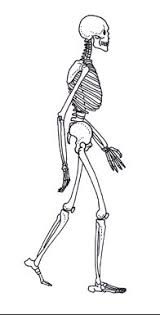
The ability to walk upright on two legs is called:
bipedalism
quadropedalism
bicyclepedalism
tripedalism


Who is the father of evolution?
Darwin
Mendel
Newton
Einstein
Which of the following is NOT an example of natural selection?
People selectively breeding hamsters.
Insect populations developing resistance to certain pesticides.
Bacteria becoming resistant to antibiotics.
Male birds of certain species developing colorful feathers to attract female mates.

What characteristic did Darwin observe about the finches on the Galapagos Islands?
Their feathers
Genotypes
Their beaks
Their body sizes

The environment around Manchester, England, changed during the Industrial Revolution. How did this change affect peppered moths living in the area?
Natural selection favored moths with dark wings because predators could not see them on the soot-colored trees.
Natural selection favored moths with white wings that were easy for predators to see.
Natural selection favored moths with white wings because predators could not see them on the soot-colored trees.
Natural selection caused moths with white wings to become extinct.
Genetic drift is more likely to happen in...
aquatic populations
small populations
terrestrial populations
older populations

Which of the following is an example of the bottleneck effect?
Cheetah populations reach their lowest levels with reduced diversity and as they rebound are so genetically similar they appear to be inbred.
Affected individuals with blue skin can trace their ancestry back to one of the first settlers in the region.
The environment of a fox population changes and over time foxes who are white survive and pass on their genes to their offspring.
Humans choose two dogs they like the characteristics of and breed them together.

Which of the following is an example of the founder effect?
Humans choose two dogs they like the characteristics of and breed them together.
Affected individuals with blue skin can trace their ancestry back to one of the first settlers in the region.
The environment of a fox population changes and over time foxes who are white survive and pass on their genes to their offspring.
Cheetah populations reach their lowest levels with reduced diversity and as they rebound are so genetically similar they appear to be inbred.
Genetic drift is change in the allele frequency of a population due to...
random chance
natural selection
non-random mating (sexual selection)
artificial selection
This mechanism of evolution occurs when populations migrate.
Extinction
Gene flow
Genetic drift
Natural Selection