wayground logo

Free Printable Worksheets

NEW

Font size

S
M
L
XL
Worksheets

Chem Module 2 Pre-Test & Post-Test

Total questions: 35

Worksheet time: 32mins

Name
Class
Date
1.

A wave with a large wavelength will have a ______ frequency and _____ energy

a)

high, low

b)

high, high

c)

low, high

d)

low, low

2.
High frequency waves have _________ wavelength.
a)
varying
b)
high
c)
the same
d)
low
3.

Based on the picture above, which kind of wave has the largest energy?

a)

microwave

b)

ultraviolet

c)

infrared

d)

gamma rays

4.

Ground state means that an electron is...

a)

at its lowest possible energy level

b)

in the first shell of an atom

c)

laying low for the weekend

d)

removed from an atom

5.

When an electron returns to ground state from an excited state, the atom will

a)

emit energy

b)

absorb energy

c)

rotate

d)

wiggle

6.

Looking at atoms in the same group/family, what factor affects the force of attraction?

a)

number of protons

b)

distance from the nucleus

7.

Looking at atoms in the same valence energy level (period), what factor affects the force of attraction?

a)

number of protons

b)

distance from the nucleus

8.
Ionization energy is the...
a)
energy needed to remove the outermost electron.
b)
ability of an atom to attract electrons from another atom.
9.
Electronegativity is the...
a)
energy needed to remove the outermost electron.
b)
ability of an atom to attract electrons from another atom.
10.
Which element has the smaller atomic radius: potassium (K) or bromine (Br)?
a)
potassium (K)
b)
bromine (Br)
11.

As the force of attraction increases the atomic radius: increases or decreases?

a)

increases

b)

decreases

12.

As the force of attraction in an atom increases, the energy needed to remove an electron: increases or decreases?

a)

increases

b)

decreases

13.
Which element has the greatest electronegativity: Nitrogen (N) or Arsenic (As)?
a)
Nitrogen (N)
b)
Arsenic (As)
14.
The atom with the largest atomic radius in Group 18 is - 
a)
Ar
b)
He
c)
Kr
d)
Rn
15.
The element with the largest electronegativity in the halogens is - 
a)
At
b)
F
c)
Cl
d)
Br
16.

Atomic radius generally increases as we move __________.

a)

down a group and from right to left across a period

b)

up a group and from left to right across a period

c)

down a group and from left to right across a period

d)

up a group and from right to left across a period

17.

Which of the following elements LOSES 1 electron in order to attain an octet?

a)

potassium

b)

calcium

c)

helium

d)

boron

e)

fluorine

18.

Which of the following elements GAINS 1 electron in order to attain an octet?

a)

sodium

b)

calcium

c)

helium

d)

boron

e)

chlorine

19.

According to the Octet Rule, atoms of elements react with each other in order to attain ____ electrons in their outermost energy level or shell.

a)

2

b)

4

c)

6

d)

8

e)

10

20.
What atom matches this electron configuration?
1s22s22p63s23p64s23d10
a)
Zinc
b)
Copper
c)
Nickel
d)
Germanium
21.
What electron configuration matches an oxygen atom?
a)
1s22s22p63s2, 3p64s23d104p5
b)
1s22s22p4
c)
1s22s22p6
d)
1s22s22p63s23p64s23d1
22.
The electron configuration of an atom is 1s22s22p6.  The number of electrons in the atom is 
a)
3
b)
6
c)
8
d)
10
23.
Which electron configuration belongs to Chlorine (Cl)?
a)
1s2s2p3s3p5
b)
1s2s2p3s3p6
c)
1s2s2p3s3p7
24.
Electrons occupy orbitals of lowest energy first is part of what electron configuration rule?
a)
Hund’s Rule
b)
Aufbau Principle
c)
Pauli Exclusion Principle
25.

What is the maximum number of electrons that an S orbital can have?

a)

1 electron

b)

2 electrons

c)

3 electrons

d)

4 electrons

26.

Up to how many electrons can the d sublevel hold?

a)

8

b)

10

c)

2

d)

4

27.

What is this element?

1s22s22p63s23p64s23d104p6

a)

Argon

b)

Krypton

c)

Selenium

d)

Bromide

28.
Which of the following is a p block element?
a)
Ca
b)
Ar
c)
Re
d)
Au
29.

Which area on the periodic table represents the electrons in the "d" sublevel?

a)

representative elements

b)

columns 3-8

c)

rare earth elements

d)

transition elements

30.

Up to how many electrons can be found in the p sublevel?

a)
2
b)
3
c)
4
d)
6
31.
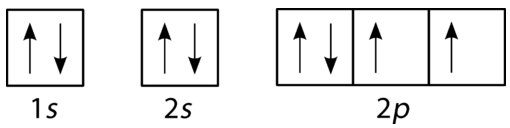
Which element is pictured?
a)
neon
b)
fluorine
c)
magnesium
d)
argon
32.
This orbital diagram represents:  
a)
C
b)
B
c)
N
d)
O
33.
This orbital diagram represents:  
a)
C
b)
B
c)
N
d)
O
34.
What is incorrect about this orbital diagram?
a)
Both arrows in the 2p box should be pointing up
b)
There is nothing incorrect with this diagram
c)
In the 2p box there should only be 1 electron in the first 2p box and one in the 2nd 2p box
d)
All the arrows should be pointing up.
35.
Which orbital shows a violation of Hund's Rule?
a)
A
b)
B
c)
C
d)
D