wayground logo

Free Printable Worksheets

Font size

S
M
L
XL
Worksheets

Chapter 1 Test Review

Total questions: 81

Worksheet time: 4hrs 3mins

Name
Class
Date
1.

What is the next number in the sequence

1, 2, 4, 7, 11, (a)  

2.

What is the next number in the sequence?

3, 6, 11, 18, 27, 38, (a)  

3.
The radius is....
a)
a line that crosses through the center and touches each edge 
b)
the center point of a circle 
c)
a line from the center point to the edge of the circle
d)
an element in science
4.
What is the midpoint between (-4,4) and (-2,2)?
a)
(3,2)
b)
(-3,3)
c)
(4,5)
d)
(6,7)
5.

Select the next letter.

A, D, G, J, M

a)

P

b)

Q

c)

R

d)

S

6.

The 11th figure will be a...

a)

triangle

b)

square

c)

rhombus

d)

circle

7.
Complete the conjecture.  Think of examples to help.
The product of any two odd numbers is _____________
a)
even
b)
odd
c)
zero
d)
positive
8.
The type of reasoning where a person makes  conclusions based on observations and patterns is called...
a)
Inductive reasoning
b)
Deductive reasoning
c)
Conjecture
d)
Experiments
9.
Used to prove that a conjecture is false.
a)
Counterexample
b)
Inductive Reasoning
c)
Concluding statement
d)
Conjecture
10.

Which of the following provide a counterexample to the claim:

"If two angles are supplementary, then they are not congruent."

a)

 40° and  140°40\degree\ and\ \ 140\degree 

b)

 80° and  80°80\degree\ and\ \ 80\degree 

c)

 30° and  150°30\degree\ and\ \ 150\degree 

d)

 90° and  90°90\degree\ and\ \ 90\degree 

11.

Which is a counterexample to the following statement?

If an angle is obtuse, then it is 125°125\degree .

a)

 90°90\degree  

b)

 57°57\degree  

c)

 160°160\degree  

d)

 180°180\degree  

12.
Two lines intersect at a ....
a)
angle
b)
point
c)
line
d)
intersection
13.
Two planes intersect at a...
a)
line
b)
point
c)
plane
d)
letter
14.
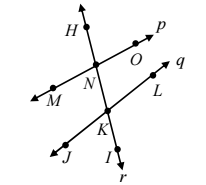
Name 4 collinear points
a)
HMNO
b)
IKNO
c)
MJOL
d)
HNKI
15.

Give another name for line k.

a)

Line BC

b)

Line BCF

c)

Line ED

d)

Line k is the only name, there isn't another name.
16.
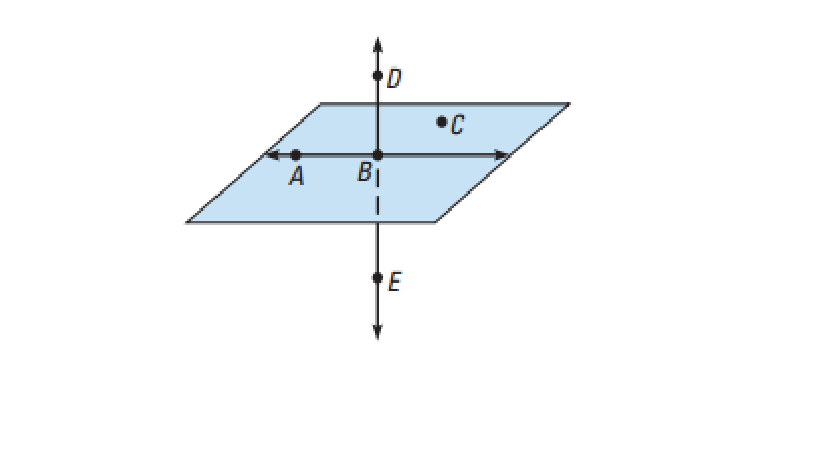
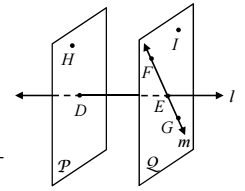
Are points D and E collinear or coplanar?
a)
Collinear
b)
Coplanar
17.
How many points do you need to make a line?
a)
1
b)
at least 2
c)
3
d)
4
18.
In geometry, a plane is a ...
a)
flat surface
b)
a flying object
c)
grassy area
19.
True or False: Line DE lies in plane ABC
a)
True
b)
False
20.
True or False: Line AB lies in plane ABC
a)
True
b)
False
21.
True or False: Point C lies on line AB
a)
True
b)
False
22.

True or False: Points B, C, and D are coplanar.

a)

True

b)

False

23.
True or False: Points A, B, and C are coplanar.
a)
True
b)
False
24.
True or False: Points A, B, and C are collinear.
a)
True
b)
False
25.
A line that extends from a point in one direction and travels forever is called a ...
a)
perpendicular line
b)
line segment
c)
ray
d)
parallel line
26.
Name the Image
a)
Angle
b)
Line
c)
Line Segment
d)
Ray
27.
An exact location in space with no length or width.
a)
Ray
b)
Point
c)
Line
d)
Line segment
28.

Idendify the Image.

a)

Ray

b)

Point

c)

Line

d)

Line segment

29.

Identify the image

a)

Line segment

b)

Line

c)

Point

d)

Ray

30.

2 rays that share the same endpoint and extend infinitely in opposite directions are called...

a)

long lines

b)

twin rays

c)

opposite rays

d)

sweet baby rays

31.

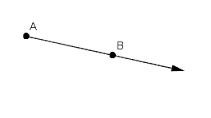
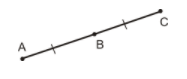
What is the name of this ray?

a)

AB\overrightarrow{AB}

b)

BA\overrightarrow{BA}

c)

ABC\overrightarrow{ABC}

d)

AC\overrightarrow{AC}

32.

Use the given diagram to state the segment addition postulate (SAP).

a)

JK = KL

b)

JK + KL = JL

c)

KL = JL

d)

J + K = L

33.

If JL = 41 and KL = 28, then find the length of JK.

a)

JK = 69

b)

JK = 13

c)

JK = -13

d)

JK = -69

34.

Write an equation that correctly models the lengths shown.

a)

2x + 20 + x + 21 = 9

b)

2x + 20 + 9 = x + 21

c)

9 + x + 21 = 2x + 20

d)

2x + 20 - 9 = x + 21

35.

Write an equation that correctly models the lengths shown.

a)

3x + 2 + 6 = 2x - 2

b)

2x - 2 + 6 = 3x + 2

c)

6 - 3x - 2 = 2x - 2

d)

2x + 2 + 3x + 2 = 6

36.

What is the value of x?

a)

x= 8

b)

x= 3

c)

x= 4

d)

x= 12

37.
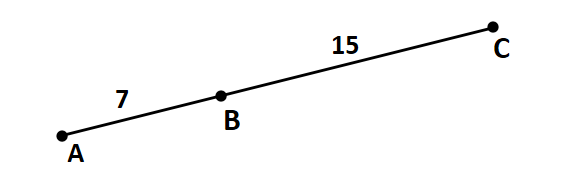
Find AC
a)
7
b)
8
c)
22
d)
23
38.

If RT=36, find the value of x.

a)

3

b)

4

c)

5

d)

6

39.
What does the word BISECT mean?
a)
To cut something into more than five pieces.
b)
It is a plane with two sets of wings.
c)
A shape that has three sides. 
d)
To cut something into two congruent pieces or in half.
40.

If T is the midpoint of SU, find x.

a)

3

b)

4

c)

5

d)

2

41.

If G is the midpoint of segment FH, find FG.

a)

15

b)

30

c)

12

d)

24

42.
Find the distance between (-12, 1) and (12, -1).
a)
24.05
b)
24.06
c)
24.07
d)
24.08
43.
Find the distance between (-5, -8) and (-1, -16).
a)
8.9
b)
9.8
c)
10.3
d)
11
44.
Find the distance between (3, 24) and (7, 56).
a)
32.1
b)
32.2
c)
32.3
d)
32.4
45.
Find the distance between (-4, 5) and (7, 18).
a)
15.96
b)
16.08
c)
16.23
d)
17.03
46.
Find the distance between (-3, -11) and (8, -42).
a)
32.1
b)
32.3
c)
32.7
d)
32.9
47.

Together the angles create 98 degrees. What is the value of angle A?

a)

34 degrees

b)

23 degrees

c)

43 degrees

d)

90 degrees

48.

Calculate m∠ABC.

a)

45°

b)

60°

c)

105°

d)

15°

49.

Calculate m∠DEF.

a)

180°

b)

60°

c)

120°

d)

80°

50.
a)

x = 6°

b)

x = 7°

c)

x = 12°

d)

x = 144°

51.
a)

x = 5°

b)

x = 11°

c)

x = 33°

d)

x = 55°

52.

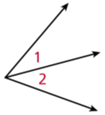
∠1 and ∠2 form a linear pair.

If m∠1 = (5x + 9)° and m∠2 = (3x + 11)°, find the measure of each angle.

a)

m∠1 = 110° and m∠2 = 70°

b)

m∠1 = 109° and m∠2 = 71°

c)

m∠1 = 70° and m∠2 = 110°

d)

m∠1 = 71° and m∠2 = 109°

53.

∠K and ∠L are complementary angles.

If m∠K = (3x + 3)° and m∠L = (10x - 4)°, find the measure of each angle.

a)

m∠K = 24° and m∠L = 66°

b)

m∠K = 66° and m∠L = 24°

c)

m∠K = 40° and m∠L = 50°

d)

m∠K = 30° and m∠L = 60°

54.
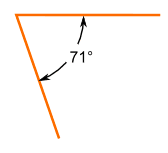
This is what kind of angle?
a)
obtuse
b)
right
c)
straight
d)
acute
55.
Vertical angles are always
a)
acute
b)
total 180 degrees
c)
congruent (equal measures)
d)
adjacent angles
56.

Supplementary angles always add up to

(a)  
57.

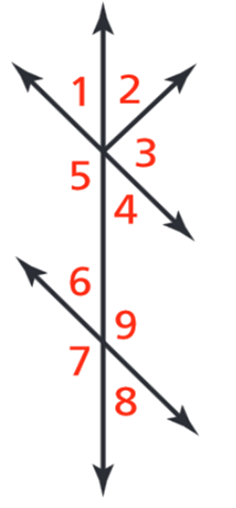
Which angle is a vertical angle to with 7\angle7  ?

a)

 1\angle1  

b)

 5\angle5  

c)

 3\angle3  

d)

 6\angle6  

e)

 9\angle9  

58.

What type of angles are these?

a)

Adjacent Angles

b)

Linear Pair

c)

Complementary Angles

d)

Supplementary Angles

e)

Vertical Angles

59.

Which angle is a linear pair with 1\angle1  ?

a)

 2\angle2  

b)

 3\angle3  

c)

 4\angle4  

d)

 5\angle5  

e)

 6\angle6  

60.
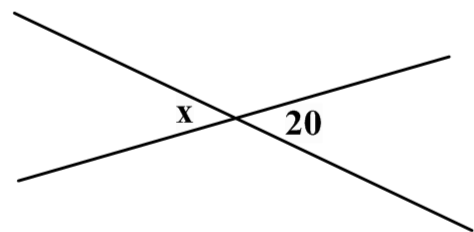
Find the missing angle.  Find x.
a)
20o
b)
70o
c)
160o
d)
180o
61.

Find the value of x if AB = 4x + 3 and BC = 21

a)

10.5

b)

4.5

c)

6

d)

21

62.

If KM\overrightarrow{KM}  bisects  LKJ\angle LKJ  and  mJKM=22°m\angle JKM=22\degree  find  mLKMm\angle LKM  .


a)

22

b)

44

c)

11

d)

68

e)

not enough information given

63.

Given that AB\overrightarrow{AB} is an angle bisector, solve for x.

4 lines
64.

Solve for x.

a)

2

b)

3

c)

4

d)

5

e)

7.4

65.

It divides or bisects a segment into two congruent segments; the point in the middle of the segment.

a)

point

b)

midpoint

c)

line

d)

bisector

66.

A segment, ray, line or plane that intersects a segment at its midpoint.

a)

point

b)

segment

c)

segment bisector

d)

perpendicular lines

67.

<ABC is bisected by ray BD. Find the value of x.

a)

x = 76

b)

x = 75

c)

x = 73

d)

x = 25

68.

Find the midpoint of the line segment with endpoints (-2,0) & (9,-1).

a)

(1, 3)

b)

(3.5, -.5)

c)

(-.5, 3.5)

d)

(6, -.5)

69.
What is the midpoint between (3, -1) and (7, -5)
a)
(5, -2)
b)
(10, -6)
c)
(5, -3)
d)
(2, -2)
70.

Find the other endpoint of the line segment with the given endpoint and midpoint. Endpoint: (-9, -5) Midpoint: (-9, 0)

a)

(-7.5, -8)

b)

(-7, -4.5)

c)

(0, -2.5)

d)

(-9, 5)

71.

Find the other endpoint of the line segment with the given endpoint and midpoint. Endpoint: (2, 1) Midpoint: (9, 5)

a)

(-3.5, -2)

b)

(-5.5, -2)

c)

(1.5, 7)

d)

(16, 9)

72.

What does perimeter mean?

a)

the amount of space inside a shape

b)

the amount of space inside a shape divided by two

c)

the distance around the shape

d)

half the distance around a shape

73.

Find the perimeter of the rectangle.

a)

38 cm.

b)

19 cm.

c)

84 cm.

d)

42 cm.

74.

Find the perimeter of the triangle.

a)

120 ft.

b)

32 ft.

c)

40 ft.

d)

20 ft.

75.

What is the formula to find circumference?

a)

 c=2\pi r  

b)

 c=πrc=\pi r  

c)

 c=2πdc=2\pi d  

76.

Find the circumference. Round to the nearest tenth.

a)

18.8 cm.

b)

75.4 cm.

c)

37.7 cm.

d)

not enough information

77.

What does area mean?

a)

the distance around a shape

b)

the amount of space outside a shape

c)

half the distance around a shape

d)

the amount of space inside a shape

78.

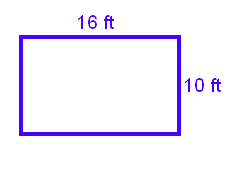
Find the AREA of this figure.

a)

160 ft.2160\ ft.^2

b)

160 ft.

c)

80 ft. 280\ ft.\ ^2

d)

1600 feet

79.
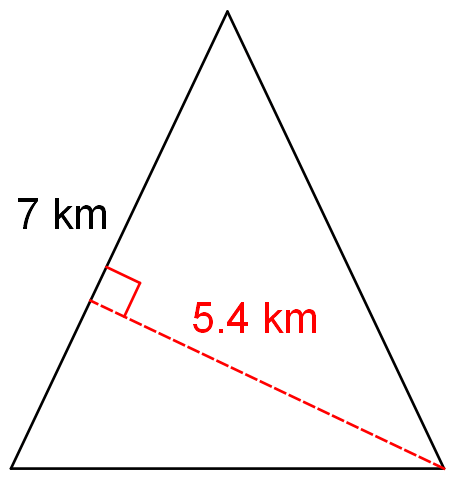
Find the Area of this triangle
a)
19.8 km2
b)
37.8 km2
c)
18.9 km2
d)
35 km2
80.
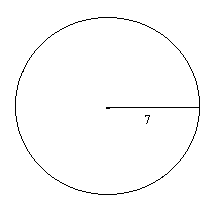
Find the area of the circle
a)
43.96
b)
153.86
c)
87.82
d)
307.72
81.
Find the circumference of the circle.
a)
113.04
b)
1017.36
c)
254.34
d)
56.52