Wayground logo

Free Printable Worksheets

Font size

S
M
L
XL
Worksheets

Physics of Sound Wk8 8th Grade CTS

Total questions: 25

Worksheet time: 27mins

Name
Class
Date
1.
Being able to tell different sounds apart is called
a)
sound amplification
b)
sound discrimination
c)
vibration
d)
frequency
2.
When you make sounds by plucking a rubber band, you make the rubber band move back and forth very quickly.  This movement is called.
a)
loudness
b)
amplitude
c)
pitch
d)
vibration
3.
If you tie a string around a doorknob, pull on the string slowly, and keep plucking it with your finger as you pull, what happens to the pitch?
a)
As you tighten the string, the pitch gets lower
b)
The pitch stays the same
c)
As you tighten the string, the pitch gets higher
d)
You can't tell unless you try it
4.
If you roll a large sheet of paper into a funnel, you can hear the sound better.  This process of increasing the loudness of a sound is called
a)
measuring a wave
b)
absorption
c)
reflection
d)
amplification
5.
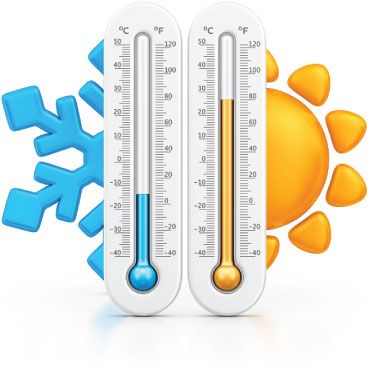
Sound Waves Move faster in what temperature 
a)
Heat 
b)
Cold
c)
Doesn't Matter
d)
Both
6.
Which of the following would you hear as a low pitched sound? 
a)
sound wave with a frequency of 50 Hz
b)
sound wave with frequency of 10,000 Hz
c)
sound wave with an intensity of 10 dB
d)
sound wave with an intensity of 100 dB
7.

Sound travels FASTEST through which of these materials?

a)

A type of gas, like helium

b)

Empty space

c)

A metal such as iron

d)

Water

8.
A student holds two vibrating objects.  Object A is vibrating faster than object B.  Which statement is true?
a)
A is louder than B
b)
B is louder than A
c)
A will have a higher pitch than B
d)
B will have a higher pitch than A
9.
If the distance represented by the letter A were increased, how would it change the way the sound was heard?
a)
The sound would be higher. 
b)
The sound would be lower. 
c)
The sound would be softer. 
d)
The sound would be louder. 
10.
Put the visible light colors in order from longest wavelength to shortest wavelength
a)
Violet, Indigo, Blue, Green, Orange, Yellow, Red
b)
Red, Yellow, Green, Orange, Violet, Blue, Indigo
c)
Red, Orange, Yellow, Green, Blue, Indigo, Violet
11.
After the train passed, the pitch of the train whistle became lower. This change in sound would be represented by what change in the diagram above? 
a)
The distance represented by C would increase. 
b)
The distance represented by C would decrease. 
c)
The distance represented by D would increase. 
d)
The distance represented by D would decrease. 
12.

Definition: Crest

a)

The highest point of a transverse wave

b)

The lowest point of a transverse wave

c)

The center of a transverse wave

d)

The distance between two points on a wave

13.

Definition: Trough

a)

The center of a wave

b)

The resting position of a wave

c)

The lowest point of a transverse wave

d)

The highest point of a transverse wave

14.

What is the amplitude of a wave?

a)

Where there is no wave movement

b)

The distance the wave oscillates from it's resting position

c)

A disturbance that transfers energy from one place to another

d)

The distance between two corresponding parts of a wave
15.
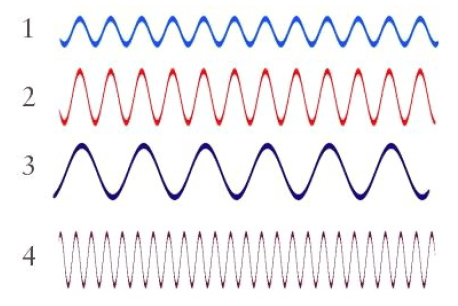
Which wave in the diagram has the greatest frequency?
a)
1
b)
2
c)
3
d)
4
16.

What type of interference do noise cancelling headphones use?

a)

Constructive Interference

b)

Destructive Interference

17.

When people speak their ________ vibrate.

a)

Ear drums

b)

Vocal chords

c)

Ears

d)

Tongue

18.

What are the most delicate bones in your body called?

a)

Cochlea

b)

Ossicles

c)

Soft bones

d)

Auricle

19.

Which tiny bone is attached to the eardrum? (Hint: We hope you “nail” this one)

a)

Malleus (hammer)

b)

Incus (anvil)

c)

Stapes (stirrup)

20.

What separates the outer ear from the middle ear?

a)

Auricle

b)

The ear wall

c)

Eardrum

d)

Cochlea

21.

Fluid moving in the _______causes you to feel dizzy after you stop spinning.

a)

Eustachian tubes

b)

Semicircular canals

c)

Erie canals

d)

Ear canals

22.

What part of your ear allows the ‘popping’ that happens when you fly?

a)

Liberty tube

b)

Eustachian tube

c)

Auditory nerve

d)

Cochlear tube

23.

Which part of the ear is most usually pierced to wear earrings?

a)

Auricle (or pinna)

b)

Middle ear

c)

Outer ear canal

d)

Malleous

24.

The border between the middle and inner ear is formed by

a)

Incus

b)

Oval window

c)

Pinna

d)

tympanic membrane

25.

Which part of human ear converts sound vibrations into electrical signals

a)

Hammer

b)

Stirrup

c)

Tympanic membrane

d)

Cochlea