

wayground logo

Free Printable Worksheets

NEW

Font size

S
M
L
XL
Worksheets

Logic

Total questions: 42

Worksheet time: 2hrs 14mins

Name
Class
Date
1.
Given, "If I have a Siberian Husky, then I have a dog." Identify the inverse.
a)
If I do not have a Siberian Husky, then I do not have a dog.
b)
If I have a dog, then I have a Siberian Husky.
c)
If I do not have a dog, then I do not have a Siberian Husky.
d)
If I do not have a Siberian Husky, then I have a dog. 
2.
Given, "If I have a Siberian Husky, then I have a dog." Identify the contrapositive.
a)
If I do not have a Siberian Husky, then I do not have a dog.
b)
If I have a dog, then I have a Siberian Husky.
c)
If I do not have a dog, then I do not have a Siberian Husky.
d)
If I do not have a Siberian Husky, then I have a dog. 
3.
What does this mean?
a)
Conditional Statement
b)
Inverse Statement
c)
Converse Statement
d)
Contrapositive Statement
4.
What does this mean?
a)
Conditional Statement
b)
Converse
c)
Inverse
d)
Contrapositive
5.
Given, "If I have a Siberian Husky, then I have a dog." Identify the hypothesis.
a)
If I have a Siberian Husky.
b)
I have a Siberian Husky.
c)
Then I have a dog.
d)
I have a dog.
6.
Given, "If I have a Siberian Husky, then I have a dog." Identify the conclusion.
a)
If I have a Siberian Husky.
b)
I have a Siberian Husky.
c)
Then I have a dog.
d)
I have a dog.
7.
Given, "If angles are congruent, then the measures of the angles are equal." Identify the converse.
a)
If the measures of the angles are equal, then the angles are congruent.
b)
"If angles are not congruent, then the measures of the angles are not equal."
c)
If the measures of the angles are not equal, then the angles are not congruent.
d)
If the angles are not congruent, then the measure of the angles are equal.
8.
Given, "If angles are congruent, then the measures of the angles are equal." Identify the inverse.
a)
If the measures of the angles are equal, then the angles are congruent.
b)
"If angles are not congruent, then the measures of the angles are not equal."
c)
If the measures of the angles are not equal, then the angles are not congruent.
d)
If the angles are not congruent, then the measure of the angles are equal.
9.
Given, "If angles are congruent, then the measures of the angles are equal." Identify the contrapositive.
a)
If the measures of the angles are equal, then the angles are congruent.
b)
If angles are not congruent, then the measures of the angles are not equal.
c)
If the measures of the angles are not equal, then the angles are not congruent.
d)
If the angles are not congruent, then the measure of the angles are equal.
10.
Given, "If angles are congruent, then the measures of the angles are equal." Identify the hypothesis.
a)
If angles are congruent.
b)
Angles are congruent.
c)
Then the measures of the angles are equal.
d)
The measures of the angles are equal.
11.
Given, "If angles are congruent, then the measures of the angles are equal." Identify the conclusion.
a)
If the angles are congruent.
b)
The angles are congruent.
c)
Then the measures of the angles are equal.
d)
The measures of the angles are equal.
12.
What is the hypothesis of the following statement: "If Johnny is late to school, then his mom will have to drive him."
a)
His mom will have to drive him
b)
If Johnny is late to school
c)
Johnny is late to school
d)
Then his mom will have to drive him
13.
Conditional: If it does not rain today, then we will have practice.
What is this statement called: If it rains today, then we will not have practice.
a)
Converse
b)
Inverse
c)
Contrapositive
d)
Negation
14.
Conditional: If Maria gets married, then the reception will be at the country club.
What is this statement: If the reception is at the country club, then Maria will be getting married.
a)
Converse
b)
Inverse
c)
Contrapositive
d)
Negation
15.
Original: If Emily is not late to class, then she will not be marked tardy.
What is this? If Emily is late to class, then she will be marked tardy.
a)
Converse
b)
Inverse
c)
Contrapositive
d)
Negation
16.
What is the converse?
If we are at the park, then we will swing.
a)
If we are not at the park, then we will not swing.
b)
If we will not swing, then we are at the park.
c)
If we are at the park, then we will  not swing.
d)
If we will swing, then we are at the park.
17.
What is the inverse?
If Jason does not go out to dinner, then he will come to the volleyball game.
a)
If Jason goes out to dinner, then he will not come to the volleyball game.
b)
If Jason comes to the volleyball game, then he will not go out to dinner.
c)
If Jason comes to the volleyball game, then he will go out to dinner.
d)
If Jason does not go out to dinner, then he will not come to the volleyball game.
18.
Identify the hypothesis and conclusion in the following  statement:
If you eat breakfast, then you will feel better at school.
a)
Hypothesis: If you eat breakfast
Conclusion: You will feel better at school
b)
Hypothesis: You will feel better at school
Conclusion: if you eat breakfast
19.
What is the converse of the following statement?
If it is Saturday, then the school is closed
a)
If the school is closed, then it is Saturday.
b)
If it is not Saturday, then the school is not closed.
c)
If the school is not closed, then it is not Saturday.
20.

p: All birds have feathers

q: Two angles are supplementary if they are a linear pair.


Find p Λ q and the truth value

a)

All birds have feathers or two angles are supplementary if they are a linear pair. True

b)

All birds have feathers and two angles are supplementary if they are a linear pair. True

c)

All birds have feathers and two angles are supplementary if they are a linear pair. False

d)

All birds have feathers or two angles are supplementary if they are a linear pair. False

21.

p: 5 is a rational number

q: 15 is a prime number

Find p ν q

a)

5 is rational number or 15 is a prime number. True

b)

5 is rational number or 15 is a prime number. False

c)

5 is rational number and 15 is a prime number. True

d)

5 is rational number and 15 is a prime number. False

22.

p: The sun is made of gas.

q: 3 is a prime number.

Find ~p Λ q

a)

The sun is not made of gas and 3 is not a prime number. False

b)

The sun is made of gas and 3 is not a prime number. True

c)

The sun is not made of gas and 3 is a prime number. False

d)

The sun is not made of gas or 3 is a prime number. False

23.

p: Vertical angles are congruent.

q: Complementary angles form a right angle.

Find p V ~q

a)

Vertical angles are not congruent and complementary angles form a right angle. False

b)

Vertical angles are congruent and complementary angles do not form a right angle. False

c)

Vertical angles are congruent or complementary angles form a right angle. True

d)

Vertical angles are congruent or complementary angles do not form a right angle. True

24.

All months that begin with the letter M have 31 days.

a)

True

b)

False; March

c)

False; May

25.

p: there are 3 feet in a yard.

q: the difference of two odd numbers is even.

The following statement is an example of what?

There are 3 feet in a yard and the difference of two odd numbers is odd.

a)

~p V ~q

b)

~p Λ ~q

c)

p Λ ~q

d)

p Λ q

26.

p: Max is eating an apple.

q: Max is eating a piece of fruit.


Is ~p V ~q true or false?

a)

False

b)

True

27.

p: Two angles that form a linear pair are adjacent.

q: All perfect squares are even.


Not all perfect squares are even or two angles that form a linear pair are adjacent.

a)

p V q

b)

q V p

c)

~p V q

d)

~q V p

28.

The reciprocal of a number is always less than 1.

a)

True

b)

False

29.

p: The sum of two prime numbers is always prime.

q: A triangle can never have two obtuse angles.


q Λ ~p

a)

The sum of two prime numbers is not always prime and a triangle can never have two obtuse angles. True

b)

The sum of two prime numbers is always prime or a triangle can never have two obtuse angles.

c)

A triangle can never have two obtuse angles and the sum of two prime numbers is not always prime. True

d)

A triangle can have two obtuse angles and the sum of two prime numbers is not always prime. False
30.
What has to happen in order to write a biconditional statement?
a)
conditional has to be true
b)
converse of the conditional has to be true
c)
all the above
d)
none of the above
31.
What phrase does a biconditional statement use?
a)
if, then
b)
if, when
c)
if and only if
d)
then, if
32.
What is the biconditional that matches the statement: "A right angle is an angle with 90 degrees."
a)
If an angle has 90 degrees, then it is a right angle.
b)
If an angle is a right angle, then it has 90 degrees.
c)
An angle is a right angle if and only if it has 90 degrees.
33.

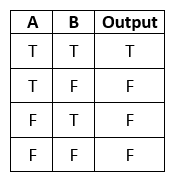
What type of logic is this table showing:

a)

AND

b)

OR

c)

NOR

d)

XOR

34.
Determine whether the stated conclusion is valid.
Given: If an animal is a dog, then they like biscuits.
Sammy is a dog.
Conclusion: Sammy likes biscuits.
a)
Invalid
b)
Valid
c)
Sammy is a Great Dane
d)
Sammy is really a cat.
35.
Use the Law of Detachment to draw a conclusion from the two given statements. If not possible, write not possible.
Statement 1: If I study for one hour each day, then I will score well on the exam
Statement 2: I will score well on the exam
a)
 I study for 1 hour each day.
b)
I do not study for 1 hour each day
c)
If I do well on the exam, I studied for 1 hour each day.
d)
not possible
36.
Determine whether the stated conclusion is valid.
Given: If a point is the midpoint of a segment, then it divides the segment into two congruent segments.
R is the midpoint of QS.
Conclusion: QR=RS
a)
Valid
b)
R is the midpoint
c)
Invalid
d)
A point is the midpoint of a segment.
37.
Use the law of syllogism to draw a conclusion from the two given statements:
Statement 1: If you exercise regularly, then you have a healthy body
Statement 2: If you have a healthy body, then you have more energy
a)
You have more energy
b)
If you exercise regularly, then you have more energy
c)
You have a healthy body
d)
If you do not have a healthy body, then you do not exercise regularly
38.

Which law of logic is this?

If I clean the bathroom, then I don't have to do the dishes.

I cleaned the bathroom.

Therefore, I don't have to do the dishes.

a)

Law of Detachment

b)

Law of Syllogism

c)

Law of Contrapositive

d)

None

39.

Use the Law of Detachment to draw a conclusion from the two given statements. If not possible, write not possible.

Statement 1: If I study for one hour each day, then I will score well on the exam

Statement 2: I will study from 6pm to 7pm tonite.

a)

I study for several hours each day.

b)

I will do well on the exam

c)

If I do well on the exam, I studied for hours.

d)

not possible

40.
Using the Law of Syllogism, which of the following completes the statement to form a valid conclusion?
If it is snowing heavily, then school will be canceled.
If school is canceled, the big test will not be given today.
It is snowing heavily, then...
a)
Look out for the snowplows while driving to school.
b)
The big test will not be given today.
c)
The roads will be hard to drive on.
d)
You should call the school to see if school is canceled.
41.
p→q
q→r
∴p→r
Which law is modeled?
a)
Law of Syllogism
b)
Law of Detachment
c)
Law of Contrapositive
d)
Law of Shannon
42.
p→q
p
∴q
Which law is modeled?
a)
Law of Syllogism
b)
Law of Detachment
c)
Law of Contrapositive
d)
Law of Shannon
