
 Worksheets
Ecological Relationships Review
Total questions: 55
Worksheet time: 2hrs 42mins
An ecologist studies a forest area for evidence of competition among organisms. She chooses a specific location where a tree was struck by lightning. The lightning strike caused the tree to fall over and opened a space in the tree canopy for light to pass through. Which of these observations provides the best evidence of competition?
Many tree seedlings crowd the open space and attempt to grow in the sunlight.
Snakes come into the open space and eat small rodents that can be easily spotted in the sunlight.
Termites that have microorganisms in their stomachs to help them digest wood are found on the fallen tree.
A type of plant called a bromeliad grows in the branches of the fallen tree and continues to survive even though the tree has fallen.
Bears and wolves eat deer, boar, sheep, and and other livestock. If the bear population in an ecosystem decreases, what would be the effect on the deer population?
The population would decrease, as the parasitism created for protection against wolves is a limiting factor.
The population would increase, as competition for the same food is a limiting factor.
The population would increase, as predation by bears is a limiting factor.
he population would decrease, as shelters created by bears' caves is a limiting factor.

The graph shown represents a predator-prey relationship. What is the most probable reason for the increasing predator population from day 5 to day 6?
A predator population equal in size to the prey population from day 5 to day 6
An increasing food supply from day 5 to day 6
The extinction of the yeast on day 3 and day 10
The decreasing prey population from day 1 to day 2
Base your answer(s) to the following question(s) on the information below.
An ecologist passed through different biomes while driving up a high mountain. At the lowest elevation (sea-level), the ecologist saw deep green vegetation, many birds, and small mammals. At the highest elevation the ecologist saw bare rock, very little vegetation, and few birds.
Which change was most likely encountered as the ecologist drove up the mountain?
A decrease in latitude
A decrease in temperature
An increase in diversity of species
An increase in the amount of atmospheric oxygen
In his studies of birds in the Galapagos Islands, Charles Darwin observed that a few bird varieties with similar beak size and shape inhabited a particular area.What limit the numbers of similar varieties?
Competition for specific concentration of oxygen in the atmosphere
The presence of an excessive number of autotrophs
he presence of a disease that attacks birds with similar beaks
Competition for the same type of food

The image shows a food web in a Florida ecosystem, with arrows pointing to the consumer. A new organism moves into the ecosystem. Its major food source is the pine borer.
Which animals in the food web will form a competitive relationship with the new organism?
squirrel and salamander
kinglet and fox
fox and hawk
salamander and kinglet

Read the passage above then answer this question:
If the human population increases, what will happen to the northern spotted owl population?
It will increase as humans will form a mutualistic relationship with the northern spotted owls.
It will decrease as humans will compete for the same food sources used by the northern spotted owls.
It will increase as humans will make newer forests with more open space for the northern spotted owls.
It will decrease as humans will cut down the old-growth forests that are used for nesting sites by the northern spotted owls.
What causes competition among organisms?
One organism tries to live on or in the other organism.
Both organisms attempt to
use the same limited resources.
Both organisms try to take
on the form of the other.
One organism tries to prey
on the other organism.

Organisms of two species using the same limited resource and having a negative impact on one another, such as hyenas and lions both hunting zebra, represent what type of relationship?
commensalism
predator-prey
mutualism
competition
All the populations of all the different species that live together in a particular area
Mutualism
Community
Commensalism
Predator/Prey

Identify the ecological relationship shown in each picture.
Write the correct answer.
(a)

Identify the ecological relationship shown in each picture.
Write the correct answer.
(a)
Which will add more organisms to a population?
5 animals die
0 animals are born
3 animals immigrate (move in) to the population
2 animals emigrate (move out) from the population


Which of the following are density dependent factors?
competition for resources
predation
disease
natural disasters
Which of the following are examples of a density independent factors?
forest fire
seasonal cycles
storms
disease
As a population of a species increases within a territory, which of the following most likely also increases?
Immigration
Food supply
Carrying capacity
Competition
Factors like predation can have a positive benefit to the population of prey organisms because predators tend to keep prey populations below their ___________.
carrying capacity
sustainibility number
exponential growth point
competition level
A population’s emigration in one month totaled 2 individuals. During the same period, immigration was 12 individuals. Natality (births) was 8, and mortality was 15 due to a parasite infection. What was the net effect on the population size?
+5
+3
0
-4
What type of factor has an increasing impact as the population size increases?
density-independent
density-dependent
cohort effect
survivorship factor
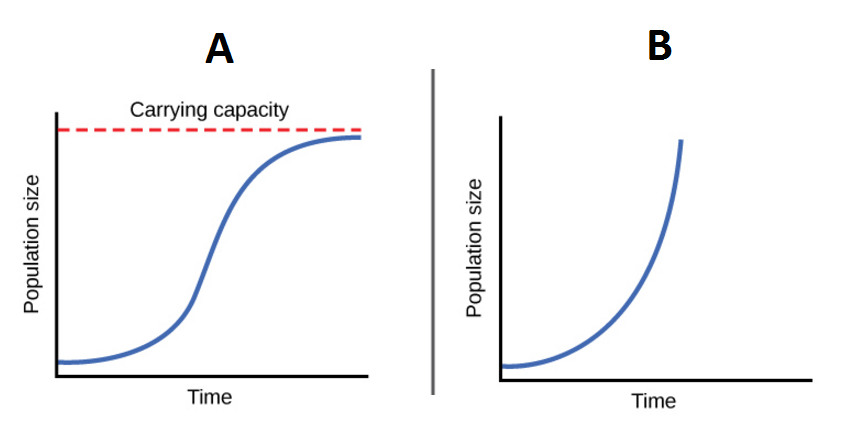
What type of growth model is shown in image A?
Exponential
Logistic
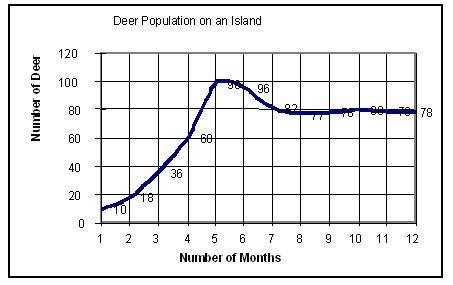
Which choice most closely approximates the deer population's carrying capacity based on the graph?
100
80
60
10

Which population growth model most closely describes the human population in the modern age?
logistic growth
exponential growth
upward growth
tumor growth
All of the following are density-dependent factors that limit populations EXCEPT
disease
competition
fire
parasites
food supply
Explains how fast a given population grows.
Population Growth Rate
Density Dependent Growth
Density In-Dependent Growth
Population Ranges
Emigration causes a population's density to
increase
decrease
stay the same
Immigration causes a population's density to
increase
decrease
stay the same
Which of the following must be true for the growth rate to equal zero?
birth rate > death rate
birth rate < death rate
birth rate = death rate
2x birth rate = 1/2 death rate
Which of the following describes how disease regulates population?
disease is a density independent factor
disease is a density dependent factor
disease selects for favorable individuals
disease removes unfavorable individuals
Which of the following is a density independent limiting factor?
disease
food
water
hurricane
The number of individuals of a species per unit area of a habitat. is called as
population area
population quadrat
population size
population density
The number of organisms present in a population is called as
population area
population quadrat
population size
population density

What could likely/possibly cause a decline in the wolf population on the island?
A hurricane
Inbreeding
Decline in moose population
massive ice bridges
canine parvovirus

Review the graph provided. What statements can be made about the significant decline in wolves around 1979?
The wolf decline was a direct result of moose decline.
The is no way to know why the wolf population dropped.
The drop is most likely due to the declining moose population, but more information would be needed to determine that.
The drop is most likely due to the increasing moose population, but more information would be needed to determine that.
The wolf decline was a direct result of the moose increase.

Use the graph provided to decide if the following statement is true or false: The wolf population on Isle Royale is rather unstable throughout this time period.
True
False
Review the graph provided. What statements can be made about the significant decline in moose in the mid 1990's?
The moose decline was a direct result of wolf decline.
The is no way to know why the moose population dropped.
The drop is most likely due to the declining wolf population, but more information would be needed to determine that.
The drop is most likely due to the increasing wolf population, but more information would be needed to determine that.
Humans are causing extiction in which ways?
By poaching animals for food or products.
By destroying the natural habitat of species.
By polluting the environments of the world.
All of the above.

