
 Worksheets
CHEM: Methods of Seperation
Total questions: 23
Worksheet time: 12mins
The tool used to separation liquids of different densities, like oil and water, is called...
filter
mortar and pestle
separation funnel
crystallization funnel
Which are methods of separating dissolved particles from the liquid they are dissolved in?
Filtration, separation funnel, crystallization
Filtration, distillation, crystallization
Evaporation, filtration, crystallization
Evaporation, distillation, crystallization
Which are methods of separating dissolved particles from the liquid they are dissolved in?
Filtration, separation funnel, crystallization
Filtration, distillation, crystallization
Evaporation, filtration, crystallization
Evaporation, distillation, crystallization
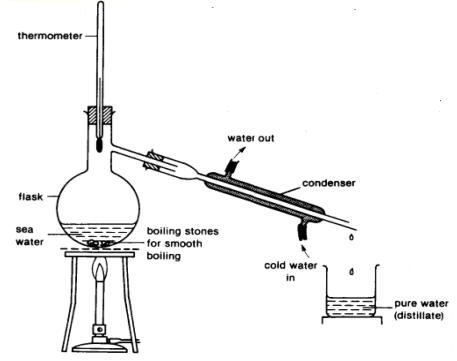
What is the name of this separation technique?
Simple distillation
Fractional distillation
Boiling
Evaporation
Which of the following statements tells us that a sample of liquid is pure water?
It is colourless.
It leaves no residue when filtered.
It boils at 100oC.
It is odourless.
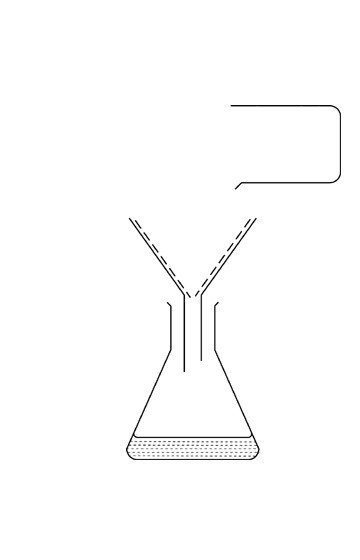
What is the name of this separation technique?
distillation
filtration
evaporation
chromatography
What is the physical property on which fractional distillation depends?
different boiling points
different melting points
different solubilities
different densities
For paper chromatography to work,
the dyes must have different boiling points.
the dyes must have different solubilities in the solvent.
the starting line on the chromatogram must be drawn using pen.
The starting line must be below the level of the solvent.
Which separation technique is used to obtain pure oxygen from liquid air?
Simple distillation
Filtration
Chromatography
Fractional distillation
Which separation technique is used to obtain salt from seawater?
Simple distillation
Filtration
Chromatography
Evaporation
During filtration, the solid that is trapped in the filter paper is called ..A.. and the liquid that has passed through the filter paper is called ..B..
A: residue B: filtrate
A: residue B: filterate
A: filtrate B: residue
A: filterate B: residue
What is the 'supraordinación' of these concepts Homogeneous and Heterogeneous?
Matter
Pure substance
Mixture
None of the above

Sofia separated a mixture (soil and water). At the end, she had clean water using a separation technique. What is the name of the separation technique she used?
Evaporation
Filtration
Separating funnel
Sieving

What separation technique should Isabella use to separate a heterogeneous mixture made of two liquids?
(a)

What is the name of the separation technique should a student use to separate the iron filings?
Magentism
Filtration
Sieving
Separating funnel
2.WHAT IS A SUBLIMATION ?
IT IS A METHOD OF CONVERTING SOLID-LIQUID.
IT IS A METHOD OF CONVERTING SOLID-VAPOUR.
IT IS A METHOD OF SEPARATING SOLID-SOLID.
IT IS A METHOD OF CONVERTING GAS-GAS.
5.A COMPOUND CONTAINING CARBON, OXYGEN, CALCIUM.
WATER
CHALK
ICE
SALT
Which one is a form of heat transfer?
Conduction
Absorption
Refraction
Reflection
Which one is a form of heat transfer?
Conduction
Absorption
Refraction
Reflection
Magnetic separation only works when the substance to separate is a:
Plastic
Metal
Liquid
Sulphur powder
If the mixture is formed by two liquids and they form an homogeneous mixture, the best separation technique would be:
Distillation
Evaporation
Crystallization
Filtration

What would you use to separate salt from sea water?
Decanting
Filtration
Crystallization
Distillation
What is a mixture?
A physical joint between two or more substances
A chemical joint between two or more substances
The result of a chemical reaction
The result of a phase change

