Wayground logo

Free Printable Worksheets

Font size

S
M
L
XL
Worksheets

MATTER

Total questions: 22

Worksheet time: 15mins

Name
Class
Date
1.
Matter is anything that takes up space
a)
True
b)
False
2.
What are the states of matter?
a)
solid, liquid, and juice
b)
solid and liquid
c)
solid and gas
d)
solid, liquid, and gas
3.
Which state of matter has particles that are tightly packed?
a)
liquid
b)
gas
c)
solid
4.
Something that takes up space and has mass.
a)
volume
b)
matter
c)
mass
d)
density
5.
Which form of matter fills the space like it has in the balloon?
a)
liquid
b)
string
c)
solid
d)
gas
6.
What is happening when my water bottle in the freezer goes from a liquid state to a solid state?
a)
melting
b)
evaporating
c)
freezing
d)
cutting
7.
Liquid matter takes the shape of _______.
a)
a gas
b)
water
c)
a pet
d)
Its container
8.

How would you find the mass of an object?

a)

Measure its dimensions with a ruler, and then multiply length x width x height

b)

Water displacement

c)

use a balance/scale

d)

use a timer

9.

How would you find the volume of an irregular shaped object?

a)

use a ruler to measure its dimensions

b)

water displacement

c)

use a balance/scale

d)

use a timer

10.

What is the density of a liquid if its volume is 125 mL and its mass is 50 g?

a)

2.5 g/mL

b)

175 g/mL

c)

0.4 g/mL

d)

6250 g/mL

11.
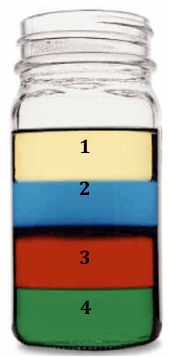
Put the liquids in order from most dense to least dense?
a)
4, 3, 2, 1
b)
1, 2, 3, 4
c)
3, 4, 2, 1, 
d)
4, 3, 1, 2
12.
Why does ice float?
a)
Liquid water is less dense than solid water.
b)
Solid water is less dense than liquid water.
c)
Gaseous water is less dense than solid water.
d)
Liquid water is less dense than gaseous water.
13.
What is the formula for density?
a)
density = mass x volume
b)
density = mass / volume
c)
density = mass + volume
d)
density = mass - volume
14.
Jack has a rock. The rock has a mass of 14 g and a volume of 2 cm3. What is the density of the rock?
a)
7 mL
b)
7 g/cm3
c)
28 g/cm3
d)
1/7 g/cm3
15.
Physical or Chemical Property? If copper comes in contact with water, it will turn green.
a)
Physical
b)
Chemical
c)
Neither
16.
Physical or Chemical Property?  The temperature of boiling water is 100 degrees Celsius.
a)
Physical
b)
Chemical
c)
Neither
17.
Define a Physical Property
a)
A property of matter not involving in its manifestation a chemical change
b)
A property in which stops a chemical reaction from occuring.
c)
A property or behavior of a substance which undergoes a chemical change or reaction.
d)
A property which makes the object smell or taste different.
18.
Define a Chemical Property
a)
A property which depends on the objects size or matter.
b)
A property of matter not involving in its manifestation a chemical change
c)
A property or behavior of a substance which undergoes a chemical change or reaction.
d)
A property which makes the object smell or taste different.
19.
One hot summer, you remember you left a cup of water outside. A few weeks later, you saw that the cup was empty and you remember the cup having water. What happened to the water?
a)
It evaporated
b)
It underwent deposition
c)
It melted
20.

Sand and salt are placed in the bottom of a beaker filled with water. The beaker is heated, and the water is stirred.


What will happen to the salt and sand?

a)

The sand and salt will settle to the bottom.

b)

The sand and salt will dissolve in the water

c)

The salt will dissolve, and the sand will settle

d)

The sand will evaporate, and the salt will dissolve.

21.

Which of the following are correct? Select all.

a)

To change from a solid to a liquid, I must use evaporation.

b)

To change from a liquid into a gas, I must use evaporation.

c)

To change from a liquid into a gas, I must use condensation.

d)

To change from a solid into I liquid, I must use heat to melt it.

e)

To change from a gas into a liquid I must use condensation.

22.
Which item is not made of matter?
a)
air
b)
water
c)
a pencil
d)
a shadow