wayground logo

Free Printable Worksheets

Font size

S
M
L
XL
Worksheets

Plate tectonics

Total questions: 40

Worksheet time: 1hrs 20mins

Name
Class
Date
1.
Created by a divergent boundary.
a)
Rocky Mountains
b)
Mariana Trench
c)
Mid Atlantic ridge
2.
Mountains form from ...
a)
plates sliding past one another
b)
collision of plates
c)
plates moving away from each other
3.
During sea floor spreading, molten material rises up from the mantle...
a)
along the continents
b)
at the mid ocean ridges
c)
deep ocean trenches
d)
at north and south poles
4.
Which of the following is where one plate slides under another plate?
a)
submarine zone
b)
divergence zone
c)
subduction zone
d)
lower zone
5.
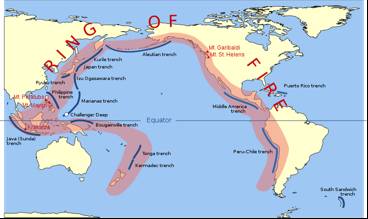
The area around the pacific plate where boundaries form is called...
a)
death ring
b)
fire zone
c)
ring of fire
d)
zone of fire
6.
Associated with transform boundaries.
a)
Volcanoes
b)
mountains
c)
trenches
d)
earthquakes
7.
This land formation occurs at a divergent continental/ continental boundary.
a)
mid ocean ridge
b)
deep ocean trench
c)
pacific hot spot
d)
rift valley
8.
What happens to temperature as you go deeper in the Earth?
a)
decreases
b)
increases
c)
fluctuates
d)
remains the same
9.
Name the boundary
a)
convergent boundary
b)
divergent boundary
c)
transform boundary
d)
sergent boundary
10.
What is represented by the picture? 
a)
Sea-floor spreading
b)
Pangea
c)
How the continents are arranged today
d)
Volcanoes
11.
Name the boundary
a)
convergent boundary
b)
divergent boundary
c)
transform boundary
d)
sergent boundary
12.
Which type of crust is more dense and thinner?
a)
Continental
b)
Asthenosphere
c)
Oceanic
d)
Byers
13.
What was Wegener's hypothesis called?
a)
The Pangea 
b)
Moving Continents 
c)
The Continental Drift
d)
Techtonic Plates
14.
Why was Alfred Wegner's theory of Continental Drift not immediately accepted by scientists?
a)
there was no mechanism to explain how Continental Drift happened.
b)
The theory of Continental Drift was immediately accepted by the scientific community.
c)
there was no evidence to support his theory.
d)
Scientists did not think it was possible for the Continents to move.
15.
A location where two tectonic plates collide is known as a _________ boundary.
a)
Convergent
b)
Divergent
c)
Transform
d)
Spreading
16.
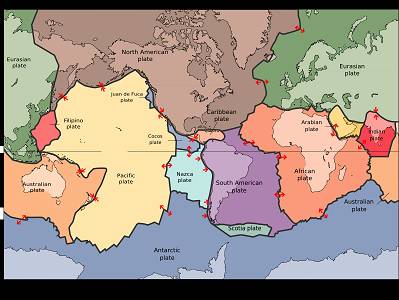
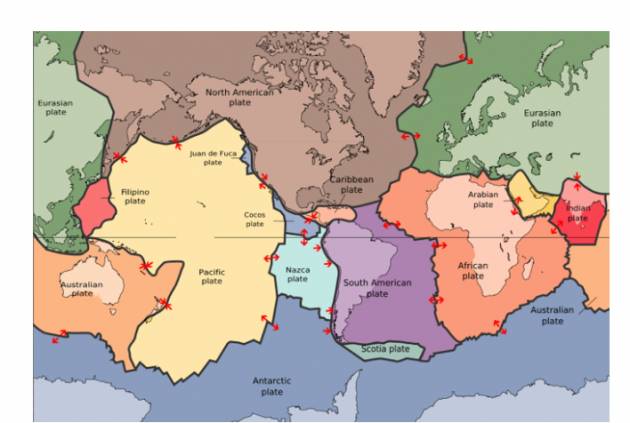
Identify the Major Plate labeled B
a)
African Plate
b)
Antarctic Plate
c)
Pacific Plate
d)
Eurasian Plate 
17.
Identify the Major Plate labeled I
a)
African Plate
b)
Antarctic Plate
c)
Pacific Plate
d)
Eurasian Plate 
18.

Subduction means.....

a)

one plate goes under another plate

b)

two plates slide past each other

c)

two plate collide and form folded mountains

19.

The process that causes the tectonic plates to move is called.....

a)

subduction

b)

transform

c)

convection

20.
Identify the Major Plate labeled J
a)
African Plate
b)
Antarctic Plate
c)
Pacific Plate
d)
Eurasian Plate 
21.

Magma that erupts out of volcanoes comes from.....

a)

melted transform crust

b)

melted oceanic crust

c)

melted continental crust

22.

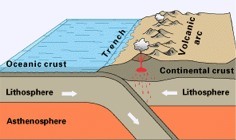
When oceanic and continental crust collide what feature would form?

a)

volcanic island arc

b)

folded mountain

c)

volcanoes on the continent

23.

Subduction means.....

a)

one plate goes under another plate

b)

two plates slide past each other

c)

two plate collide and form folded mountains

24.

divergent plates move

a)

away fro each other

b)

towards each other

c)

slide past each other

25.

Sea-floor spreading explains how.....

a)

new crust is created at a divergent boundary

b)

volcanoes are formed on continents

c)

deep sea trenches are formed

26.

At a transform boundary the plates.....

a)

collide

b)

diverge

c)

slide past each other

27.

This area is called the....

a)

Arc of Volcanoes

b)

Ring of Fire

c)

Horseshoe of Magma

28.

The movement of the tectonic plates is caused by

a)

the rotation of the Earth.

b)

convection currents in the Asthenosphere

c)

the gravity of the iron-nickel core.

d)

the Moho discontinuity.

29.

In some areas of the world, like California and Japan, earthquakes are a common occurrence. How can this best be explained?

a)

The strong ocean currents are undermining both areas causing earthquakes.

b)

Both areas are located near the edge of the Pacific Ocean, the unstable sand causes earthquakes.

c)

Both areas are subjected to strong ocean wind and waves that causes earthquakes.

d)

Both areas are on the boundary of active plates, the motion of the plates causes earthquakes.
30.
There are three types of plate boundaries. Which choice is NOT a type of plate boundary?
a)
convergent
b)
thrust
c)
divergent
d)
transform
31.

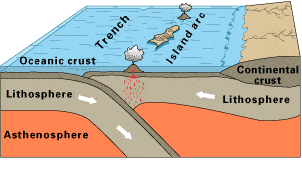
Observe this diagram of a plate boundary. One statement BEST describes what is happening. It is that

a)

the oceanic crust is melting.

b)

the denser ceanic crust is subducting under the less dense oceanic crust

c)

volcanic islands are forming.

d)

the tectonic plates are moving away from each other.
32.
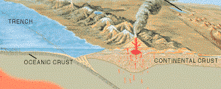
What geological forces might be responsible for this range of mountains?
a)
diverging tectonic plates
b)
erosion of the land by the ocean
c)
converging tectonic plates
d)
deposition of sediments by the ocean
33.

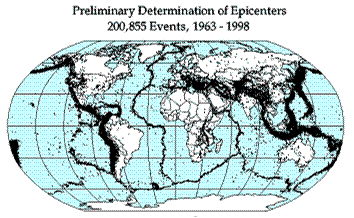
Earthquake epicenters (center of where the earthquakes started) were mapped for a 35 year period in the diagram above. The black dots indicate these epicenters. The black dots appear along what feature on Earth?

a)

hot spots

b)

plate boundaries

c)

rift zones

d)

sea floor spreading

34.
The Earth’s surface is not a solid surface but is divided into
a)
several oceanic plates.
b)
continental and crustal plates.
c)
seven continental plates.
d)
continental and oceanic plates.
35.
Geologists have long recognized that earthquakes are not randomly distributed on Earth but occur in concentrated areas that coincide with __________ and provide evidence for the theory of ___________ .
a)
mountain ranges; fault zones.
b)
continental borders; supercontinents.
c)
plate boundaries; plate tectonics
d)
areas of liquid magma; sea floor spreading.
36.
Which geological features MOST LIKELY prompted the development of the theory of plate tectonics?
a)
river deltas
b)
mountain ranges
c)
glacier fields
d)
tropical rainforests
37.

Where are earthquakes MOST LIKELY to occur?

a)

close to the equator

b)

close to the center of tectonic plates

c)

at divergent or convergent plate boundaries

d)

at transform plate boundaries

38.
The image shows the Pacific Ring of Fire, a region of high tectonic activity. What evidence supports the theory that the tectonic activity of the region is due to the subduction of tectonic plates?
a)
The region is bound by many oceanic trenches.
b)
North America seems to be colliding with Asia at the north of the ring.
c)
The Asia-Pacific region is dotted by many small and large islands
d)
The landmasses look like they would fit together like the pieces of a jigsaw puzzle.
39.

___________ currents in the Earth's asthenosphere cause plate to shift at their boundaries. This movement also causes earthquakes and volcanic activity.

a)

conduction

b)

convection

c)

radiation

d)

ocean

40.
Observe the plate boundary shown here. What type of plate boundary is this? Many geologic events occur at these boundaries. Some are shown, but one is missing. What geologic event would you predict would occur at this plate boundary?
a)
convergent oceanic-oceanic plate boundary; volcano
b)
divergent oceanic-oceanic plate boundary; sea floor spreading
c)
convergent oceanic-continental plate boundary; earthquake
d)
convergent continental-continental plate boundary; mountain building