
 Worksheets
9 Weeks Test Review
Total questions: 186
Worksheet time: 2hrs 55mins
Aztecs
conquered most of Mexico
their empire numbered about 30 million people
war brought intense wealth as well as power to them
lived in teepees
Mound builders
made river valleys and farming cultures
trade networks stretched from the Gulf of Mexico to the Great Lakes
they build large towns and ceremonial centers
they danced around the fire
Incas
their civilization rose and fell
they came down from the Andes mountains of Peru
they were led by a skilled warrior and leader
they imposed their own leader
made fancy head dresses to wear
Amerigo Vespucci was an _______________ explorer.
American
Italian
Who funded (paid for) his voyage to the New World?
his parents
The King and Queen of Spain
What continent did Amerigo Vespucci discover?
Asia
South America
Which river was discovered by Vespucci?
Mississippi
Amazon
Which among the following was the peculiarity of Neolithic age?
Early Humans started doing agriculture
Early humans started settled life
Early humans started domesticating animals
All of the above
Which among the following was used to make the weapons during Neolithic period?
Stone
Wood
Antlers and bone.
All of the above
People changed from nomadic hunter-gatherers to settled members of ………..
Farm-based communities.
Largest cities
Large trade communities
All of the above
Farm based communities led to better health, longer life, and the beginning of ……………..
Civilizations.
Cities
Towns
Countries
What are the 3 ancient kingdoms of Egypt?
Old Kingdom-built pyramids
Middle Kingdom-art took on new styles and techniques
New Kingdom-conquer the most lands
Baby Kingdom-land ruled by babies
A disorder of the Holy Roman Empire led to the formation of independent towns and principalities in Northern Italy. The 3 most important city-states were...
Florence
Milan
Venice
Mexico City
The disorder of the Holy Roman Empire led to the formation of independent towns and principalities in northern Italy. Lesser city-states included..
Ferrara, Genoa, Lucca, Mantua, Padua, Pisa, Siena, and Urbino
Columbus, Starkville, Louisville, Tupelo, Nettleton, New Hope, Caledonia, and West Point
Atlanta, Rome, Helen, Peach Tree City, and Savannah
What does the title Augustus mean?
The First among Equals
The Revered One
The Chosen One
The Most Important One
What was one reason that Augustus was successful in securing and maintaining power?
He proclaimed himself king
He didn't proclaim himself king
He declared himself dictator for life
He ensured that senate was populated with those who supported him
What role did Augustus turn down in 22 BC?
Consul
Dictator
Proconsul
Triumvirate
What was the result of the Settlements for Augustus?
He could retire peacefully to the countryside
He could hand over power back to the two consuls
He had complete control of all aspects of the Roman government
He had the support of the ordinary people (the plebs)
Why was Augustus able to use the title 'Divis Filius'?
Because revered that he was considered a god
He had godlike powers over Rome
Because Caesar had been deified and he Caesar's adopted son
He was worshipped by the Roman people
Who is Martin Luther?
A baptist minister and social activist
German theologian and religious reformer
A singer in the catholic church
A racecar driver
Why did Martin Luther become a monk?
His dad was a monk and influenced him to become one
He was walking through a violent thunderstorm and if he was spared he said he would become a monk
He helped build a monastery and thought that it was a good lifestyle choice for him
He enjoyed the foods that they ate
What mainly helped Martin Luther spread his teachings?
Word of mouth
Printing press
Food
Paintings
What language did Martin Luther translate the New Testament to?
German
French
English
Chinese
How many wives did Henry VIII have?
1
3
4
6
What were the consequences of Henry's reign for the Church? (more than one answer)
he beheaded two of his wives
Henry created the new Church of England and became its head
Henry took wealth and power away from the Church and gave it to a country
England became a Protestant country
Which of these statements is true about Henry VIII? (more than one answer)
He spoke several languages.
He didn't like parties.
He was very good at tennis and hunting.
He wrote books and poems.
He built many great churches and collages.
What is Henry's family name?
House of Stuart
House of Windsor
House of Hanover
House of Tudor
How old was Henry when he became the king?
15 years old
18 years old
20 years old
24 years old
Which of Henry's children became a very famous British monarch?
Mary I
Elizabeth I
Edward VI

a reform movement against the Roman Catholic Church that began in 1517; it resulted in the creation of Protestant churches
Reformation
Indulgence
Purgatory
Protestant

Why did England break with the Church?
Martin Luther's influence spread throughout country
John Calvin set up his theocracy in one the towns
The king wanted a divorce and Church said no
The England did not break from the Catholic Church

What was the Catholic Church's response to Martin Luther's 95 Theses?
Excommunication
The Peace of Westphalia
The Counsel of Trent
They ignored it

Luther's followers called themselves what?
Protestants
Protestors
Reformers
Transformers

According to Martin Luther, where is ultimate religious authority determined?
The decisions of the Pope
The bible
The actions of the Priest
Whatever feels good in the moment

What was the significance of the printing press?
the production of written work was slower, therefore written works were not available to everyone.
there is no significance
the production of written work was faster, however not everyone was able to read.
the production of written work was faster, therefore written works were available to everyone.
True or False: City on a Hill was a sermon given by John Winthrop describing the expectation that the Massachusetts Bay colony would shine like an example to the world. He also expected Massachusetts to differ from the rest of the world.
true
false
Quakers are a religious group that
hates women.
goes to war often.
is very peaceful.
kills Native Americans.
William Penn founded
Virginia
Massachusetts
New York
Pennsylvania
Quaker refuse to fight in wars.
True
False
Quakers believe Native Americans should be treated with care.
True
False
Puritans believed women were equal to men.
True
False
Puritans were terrified of the devil to the point of being overly paranoid.
True
False
The Puritans founded
the Massachusetts Bay Colony.
the Plymouth Colony.
Puritan children had lively and creative childhoods.
True
False
Quakers left England because they were ___________ for their beliefs.
persecuted
applauded
rewarded


In the summer of 1607, this country sent about 110 men to the "new world" to establish a permanent colony. The colony was named Jamestown.
France
England
Spain
Portugal

English people who were sent to the colony of Jamestown were called...
Clowns
Couriers
Conquistadors
Colonists

In what modern-day state is Jamestown located?
Illinois
New Mexico
Virginia
Massachusetts

What body of water did the Jamestown Colonists cross when traveling from England?
Atlantic Ocean
Pacific Ocean
Gulf of Mexico
Southern Ocean

After crossing the Atlantic Ocean, the Jamestown Colonists entered the ______ Bay
Cheesecake Bay
Chesapeake Bay
Cheddar Bay
San Francisco Bay

After entering the Chesapeake Bay, the Jamestown Colonists traveled up the __________ River.
Mighty Mississippi River
James River
Missouri River
Rio Grande

When the Colonists landed in Jamestown, what Native American tribe was living in the area?
Cahokians
Hohokam
Anasazi
Powhatan

The chief of the Powhatan's had a daughter named...
Mulan
Pocahontas
Cinderella
Moana

Out of the 110 original settlers, how many would be alive by the end of December?
70
60
55 (50% survival)
40

In January, Captain John Smith was sent to Jamestown for leadership.
True
False
In his "City upon a Hill" sermon John Winthrop was appealing to the puritans to?
select ground well away from swamps and marshes to settle on
open their communities to people of all faiths who were fleeing England
Build a godly community to people of all faiths who were fleeing England
exile dissidents like Roger Williams and Anne Hutchinson to Western Massachusetts


True or False?
Anne Hutchinson was considered one of the earliest American feminists, Anne Hutchinson was a spiritual leader in colonial Massachusetts who challenged male authority—and, indirectly, acceptable gender roles—by preaching to both women and men and by questioning Puritan teachings about salvation.
true
false
True or False?
Roger Williams 1603?-1683) was the political and religious leader that is best known for founding the state of Rhode Island and advocating separation of church and state in Colonial America. He is also the founder of the first Baptist church in America
true
false


True or False?
The Spanish colonies become "a frontier of inclusion"? There were very few European women in the colonies.
true
false

The middle passage was apart of what trading system
Triangular Trade
African Trade
Square Trade
Gold Mine Trade

How were the conditions of the slave boats during the Middle Passage?
The lodgings were clean and sanitary for the slaves
The slaves were well fed and clothed
The conditions were dirty and unsanitary for the slaves
All of the above
True or False?
Among the enumerated goods were furs, ship masts, rice, indigo and tobacco. Importantly, ships registered in the colonies were allowed to carry trade within the empire. Enumerated goods were also only allowed to be exported to limited destinations.
true
false
In what year was the Glorious Revolution?
1588
1687
1688
1517
What is absolutism?
belief the no one is above the law even the king
belief that salvation belongs to the individual
that a king has total total, unrestricted authority
that man's reason can unlock the workings of the universe
Who was the epitome of an absolute ruler?
Charles I
Louis XIV
James II
Oliver Cromwell
The Glorious Revolution changed _________ from Catholic to Protestant
France
The Netherlands
Great Britain
Holy Roman Empire
The Glorious Revolution ended tensions between
The king, William of Orange and the Pope
Parliament, Catholics, and the King
Parliament, Mary Stuart, and France
The king, Parliament and Protestants
True or False?
Known as the “Sun King,” Louis XIV centralized power in the monarchy and reigned over a period of unprecedented prosperity in which France became the dominant power in Europe and a leader in the arts and sciences.
true
false
Which British Prime Minister was responsible for funding much of the 7 Years War?
David Cameron
Benjamin Franklin
William Pitt
George Washington
Which treaty officially brought an end to the 7 Years War
The Treaty of Paris
The Treaty of London
The Treaty of Versailles
The Treaty of Quebec
Which of the following was NOT involved in the French and Indian War?
France
Britain
Native Americans
Italy
In the Treaty of Paris, after the French and Indian War, who gained control of Canada?
Britain
France
Spain
In the Treaty of Paris, after the French and Indian War, who gained control of all the land East of the Mississippi (except New Orleans)?
Britain
France
Spain
In the Treaty of Paris, after the French and Indian War, who gained control the islands in the Caribbean known as the West Indies?
Britain
France
Spain
In the Treaty of Paris, after the French and Indian War, who gained control of some smaller islands in the Gulf of the St. Lawerence River?
Britain
France
Spain
In the Treaty of Paris, after the French and Indian War, who gained control of Florida?
Britain
France
Spain
In the Treaty of Paris, after the French and Indian War, who gained control of the territory west of the Mississippi including New Orleans?
Britain
France
Spain
In what country was Catherine the Great born?
Russia
France
Germany
Italy
What was the name of Catherine the Great's husband?
Peter III
Peter the Great
Paul I
George V
Catherine the Great was the Empress of Russia
in the 1800's.
in the 1600's.
in the 1700's.
in the 1900's.
Catherine the Great became Empress when
her husband, Peter III, died.
she had had her husband left the country.
she had her husband removed from being the Czar.
Catherine the Great is remembered has doing what for Russia.
Improving education for women.
Bringing literature, music, and art to the people.
Modernizing Russia long European lines.
All of the above.
Elizabeth belonged to what royal family?
Windsor
Stuart
Tudor
Plantagenet
What relation was Mary I to Elizabeth I?
Cousin
Half-sister
Sister
Mother
What religion was Elizabeth I?
Catholic
Protestant
Buddhist
Sikh

French Enlightenment philosopher who strongly believed in freedom of speech and religion
Voltaire
Denis Diderot
Mary Wollstonecraft
John Locke

The rights of life, liberty, and property are called:
Unalienable Rights
Essential Rights
Natural Rights
Original Rights

How did the ideas of the Enlightenment philosophers most influence popular revolutions in France and in the United States?
by explaining that society could be improved through scientific discovery
by challenging the belief in the divine right of kings
by stressing the importance of military strength
by examining other countries as models of self-government
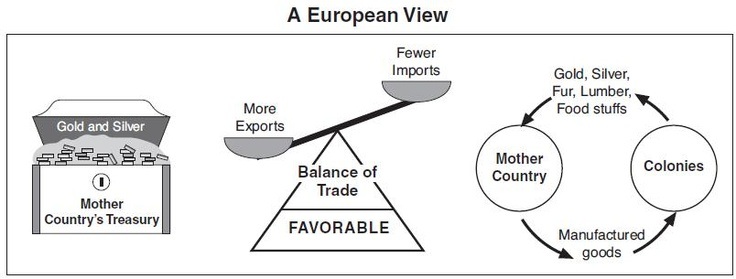
What is mercantilism?
A system where a mother countries gains money and power from natural resources that come from its colonies.
where colonies trade gold and silver with each other.
Wars that start over money.
Plantation colonies trading slaves for money.

Which term means a good to sold another country?
Import
Export

The impact of mercantilism was that
The rate of slavery in the Americas went down
Trade was limited in the Atlantic
The Colony grew wealthy
The Mother Country grew wealthy


Mercantilism is when
Raw materials were bought cheaply by the colony and sold as refined materials to the 'Mother Country'
Raw materials were bought cheaply by the 'Mother Country' and sold as refined materials to the colony
When merchants sold their goods for high prices to working class citizens
When working class citizens were forced to sell their products to make profits
True or False?
Salutary neglect, was a policy of the British government from the early to mid-18th century regarding its North American colonies under which trade regulations for the colonies were laxly enforced and imperial supervision of internal colonial affairs was loose as long as the colonies remained loyal to the British government.
true
false

True or false...Cromwell was one of the Members of Parliament who signed Charles I's death warrant?
True
False
What title did Oliver Cromwell have when he was in charge of the country?
King Cromwell
Lord Protector
Supreme Leader
Secretary of the State
Cromwell was a...
Catholic
Puritan
When Cromwell ruled the country it was known as a...
Monarchy
Republic
Dictatorship
Totalitarian
How many districts (areas) did Cromwell divide the country into?
9
11
13
15
What term describes the belief that a monarch's right to rule came directly from God
Petition of Right
Divine Right
Limited Monarchy
Bill of Rights
True or False?
Constitutional monarchy, is a system of government in which a monarch (see monarchy) shares power with a constitutionally organized government. The monarch may be the de facto head of state or a purely ceremonial leader. The constitution allocates the rest of the government's power to the legislature and judiciary.
true
false
Which people group makes up the 1st Estate?
Peasants, Craftsman, Bourgeoisie
Clergy, Monks, Nuns
Nobility
Monarchy
The 2nd Estate is made up of the nobility of France.
True
False
The 3rd Estate consists of which people group?
Peasants, Craftsman, Bourgeoisie
Clergy, Monks, Nuns
Nobility
Monarchy
Which estate was responsible for paying all taxes in France?
1st Estate
2nd Estate
3rd Estate
Monarchy
Which of the following caused economic problems in France? (you may select more than one)
Lavish spending by monarchy
Unemployment
Decisions made by Catholic Church
When a government spends more money than they bring in, what is it called?
Deficit Spending
Deductible
Balanced budgeting
Who was King of France when the French Revolution began?
King James I
King Henry VIII
Napoleon
King George V
King Louis XVI
Which of the following best describes the Estates General?
The region in Paris where the middle class lived
Powerful nobles that advised the king of France
A number of large homes owned by the French nobility
High ranking officials that ran the French government
The legislative body of France tthat had little real power, and was unfair to the common People of the Third Estate.
Maximilien Robespierre is famous for his role in what major world event?
World War I
World War II
American Revolution
French Revolution
Boer War
Robespierre attended the Estates-General as an elected member from what Estate?
First
Second
Third
He represented all the Estates
He didn't represent any Estate
Which of the following best describes France under the Reign of Terror?
A time of freedom of speech and the press
A time when people were free to voice their opinions
A time of open discourse as to the future of the French government
A time when anyone against the government was killed or put in jail
A time of peace and prosperity
Which of the following statements is true about Robespierre? (multiple answers)
He had people killed for the suspicion of not supporting the revolution
He was against the Catholic Church
He helped to get slavery abolished in France
He established a new religion called the Cult of the Supreme Being
Why was Marie Antoinette married of to Louis XVI?
Because she wanted to
Because her father wanted her to marry him
Because her mother wanted to form an alliance with France
Because her sister wanted to form an alliance with Spain.
Why was the poor so angry at Marie Antoinette (There are two answers)
She spent too much money on her lifestyle
She didn't give the poor enough cake
She didn't invade Britain
They believed that she was sending French military secrets to Austria
Who called the meeting of the Estates General in 1789?
King James I
King Henry VIII
Napoleon
King Louis XVI
King George V
What was the main reason that the National Assembly formed?
They wanted the church to rule France
They wanted more voting power
They wanted the nobility to rule France
They wanted to work fewer hours
They wanted to meet in a nicer building
What were the members of the National Assembly called?
Senators
Congressmen
Deputies
Aristocrats
Members of parliament
Where did the National Assembly meet after the king ordered them to disperse?
At a tennis court
At a local pub
At a restaurant
At a member's house
At the market square


What was the Bastille used for?
Food storage
housed the French King
A prison or fortress
a Church
What did the Bastille symbolize?
a symbol of royal power
the artistic ability of local artisans
an outreach to the poor
pride for the locals
Who stormed Bastille?
Nobles
ordinary people of France
the royal guard
The Storming of the Bastille is considered the starting point of what major historical event?
American Revolution
World War I
Hundred Year's War
French Revolution
Napoleonic Wars
True or False?
The Women's March on Versailles was an important event at the start of the French Revolution. It gave the revolutionaries confidence in the power of the people over the king. In 1789 France, the main food of the commoners was bread. A poor French economy had led to a scarcity of bread and high prices
true
false

What event restored monarchies and the balance of power to Europe after the Napoleonic Wars?
Congress of Vienna
Parliament
League of Nations
Estates General
One goal of the Congress of Vienna was to
establish a new balance of power in Europe
protect Europe from Ottoman advances
end abuses within the Catholic Church
redraw the boundaries of Africa
The Congress of Vienna attempted to restore Europe to as it had been before (2 things)
American Revolution
Napoleon's Conquests
French Revolution
Industrial Revolution
One goal of the Congress of Vienna was the -
restoration of Napoleon
execution of Napoleon
restoration of monarchies
abolishment of monarchies
The Congress of Vienna -
reclaimed American colonies
redrew the map of Europe
redrew the map of America
reclaimed African colonies
True or False?
Jean-Paul Marat was a French political theorist, physician, and scientist. A journalist and politician during the French Revolution, he was a vigorous defender of the sans-culottes, a radical voice and published his views in pamphlets, placards and newspapers.
true
false

