
 Worksheets
MAGNET TOPIC
Total questions: 15
Worksheet time: 11mins
What are the poles of a magnet known as?
North pole only
South pole only
East pole and West pole
North pole and South pole

The strongest parts of the magnet are ...
fronts
backs
poles
middle
The middle of the magnet is the ________________ point.
hottest
coldest
weakest
strongest
A magnet will pick up an object that is made of...
plastic
iron or steel
glass
copper

The area around a magnet is called the .....
attraction zone
work area
magnetic field
hot zone
What does repel mean?
magnets move toward each other
magnets do not have magnetism
magnets move away from each other
magnets stick together
What happens if you hold the south pole of one magnet close to the north pole of another magnet?
They will attract each other
They will repel each other
They will grow very hot
Nothing will happen
Like poles __________ each other while unlike poles ___________ each other.
attract, repel
repel, attract
oppose, connect
connect, oppose
What happens if you hold the north poles of two different magnets close to each other?
They will attract each other
They will repel each other
They will grow very hot
Nothing will happen

Jordan places four ring magnets A, B, C and D onto a wooden stand as shown.
If he wants the four ring magnets to be attracted to each other, which magnet A, B, C or D should he flip?
A
B
C
D

The diagram shows what happens when bars X and Y are brought near to each other.
Which one of the following statements is correct?
X is a magnet but Y is a magnetic material.
Both X and Y are magnets.
X is made of aluminium but Y is made of iron.
Both X and Y are made of non-magnetic materials.

The diagram shows an arrangement of three magnets. The poles of the magnets are labelled A, B, C, D, E and F respectively.
Which one of the following arrangements of the three magnets is possible?


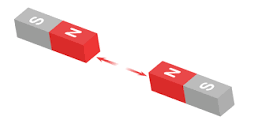


Jannah placed two bar magnets four times next to each other. The movements of the magnets are shown in Figure below
Like poles attract each other, unlike poles repel each other
Like poles repel each other, unlike poles attract each other
Unlike and like poles repel each other
Unlike and like poles have no effect on each other

