wayground logo

Free Printable Worksheets

NEW

Font size

S
M
L
XL
Worksheets

Exam 1 Review

Total questions: 29

Worksheet time: 36mins

Name
Class
Date
1.

Which of the following makes up a molecule of water?

a)

one atom of oxygen, two atoms of hydrogen

b)

one atom of hydrogen, two atoms of oxygen

c)

one atom of chlorine, one atom of sodium

d)

one atom of hydrogen, one atom of oxygen

2.

Ice floats on water because

a)

adhesion

b)

cohesion

c)

water expands when it freezes

d)

water shrinks when it freezes

3.

When salt is dissolved in water, water is the

a)

solvent

b)

solute

c)

solution

d)

reactant

4.

A substance with a pH of 6 is called a....

a)

Base

b)

Acid

5.

Oil and water don't mix because oil is

a)

hydrophilic

b)

hydrophobic

c)

an emulsifier

d)

a buffer

6.

What property of water is in this picture?

a)

high specific heat

b)

surface tension

c)

greatest density at 4oC

d)

capillary action

7.

During the winter when lakes freeze over the fish and other animals living in it survive. Which property of water?

a)

high specific heat

b)

capillary action

c)

greatest density at 4 oC

d)

surface tension

8.

Water is a polar molecule, which means it has a positive and a negative side. Hydrogen bonds form when:

a)

The positive end of one water molecule bonds to the positive end of another water molecule.

b)

The negative end of one water molecule bonds to the negative end of another water molecule.

c)

The positive end of one water molecule bonds to the negative end of another water molecule.

9.

The ability of water molecules to stick to each other, creating surface tension is called:

a)

Cohesion

b)

Adhesion

c)

Insulation

d)

Ph

10.

The fact that water can stick to other substances is called:

a)

Ph

b)

Adhesion

c)

Cohesion

d)

Insulation

11.

Heat Capacity is a measure of the heat required to raise the temperature of 1g of a substance by 1°C.


So...

True or False:

Water has a very high heat capacity, which means it resists changing temperature when heat is added or removed.

a)

True

b)

False

12.
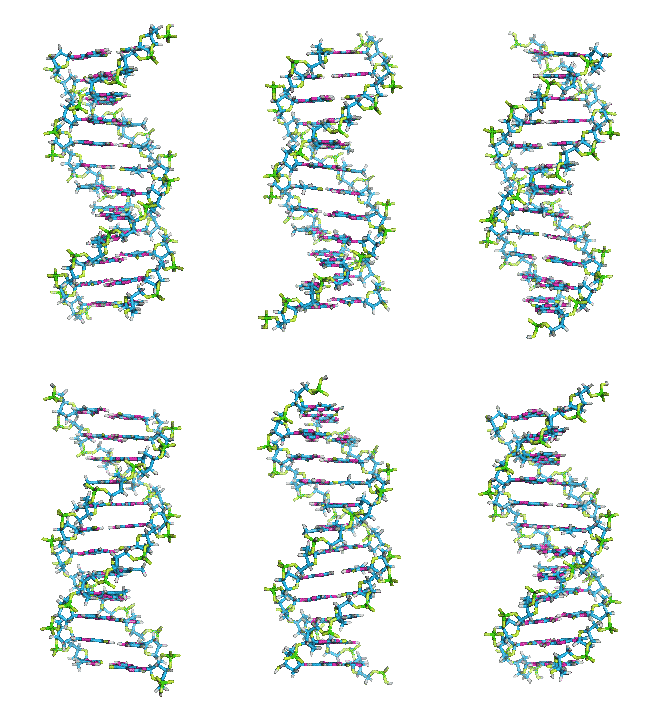
Which biomolecule is made of nucleotides and contain you DNA?
a)
Carbohydrate
b)
Lipids
c)
Protein
d)
Nucleic Acid
13.
Which biomolecule is made of nucleotides and include your DNA? (Hint: they carry genetic information)
a)
Carbohydrate
b)
Lipids
c)
Protein
d)
Nucleic Acid
14.
Which biomolecule is a main source of quick energy?
a)
Nucleic Acid
b)
Protein
c)
Lipid
d)
Carbohydrate
15.
What elements are common to all 4 biomolecules?
a)
Carbon, hydrogen, nitrogen
b)
Carbon, Nitrogen, Phosphorus
c)
Carbon, Hydrogen, Oxygen
d)
Carbon, Hydrogen, Phosphorus
16.
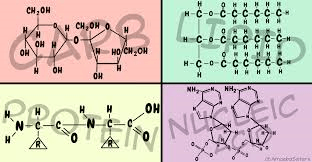
What are the four biological molecules?
a)
proteins, carbohydrates, lipids, nucleic acids
b)
A, T, C, G
c)
water, air, earth, and fire
d)
Joe, Nick, and Kevin Jonas
17.
Which biomolecule is made of amino acids?
a)
Nucleic Acid
b)
Carbohydrate
c)
Protein
d)
Lipid
18.

Which biomolecule makes up cell membranes?

a)

Protein

b)

Carbohydrate

c)

Lipid

d)

Nucleic acid

19.
Proteins are made of monomers called ___________
a)
Nucleotides
b)
Monosaccharides
c)
Amino Acids
d)
Glycerol and fatty acids
20.
The element _______is found in all of the organic compounds.
a)
Iron
b)
Nitrogen
c)
Carbon
d)
Oxygen
21.
DNA and RNA are examples of 
a)
Carbohydrates
b)
Lipids
c)
Proteins
d)
Nucleic Acids
22.
Nucleotides are monomers of
a)
Carbohydrates
b)
Lipids
c)
Proteins
d)
Nucleic Acids
23.
Monosaccharides are monomers of
a)
Carbohydrates
b)
Lipids
c)
Proteins
d)
Nucleic Acids
24.
Waxes, oils and fats are examples of
a)
Carbohydrates
b)
Lipids
c)
Proteins
d)
Nucleic Acids
25.
Glycerol and fatty acids are the monomers of
a)
Carbohydrates
b)
Lipids
c)
Proteins
d)
Nucleic Acids
26.
What is the function of nucleic acids?
a)
store genetic information
b)
store energy (long-term)
c)
store energy (short-term)
d)
build skin, hair, nails, muscles
27.
What type of macromolecule are enzymes?
a)
Protein
b)
Carbohydrate
c)
Lipid
d)
Nucleic Acid
28.
Which macromolecule stores energy, insulates us, and makes up the cell membrane?
a)
lipids
b)
proteins
c)
carbohydrates
d)
nucleic acids
29.
This is one job proteins do NOT have in the body
a)
insulation
b)
structure for tissues and organs
c)
speed up chemical reactions
d)
transport things through cell membrane