
 Worksheets
Ecology Assessment 1
Total questions: 30
Worksheet time: 15mins
A community of organisms and their environment is called a(n) ______________.
biosphere
population
neighborhood
ecosystem
A (n) __________ is made up of __________.
community, populations
population, ecosystems
ecosystem, biosheres
organism, populations
All _________ are a part of the _________.
ecosystems, biosphere
populations, world
communities, population
biospheres, universe
The environment includes _________ factors including water, rocks, and light.
abiotic
biotic
non-living
living
The environment also includes ________, or living, factors.
abiotic
biotic
biological
ecological
If there is more food than usual in an ecosystem, then the population will most likely __________.
Which of the following would cause a population to increase in size?
Emigration
Immigration
Population density can be best described as:
The amount of deaths that occur in a population.
The amount of births that occur in a population.
The amount of individuals in a given space.
The amount of available nutrients in an ecosystem.
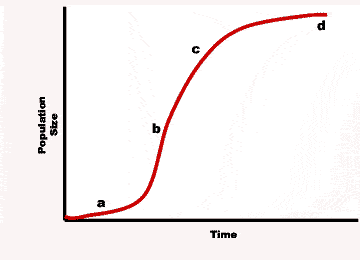
What point on the graph represents carrying capacity?
a
b
c
d
Nesting birds often space themselves evenly from other nests. This pattern is called __________.
The way in which individuals of a population are spread out is called __________.

Populations of different organisms living in an area.
An example of a population is __________.
all trees in a forest
all maple trees in a forest
all plants in a forest
all animals in a forest
Anything that regulates the size of a population of an organism is known as __________.
An environment that provides the things an organism needs to survive.
biotic factor
habitat
ecosystem
Determining the population of a species by observing and counting all of the organisms in the ecosystem.
mark and recapture
indirect observation
direct observation
sampling
In determining population this type of observation would have you counting nests or signs of an organism.
indirect
direct
sampling
mark and recapture
True or False: An organism is a single individual of a species.
True
False
True or False: In sampling a population, a scientist only counts some of the organisms and makes an estimate of the total amount of organisms.
True
False
The mark recapture method involves capturing a number of animals, marking them, releasing them back into the population, and then determining the population when marked and unmarked animals are captured at a later date.
True
False

