Font size
 Worksheets
Free fall motion
Total questions: 25
Worksheet time: 30mins

A baseball is thrown up into the air. What happens to the velocity as the ball rises in the air?
the velocity increases
the velocity decreases
the velocity remains constant

A baseball is thrown up into the air. What happens to the acceleration as the ball rises in the air?
the acceleration increases
the acceleration decreases
the acceleration remains constant

A baseball is thrown up into the air. What direction is the velocity of the ball the instant after it leaves the person's hand?
upward
downward
Any motion where gravity is the only force acting on an object is called ___________________.
kinematics
free fall
mechanics
velocity
The acceleration due to gravity near the surface of the Earth, if we ignore air resistance, is
9.8 m/s.
9.8 m.
9.8 m/s2.
9.8 s.
Heavier objects free fall faster than lighter objects in a vacuum found in outer space or on the moon.
True
False
The state that exists when the only force acting on an object is gravity is called
free fall
inertia
acceleration
momentum
Which of the following statements applies to the motion of a ball rising and then falling in free fall?
I. The ball has constant acceleration as it moves upward.
II. The ball has constant acceleration at the top of its path.
III. The ball has constant acceleration as it moves downward.
IV. The ball has a constant acceleration at all times when it is in the air.
I
II
III
IV
If a dropped object on Earth was equipped with a speedometer, its speed reading would increase each second by
about 5 m/s.
about 10 m/s.
about 15 m/s.
a rate that depends on its initial speed.
On Earth, the reason a feather falls slower than a bowling ball is due to
air resistance
the feather being lighter than the bowling ball
the feather having less mass

A baseball is thrown up into the air. What direction is the acceleration due to gravity on the ball the instant after it leaves the person's hand?
upward
downward
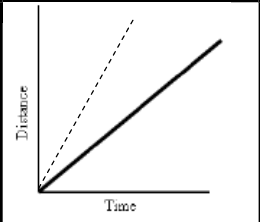
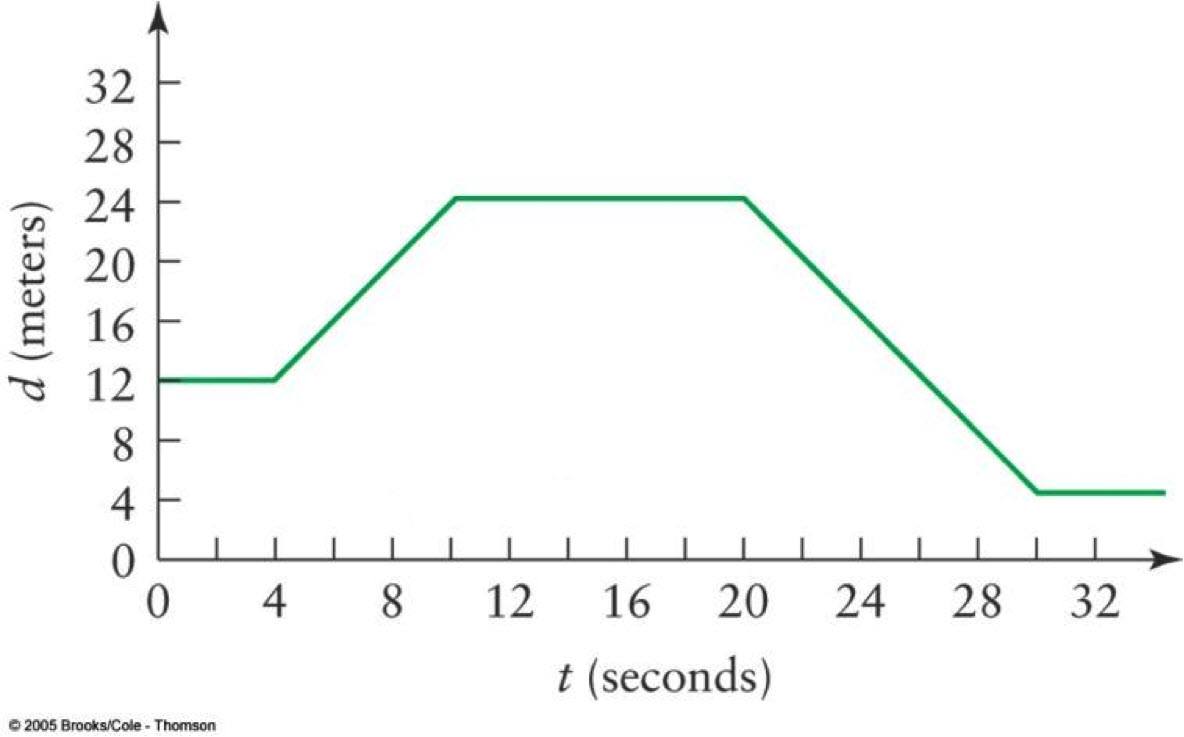
What kind of motion does this distance-time graph represent?
Constant Speed
Acceleration
Not moving
Do free falling objects move at constant velocity or do they accelerate?
Falling objects accelerate at 10 m/s2
Falling object move at constant velocity
Falling objects accelerate at 100 m/s2
It depends on the mass: heavy objects accelerate, light objects do not
A ball is thrown up in the air with an initial velocity of 40 m/s. What is the ball's velocity after 2 seconds?
0 m/s
20 m/s traveling upward
20 m/s traveling downward
40 m/s traveling downward
I. The ball has constant acceleration as it moves upward.
II. The ball has constant acceleration at the top of its path.
III. The ball has constant acceleration as it moves downward.
If an object is dropped from a cliff of 100m, what are your 'givens' you can start with?
SELECT ALL THAT APPLY
d = 100 m
vi = 0
t = 100 s
a = 9.8 m/s2
vf = 0
A pumpkin is thrown downward off a building on earth with an initial velocity of 8 m/s downward and falls for 4 seconds. What is the final velocity of the pumpkin?
47.2 m/s
31.2 m/s
-31.2 m/s
-47.2 m/s
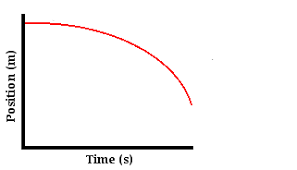
Which of the following graphs best represents free fall motion?