

wayground logo

Free Printable Worksheets

Font size

S
M
L
XL
Worksheets

Graded assignment- Physics

Total questions: 21

Worksheet time: 2hrs 33mins
Name
Class
Date
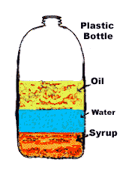
1.
Which liquid is the least dense?
a)
oil
b)
water
c)
syrup 
d)
plastic bottle
2.
What is the formula for density?
a)
density = mass x volume
b)
density = mass / volume
c)
density = mass + volume
d)
density = mass - volume
3.
Frank has a paper clip. It has a mass of 9g and a volume of 3cm3. What is its density?
a)
3 g/cm3
b)
1/3 g/cm3
c)
27 g/cm3
d)
39 g/cm3
4.
Why do some substances float on water?
a)
they are warmer than water
b)
they are cooler than water
c)
they are more dense than water
d)
they are less dense than water
5.
Bill jogs 400 meters to Andy's house, turns around, and runs 400 meters back home.  He does so in 267 seconds.  What is Bill's average speed?
a)
about 3 m/s
b)
about 1.5 m/s
c)
0
d)
about 4 m/s
6.
What is the formula to calculate speed?
a)
S = t/d
b)
S = d/t
c)
S = d x t
d)
S = t x d
7.

A runner races in the 600 meter run. It takes her 60 seconds to complete 4 laps. What is her average speed?

a)

40 m/s

b)

4000 m/s

c)

100 seconds

d)

10 seconds

8.
Why does a car accelerate as it round a corner at a constant speed?
a)
Its direction changes
b)
It doesn't
c)
It slows down
d)
Its speeds up  
9.

When are you undergoing an acceleration in a car? (Choose all that are correct)

a)

speed up

b)

slow down

c)

make turns

d)

constant speed

10.
What does this graph represent?
a)
Constant speed
b)
Acceleration
c)
Not moving
11.
During which interval is the object speeding up?
a)
A to B
b)
B to C
c)
D to E
d)
E to F
12.
What is happening at D?
a)
Stationary
b)
Accelerating
c)
Fast steady speed; moving away from the starting position
d)
Slower steady speed; moving away from the starting position
13.
Describe the speed of the object from
0-2 seconds using the distance vs. time graph.
a)
Constant speed
b)
Speeding up
c)
Slowing down
d)
Not moving
14.

calculate the displacement done in the first 2 seconds.

a)

20 m

b)

40 m

c)

10 m

d)

60 m

15.

using the same force on different objects with different masses, the object with less mass

a)

will accelerate quicker

b)

will accelerate slower

c)

will not move

d)

will accelerate at the same speed

16.
___________ is the amount of matter in an object.
a)
mass
b)
weight
c)
volume
d)
force
17.

What do we call a force that has a net force of zero Newtons and the object does not change its motion?

a)

balanced force

b)

unbalanced force

c)

acceleration force

d)

net force

18.

What do we call a force that causes an object to accelerate?

a)

net force

b)

moving force

c)

acceleration force

d)

unbalanced force

19.

What is the magnitude and direction of the force in the free body diagram shown?

a)

70 N right

b)

70 N left

c)

50 N right

d)

50 N left

20.

A car travels to Karnataka at the speed of 10 metres / second then what is the distance covered by the car in 45 minutes. (Hint- use the formula of the distance. )

a)

350m

b)

450m

c)

27000m

d)

34000

21.
The graph shows how the speed of an object changed over time. During which segments of this graph were the forces acting on the object balanced?
a)
R only
b)
Q and S
c)
R and T
d)
R, S and T
