
 Worksheets
Static Electricity
Total questions: 23
Worksheet time: 18mins
Ms Pippin rubbed two balloons with a piece of wool. What will happen when the balloons are brought near each other?
The balloons will repel each other.
The balloons will attract each other.
The balloons will become positively (+) charged.
The balloons will pop.
Attract is to pull something closer and repel is to push something away.
True
False

the positively charged particle in an atom, never leaves the nucleus, determines the element
proton
neutron
electron
An object that is neutral contains the same number of electrons and protons.
True
False
the negatively charged particle in an atom, moves freely, can be released, shared, or “stolen” from an atom
proton
neutron
electron

Will the balloons ATTRACT or REPEL each other?


Will the balloons ATTRACT or REPEL each other?


Static electricity can "jump" from the charged object to another object, causing . . .
static cling (objects sticking together)
electric discharge (and a shock!)

When negative charges on a cloud cause positive charges to build up on the ground, what may happen?


Where is the safest place to be during a lightning storm?
In a lake
Under a tree
An open field
Inside a building or a car
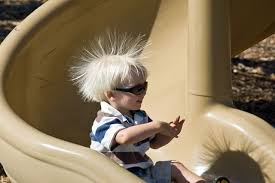

If an object has more negative charges than positive charges, its electrical charge is...
positive
negative
neutral or no charge
opposite


Two balloons are hanging from a stick.
One balloon has a positive charge and the other has a negative charge.
How would you expect the balloons to move?
there would be no movement
towards each other
away from each other

Why is the balloon attracted to the cat?
The balloon and the cat's hair have opposite electric charges
The cat sat in glue
The balloon is in love with the cat
The balloon and the cat's hair have the same electric charges
The buildup of electric charges is called . . .
static electricity
electric discharge
electric charge

What is the purpose of a lightning rod?
So birds won't sit on the roof
To look cool
To safely send electric charges from lightning into the ground

