
 Worksheets
Review: Unit 1( Atomic structure and Periodic trends)
Total questions: 35
Worksheet time: 1hrs 7mins
The chemist is required to find an element that has the same number of valence electrons as sulfur. Select
the element that the chemist chose and an explanation for that choice. Select all that apply.
It is in the same group as sulfur.
Magnesium
Oxygen
It is in the same period as sulfur.
The complete electron configuration for gallium, element 31, is
1s2 2s2 2p10 3s2 3p10 4s2 3d3
1s2 2s2 2p6 3s2 3p6 4s2 3d10 4p1
1s4 2s4 2p6 3s4 3p6 4s4 3d3
1s2 2s4 2p8 3s4 3p8 4s3
For the main group elements of the periodic table, which
property is the same for all elements within a group?
the reactivity of the elements
the atomic mass of the elements
the electronegativity of the elements
the valence electrons of the elements
Which statement describes the main characteristic used to
organize elements in the periodic table?
They are organized according to the number of
protons in each element.
They are organized according to the number of
electrons in each element.
They are organized according to the total number
of protons and neutrons in each element.
They are organized according to the total number
of electrons and protons in each element

The diagram shows how the sizes of atoms change across
a period.
What phenomenon is shown in the diagram?
The greater the number of electron shells, the larger
the atomic radius.
The greater the number of electron shells, the
smaller the atomic radius
The greater the number of electrons in the outer
electron shell, the larger the atomic radius.
The greater the number of electrons in the outer
electron shell, the smaller the atomic radius.

Which statement helps to explain the phenomenon shown in
the diagram?
The greater the number of valence electrons, the
more attraction they have with the atomic nucleus
The greater the number of valence electrons, the
less attraction they have with the atomic nucleus
The farther away the valence electrons are from the
nucleus, the weaker the attraction between the
valence electrons and the nucleus.
The farther away the valence electrons are from the
nucleus, the greater the attraction between the
valence electrons and the nucleus.

What does 'X' represent in the following symbol with atomic number 35 and average atomic mass 80?
Mercury
Bromine
Chlorine
Scandium
Calculate the average atomic mass of silver if silver has two naturally occurring isotopes with the following
masses and natural abundances:
Ag-107 106.90509 amu 51.84%
Ag-109 108.90476 amu 48.16%
107.87 amu
108.00 amu
108.32 amu
107.79 amu
Which scientist is credited with conducting the "Gold Foil Experiment" and discovering the nucleus of the
atom?
Thompson
Dalton
Rutherford
Chadwick
Read the following claim.
X-ray radiation emits more energy than
microwave radiation.
Which statement is true based on the information
?
The claim is not valid because x-ray radiation and
microwave radiation are both ionizing radiation
The claim is not valid because x-ray radiation and
microwave radiation are both non-ionizing radiation.
The claim is valid because x-ray radiation is
stronger and more frequent than microwave
radiation.
The claim is valid because microwave radiation is
stronger and more frequent than x-ray radiation.
Give the ground state electron configuration for Sr.
[Kr]5s2 4d2
[Kr]5s2 4d1 05p2
[Kr]5s2 5d1 05p2
[Kr]5s2
A cation of 2+ indicates that an atom has
lost two electrons
lost two protons
lost two neutrons
gained two electrons
Identify the description of an atom.
neutrons and electrons in the nucleus; protons in the orbitals
neutrons in the nucleus; protons and electrons in the orbitals
neutrons and protons in the nucleus; electrons in the orbitals
protons and electrons in the nucleus; neutrons in the orbitals

The model shows an oxygen atom, which consists of 8
protons, 8 neutrons, and 8 electrons.
Choose THREE statements that describe two electrons
being added to the oxygen atom.
The atom becomes more stable as all the electron
shells are filled
An oxygen ion (Oxide) is formed.
There is an increase in the atomic number.
There is a change in the chemical properties of the
oxygen atom.
To help finalize her decision, the scientist places the elements in order of greatest to least electronegativity.
She knows she needs an element with a strong electronegativity.
Which answer correctly lists the element with the smallest electronegativity first and the element with the
greatest electronegativity last?
oxygen → fluorine → calcium → magnesium → rubidium
fluorine → oxygen → magnesium → calcium → rubidium
rubidium → magnesium → calcium → fluorine → oxygen
rubidium → calcium → magnesium → oxygen → fluorine
What electromagnetic wave . has . the shortest wavelengths and the highest frequencies?
Gamma Rays
Ultraviolet Rays
Radio Waves
X Rays
What happens to wavelength as the frequency of a wave increases?
increase
stays the same
decreases
becomes faster
The human eye is only capable of seeing which electromagnetic wave?
Infrared Light
Ultraviolet Light
Visible Light
All of the above
Which is the electron configuration for an oxygen atom?
1s22s22p63s23p64s2
1s22s22p4
1s22s22p6
1s22s22p63s23p6

How many valence electrons are represented here?
7
5
2
8
What atom matches this electron configuration?
[Xe] 6s2 4f14 5d9
Mercury
Gold
Platinum
Thallium
As you move down a group, atomic radius increases because -
you add more and more neutrons
you add more and more protons
you add more and more shells (energy levels)
you add more atomic mass
As you move across the periodic table from left to right, the atomic radius decreases. This is because -
the number of protons increases, so attraction to electrons increases
the number of energy levels increases
the number of electrons increases
the atomic mass increases
Francium (Fr) has the lowest ionization energy in Group 1 because -
it has the smallest number of valence electrons
it has the greatest atomic mass
it has the greatest number of protons, so it attracts its electrons the strongest
its 1 valence electron is very far from the nucleus, so little energy is needed to remove it
Looking at atoms in the same group/family, what factor affects Coulombic attraction?
number of protons
distance from the nucleus
Looking at atoms in the same valence energy level, what factor affects Coulombic attraction?
number of protons
distance from the nucleus
As the Coulombic attraction of an atom increases, the electronegativity of the atom: increases or decreases?
increases
decreases
As the Coulombic attraction in an atom increases, the energy needed to remove an electron: increases or decreases?
increases
decreases
Beryllium (Be) has an atomic number of 4 & Magnesium (Mg) has an atomic number of 12. They behave the same in a chemical reaction.How should they be placed on the periodic table?
They should be placed in the same group with Mg on the top and Be below.
They should be placed in the same group with Be on the top and Mg below.
They should be placed in the same period with Mg on the top and Be below.
They should be placed in the same period with Be on the top and Mg below.

The diagram shows an atom of a neutral element from the periodic table. The atom in the diagram represents which element?
beryllium
magnesium
sodium
neon
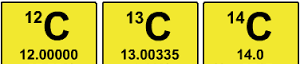
What do these isotopes of carbon all have in common?
neutrons & mass number
atomic number and neutrons
atomic number and electrons
protons, atomic number, and mass number

What isotope is shown here? (Red = protons, gray = neutrons, blue = electrons)
Beryllium-5
Beryllium-9
Boron-4
Boron-9

_______ are atoms with the same number of protons but varying numbers of neutrons.
ions
elements
allotropes
isotopes
Which element has the highest electronegativity on the periodic table?
Oxygen
Fluorine
Chlorine
Nitrogen
What is the primary reason for the increase in ionization energy across a period?
Increase in atomic radius
Increase in nuclear charge
Decrease in electron shielding
Decrease in atomic mass

