
NEW
Font size
S
M
L
XL
 Worksheets
Chapter 4 Review
Total questions: 32
Worksheet time: 25mins
Name
Class
Date
1.
He developed the planetary model of the atom.
a)
Rutherford
b)
Bohr
c)
Chadwick
d)
Dalton
2.
James Chadwick discovered the ________.
a)
proton
b)
neutron
c)
electron
d)
nucleus
3.
What did Thomson discover?
a)
electron
b)
proton
c)
neutron
d)
electron cloud
4.
A tiny but very dense, positively charged portion of the atom that holds most of the atomic mass
a)
Electron Shells
b)
Orbitals
c)
Electron Cloud
d)
Nucleus
5.
He claimed that matter was made of small, hard particles that he called “atomos.”
a)
Democritis
b)
Dalton
c)
Moseley
d)
Einstein
6.
The scientist responsible for "discovering" the nucleus is:
a)
Bohr
b)
Rutherford
c)
Schroedinger
d)
Einstein
7.
Which subatomic particle has a positive charge?
a)
proton
b)
neutron
c)
electron
d)
midichlorian
8.
Which subatomic particle has a negative charge?
a)
proton
b)
neutron
c)
electron
d)
cybertron
9.
How many electrons does a Copper atom have?
a)
63
b)
29
c)
92
d)
34
10.
What is the atomic number for an element with 41 neutrons and a mass number of 80?
a)
39
b)
41
c)
80
d)
121
11.
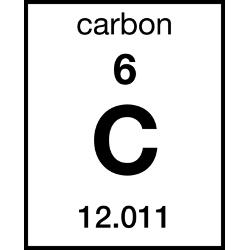
What does the 6 represent above the C
a)
Symbol
b)
Name
c)
Mass Number
d)
Atomic Number
12.
An element is defined by its number of ...
a)
protons
b)
electrons
c)
neutrons
d)
protons + electrons
13.

How many protons are in Cadmium?
a)
112.411
b)
170
c)
64
d)
48
14.
Which element has 6 protons?
a)
N
b)
C
c)
O
d)
B
15.
Calculate the atomic number of an atom with :
2 protons
3 neutrons
4 electrons
2 protons
3 neutrons
4 electrons
a)
2
b)
3
c)
4
d)
5
16.
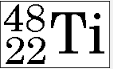
How many protons does this isotope of titanium have?
a)
48
b)
22
c)
26
d)
70
17.

How many neutrons does the isotope of lithium have?
a)
8
b)
3
c)
4
d)
5
18.

In a correctly written symbol what would be located in the "A" position?
a)
number of neutrons
b)
atomic number
c)
number of electrons
d)
mass number
19.
How many neutrons does the isotope below have? 89 36Kr
a)
53
b)
36
c)
89
d)
125
20.

What is the mass number of the element shown?
a)
15
b)
7
c)
8
d)
0
21.
24.1% of all the isotopes of a an element have a mass of 75.23 amu, 48.7% have a mass of 74.61 amu, and 27.2% have a mass of 75.20 amu.
What is the average mass of this element?
What is the average mass of this element?
a)
74.92 amu
b)
24.97 amu
c)
75.01 amu
d)
74.51 amu
22.
An element has three different isotopes. One has a mass of 35.00 amu; another has a mass of 36.00 amu; and another has a mass of 38.00 amu. What is the average atomic mass of this element?
a)
36.33 amu
b)
37.00 amu
c)
12.11 amu
d)
impossible to tell
23.
An isotope has three forms. 30% have a mass of 4 amu, 20% have a mass of 5 amu and 50% have a mass of 3 amu. Average atomic mass will be closest to
a)
2 amu
b)
3 amu
c)
4 amu
d)
5 amu
24.
If X is the symbol for an element, which of the following two symbols represent isotopes of the same element?
I. 7735X II. 7733X III. 8137X IV. 8135 X
I. 7735X II. 7733X III. 8137X IV. 8135 X
a)
I and II
b)
III and IV
c)
I and IV
d)
I and III
25.
Calcium has three different isotopes. One has a mass of 35.00 amu; another has a mass of 41.00 amu; and another has a mass of 40.00 amu. Which isotope is the most abundant of the three?
a)
40.00 amu
b)
41.00 amu
c)
35.00 amu
d)
impossible to tell
26.
A neutral atom of the isotope 2612Mg would consist of
a)
12 protons, 26 neutrons, 26 electrons
b)
26 protons, 12 neutrons, 26 electrons
c)
26 protons, 14 neutrons, 14 electrons
d)
12 protons, 14 neutrons, 12 electrons
27.

How many neutrons does a Sulfur-32 isotope have?
a)
15
b)
16
c)
32
d)
12
28.
How is the alpha particle written in a nuclear equation?
a)
42He
b)
24He
c)
0-1e
d)
00γ
29.
Solve this equation for alpha decay.
85209At = ___ + 24He
85209At = ___ + 24He
a)
83205Bi
b)
86209Rn
c)
81207Tl
d)
85208At
30.
Solve this equation for beta decay.
614C = ___ + -10e
614C = ___ + -10e
a)
410Be
b)
714N
c)
210He
d)
613C
31.

What particle completes this reaction?
a)
alpha particle
b)
beta particle
c)
gamma particle
d)
neutron
32.
Which of these particles would be an ion?
a)
6 protons, 6 neutrons, 6 electrons
b)
5 protons, 4 neutrons, 5 electrons
c)
5 protons, 5 neutrons, 4 electrons
d)
4 protons, 5 neutrons, 4 electrons
Reset

