wayground logo

Free Printable Worksheets

NEW

Font size

S
M
L
XL
Worksheets

Cell transport

Total questions: 26

Worksheet time: 52mins

Name
Class
Date
1.
All living things want to remain in...
a)
chaos
b)
homeostasis
c)
limbo
d)
plasmolysis
2.
Humans shiver when they are cold to maintain
a)
cytolysis
b)
turgor pressure
c)
limbo
d)
homeostasis
3.
Why will a plant die if you water it with a salt water?
a)
hypotonic solution
b)
hypertonic solution
c)
isotonic solution
d)
silly solution
4.
If the sodium concentration inside a cell is greater than outside the cell, how can a cell take in more sodium?
a)
osmosis
b)
diffusion
c)
active transport
d)
passive transport
5.
Which is an example of how humans maintain homeostasis in bad environmental conditions?
a)
sweating in the heat
b)
shivering in the heat
c)
digesting amino acids
d)
regulating glucose levels
6.
Which process involves the movement of molecules from high concentration to low concentration?
a)
Endocytosis
b)
Active transport
c)
osmosis
d)
phagocytosis
7.
Two different solutions are separated by a membrane permeable only to water. How will molecules move?
a)
solutes will move by dissolving
b)
water will move by active transport
c)
solutes will move by osmosis
d)
water will move by osmosis
8.
Your gums are swollen. How will rinsing with warm salt water help the swelling?
a)
swollen gums will absorb the salt
b)
salt lowers the temp
c)
salt goes against the concentration gradient
d)
water in the gums has diffused out of the cells
9.
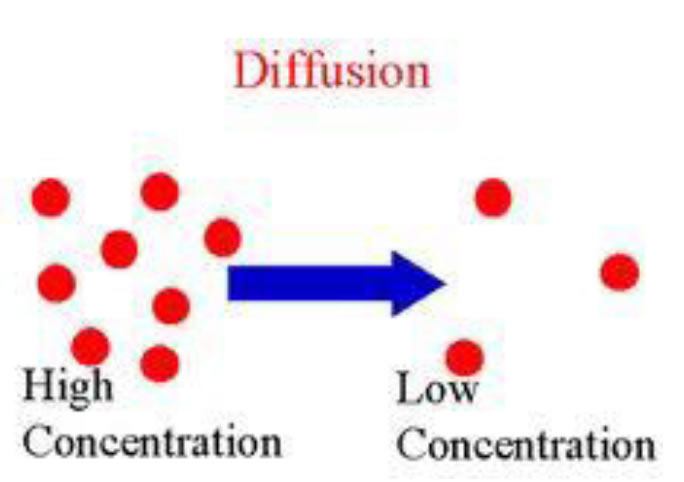
Movement of particles from high to low concentration. 
a)
Passive Transport
b)
Active Transport
10.
Osmosis is a form of ______________. 
a)
Passive Transport
b)
Active Transport
11.
What is it called when molecules move across the cell membrane from an area of high concentration to an area of low concentration through a carrier protein?
a)
Diffusion
b)
Osmosis
c)
Active Transport
d)
Facilitated Diffusion
12.
This picture represents what type of cell transport?
a)
endocytosis
b)
exocytosis
c)
osmosis
d)
passive transport
13.
Which is true about active transport?
a)
It requires energy
b)
it does not require energy
c)
It moves substances down the concentration gradient
d)
it moves material from high to low concentration
14.
A cell in an isotonic solution will
a)
swell
b)
shrink
c)
stay the same size
d)
impossible to tell
15.
A cell will __________________ in a hypotonic solution.
a)
swell and perhaps burst (lyse)
b)
shrink
c)
the size of the cell will not change
d)
the size of the cell will change from large to small and from small to large
16.
When the concentration of particles inside of a cell is the same as the concentration of particles outside of the cell. 
a)
active transport
b)
concentration
c)
diffusion
d)
equilibrium
17.
Particles are removed from a cell (pushed out).
a)
Endocytosis
b)
Exocytosis
c)
Permeable
d)
In high concentration
18.

Which describes a hypotonic environment?

a)

Too much water in the cell will cause the cell to burst - the percentage of water is higher outside the cell than inside the cell

b)

Too little water in the cell will cause the cell to shrink - the percentage of water is lower outside the cell than inside the cell

c)

Concentrations of water are equal inside and outside the cell

19.

Which describes a hypertonic environment?

a)

Too much water in the cell will cause the cell to burst - the percentage of water is higher outside the cell than inside the cell

b)

Too little water in the cell will cause the cell to shrink - the percentage of water is lower outside the cell than inside the cell

c)

Concentrations of water are equal inside and outside the cell

20.

Which describes an isotonic environment?

a)

Too much water in the cell will cause the cell to burst - the percentage of water is higher outside the cell than inside the cell

b)

Too little water in the cell will cause the cell to shrink - the percentage of water is lower outside the cell than inside the cell

c)

Concentrations of water are equal inside and outside the cell

21.

The movement of particles from an area of high concentration to an area of low concentration

a)

active transport

b)

osmosis

c)

diffusion

d)

random movement

22.

If a cell is placed in an environment with MORE oxygen OUTSIDE the cell than inside, the cell will...

a)

gain oxygen

b)

lose oxygen

c)

gain water

d)

lose water

23.

The movement of materials from an area of low concentration to an area of high concentration would require...

a)

glucose

b)

energy (ATP)

c)

fish

d)

chips

24.
The cell membrane of the red blood cell will allow water, oxygen, and carbon dioxide to pass through. Because other substances are blocked from entering, this membrane is called
a)
perforated
b)
semi-permeable
c)
non-conducive
d)
permeable
25.
Look at the cross section of a cell membrane of a eukaryotic cell. H+ ions are being pumped from a low concentration to a high concentration. How do you describe this type of transport across the cell membrane?
a)
active transport
b)
passive transport
c)
facilitated diffusion
d)
co-transport
26.
The diagram below represents a cell and some molecules in its environment. Which molecule would require the use of energy in order to be brought into the cell?
a)
1
b)
2
c)
3
d)
4