
 Worksheets
Chemistry Unit 1. Structure of Matter
Total questions: 171
Worksheet time: 2hrs 38mins
Which statement describes an example of a chemical property of a metal statue?
It is a solid.
It is shiny.
It is silver.
It can tarnish.
Which of these is an example of a physical property?
the fact that iron rusts
the texture of a piece of chocolate
the effect of acid rain on automobiles
the fact that gasoline in a car engine combusts
Which of these is a chemical property of a sheet of paper?
The paper can be burned.
The paper can be crumpled.
The paper does not attract a magnet.
The paper does not conduct electricity.
Hydrogen gas (H2) can be found in trace amounts in Earth’s atmosphere. Which of these statements describes a physical property of hydrogen?
Hydrogen is found in acids.
Hydrogen gas is highly flammable.
Hydrogen reacts with oxygen to form water.
Hydrogen gas is less dense than oxygen gas.
Which properties describe all matter?
being able to be seen in nature
having energy and temperature
being able to be easily measured
having mass and taking up space
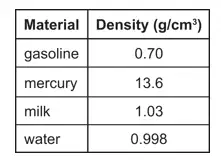
The table lists the densities of some common materials at 20 degrees C. If a scientist has 10 grams of each material, which material has the greatest volume?
milk
water
mercury
gasoline
Which statement best describes physical properties?
Physical properties behave identically for all matter under the same conditions.
Physical properties can be observed without changing the identity of a substance.
Physical properties are observed by seeing how a substance reacts with other substances.
Physical properties cause atoms and molecules to change structure when substances are mixed.
What is the correct formula used to find the volume of a rectangular prism?
V = l x w x h
V = l x w / h
V = l / w x h
V = l / w / h
What is the correct formula to find the volume of an irregularly shaped object?
initial volume - volume of water with object
volume of water with object - initial volume
Which of the following are examples of matter?
desk
pebble on a beach
rainbow
milk in a carton
Which of the following are things that are not examples of matter?
light from the sun
sound of thunder
air
fire
Objects that have _____ matter have a greater mass.
more
less
What are units of measure for mass?
gram
milligrams
kilograms
newtons
What are units of measure for weight?
newtons
pounds
kilograms
g/mL
What is anything that has mass and takes up space?
matter
volume
density
weight
What is a measure of the gravitational force on an object?
matter
mass
volume
weight
What is a measure of the amount of matter in an object?
mass
weight
volume
density
What is a measure of the amount of space an object takes up?
volume
matter
mass
weight
What are units of measure for volume of 3D objects?
cubic centimeters
cubic meters
milliliters
liters
What are units of measure for volume of liquids?
cubic centimeters
cubic meters
milliliters
liters
What tools can be used to measure liquid volume?
graduated cylinders
beakers
meter sticks
rulers
What is the ratio of the mass of a substance to its volume?
matter
weight
density
mass
The ____ mass in a given volume, the greater the density of the object.
less
more
What is the unit of measurement for density of liquids?
g/mL
g/cm^3
kg/m^3
What is the unit of measurement for density of solids?
g/mL
g/cm^3
kg/m^3
What are properties that can be observed without changing the identity of the substance?
physical properties
chemical properties
What is a substance's ability to change into a new substance with different properties?
physical properties
chemical properties
Which of the following are physical properties?
shape
color
size
mass
Which of the following are physical properties?
volume
density
state
texture
reactivity
Which of the following are physical properties?
melting point
thermal conductivity
megnetic attraction
reactivity
Which of the following are chemical properties?
flammability
reactivity
mass
size
Which of these is the smallest particle to retain the properties of an element?
an atom
a proton
a molecule
an electron
What makes physical properties different from chemical properties?
Physical properties relate to elements rather than compounds.
Physical properties appear only after a chemical change occurs.
Physical properties describe elements in the solid state rather than in the liquid or gas state.
Physical properties can be observed without attempting to change the identity of the substance.
A water molecule is made up of one oxygen and two hydrogen atoms. Why is water considered a pure substance?
Each water molecule is identical.
Water can be broken down by physical means.
Water molecules are made up of different types of atoms.
Water can be combined with other substances by physical means.
Each element has a unique name. How else can an element be represented?
by its mass
by its state of matter
by its chemical symbol
by an identification number
Which of these substances is likely to be formed of particles with a repeating crystalline structure?
salt
glass
honey
nitrogen
Which statement describes a chemical property of an object?
The object is white in color.
The object has a powdery texture.
The object’s density is 2.11 g/cm3.
The object reacts with acid to form water.
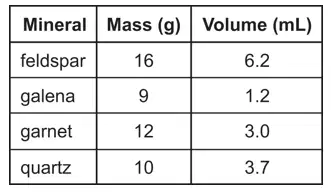
The table lists the masses and volumes of four mineral samples. Which mineral has the greatest density?
feldspar
galena
garnet
quartz
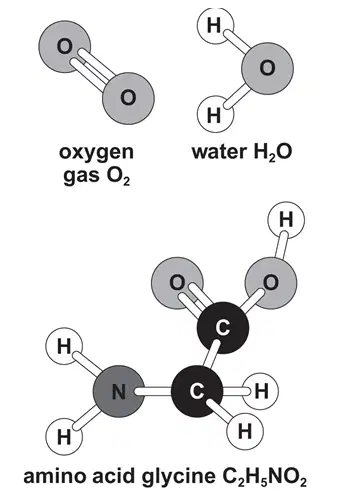
Models of different combinations of elements are shown. Which image is a molecule?
Only the second image, water, is a molecule.
Only the first image, oxygen gas, is a molecule.
Only the third image, amino acid glycine, is a molecule.
All three images, oxygen, water, and amino acid glycine, are molecules.
Which statement describes a chemical property?
A particular substance evaporates at 30 °C.
A 2 ft. long metal bar has a mass of only 176 g.
A certain heavy metal turns to a liquid at room temperature.
A metal is added to a beaker of water, and the beaker explodes.
All of these statements about elements, atoms, and compounds are true except _____.
compounds are smaller than atoms
atoms cannot be broken down into smaller substances
elements and compounds form the basis of all materials on Earth
elements consist of one type of atom and can combine to form compounds
Which of the following describes objects that are formed of molecules very close together with little room to move or are made up of molecules with repeating crystalline patterns?
colloid
gas
liquid
solid
Which of these is a way in which elements and compounds are similar?
Elements and compounds are both pure substances.
Elements and compounds are both listed on the periodic table.
Elements and compounds are both made up of different kinds of atoms.
Elements and compounds can both be broken down by physical changes.
Which type of substance is always made up of two or more different types of atoms joined by chemical bonds?
mixture
element
compound
pure substance
The two beakers shown contain pure water. Which of these is a chemical property of the water in both beakers?
The water is colorless.
The water freezes at 0 °C.
The water reacts with some metals.
The water has a total volume of about 400 mL.
Diamond is a covalently bonded network solid that is made up of carbon atoms arranged in a way that gives diamonds their hardness. Which of these characteristics do diamonds share with all network solids?
low melting point
rarity and high cost
orderly crystal structure
made up of carbon atoms
How are elements organized in the periodic table?
by density and date of discovery
by atomic number and properties
by atomic mass and melting point
by abundance in nature and usefulness to humans
Which of these is smallest?
cells
atoms
matter
elements
How do atoms of copper differ from atoms of aluminum?
They are not pure substances.
They have different chemical properties.
They can be formed by physical changes.
They are made up of more than one type of particle.
Which substance is one that cannot be separated or broken down into simpler substances by chemical means?
table salt
gold wire
candle wax
water vapor
Think about a wooden chair and a balloon. What do these two objects always have in common?
Both are made of atoms.
Both have the same physical properties.
Both are made of the same kind of atom.
Both are made of the same number of atoms.
Which statement correctly describes atoms?
Atoms combine to make all the substances on Earth.
Atoms of all substances have the same chemical properties.
Atoms are easily destroyed when matter is cooled or heated.
Atoms come in different sizes, but most are visible using a simple hand lens.
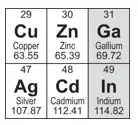
Here is a portion of the periodic table. Which two elements are most likely to have similar physical properties?
copper and zinc
copper and silver
cadmium and indium
gallium and cadmium
Which statement correctly describes atoms?
Atoms combine to make all the substances on Earth.
Atoms of all substances have the same chemical properties.
Atoms are easily destroyed when matter is cooled or heated.
Atoms come in different sizes, but most are visible using a simple hand lens.
Which subatomic particle identifies an element?
protons
neutrons
electrons
atoms
Atoms consist of three subatomic particles. _______ are positively charged, _________ are negatively charged, and _________ are neutral.
protons, electrons, and neutrons
neutrons, protons, and electrons
neutrons, electrons, and protons
electrons, neutrons, and protons
How is the periodic table arranged?
increasing atomic number from left to right
increasing atomic number from right to left.
columns include elements with similar physical and chemical properties
rows include elements with similar physical and chemical properties
Columns of the periodic table are called ______.
periods
groups
Rows of the periodic table are called ______.
periods
groups
Reactivity in the periodic table _____ from left to right.
increases
decreases
What information is included in each box of the periodic table?
atomic number of the element
atomic mass of the element
the element's name
the element's symbol
Each element has a unique set of physical and chemical properties.
true
false
What elements are in the first column on the periodic table?
very reactive metal elements
nonreactive elements that are all gases at room temperature
What elements are in the last column on the periodic table?
very reactive metal elements
nonreactive elements that are all gases at room temperature
What is the atomic number of an element based on?
the elements color
the name of the element
the elements mass
the structure of the atom
Early periodic tables organized elements based on their atom masses and their properties. Why might this not be the best way to organize a periodic table? Select all that apply.
Two elements might have similar atomic numbers.
Some elements are not very reactive.
Using different properties could lead to a different grouping.
Some elements do not have any properties.
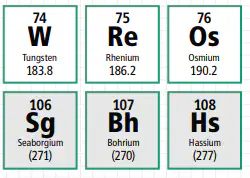
Which pair of elements is most likely to have similar properties?
tungsten and osmium
osmium and hassium
seaborgium and rhenium
bohrium and tungsten
Which properties do atoms of the same element share? Select all that apply.
atomic number
chemical reactivity
melting point
Chemists use the periodic table to organize the elements. What are some ways in which this organization is useful? Select all that apply.
It groups elements that have similar properties.
It identifies which elements are most common and which are rare.
It allows scientists to predict how a particular element will interact with others.
It arranges elements in order of usefulness for human activities.
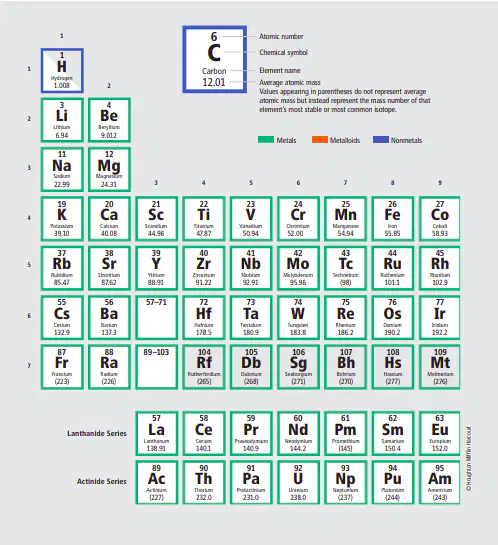
What is the second lightest element in group 2?
beryllium
magnesium
calcium
barium
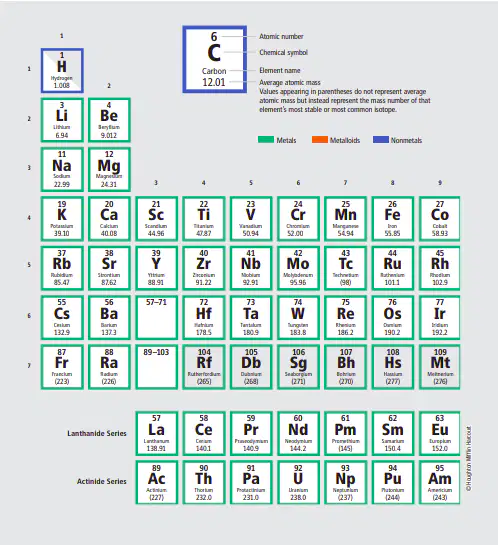
What is the symbol for the element with atomic number 92?
U
Ba
uranium
92
Imagine that you have a sample of a substance. You cannot physically separate that substance into components. You also cannot separate that substance into components. Which of the following are true about your sample? Choose all that apply.
The sample is made up of one type of atom.
The sample is made up of multiple elements.
The sample is made up of a single element.
The sample is made up of several types of atoms.
Where are the nonmetals located on the periodic table?
top left corner
bottom left corner
top right corner
bottom right corner
How many electrons can "live" on the first electron shell?
2
8
16
infinite
How many electrons can "live" on the 2nd electron shell?
2
8
16
infinite
How many protons are in Beryllium?
4
9
5
2
Which of the following best describes the three general groups of elements?
solids, liquids, gas
metals, nonmetals, gases
metals, nonmetals, metalloids
metals, metalloids, synthetics
An atom of zinc has 33 protons and 33 electrons. What is its atomic charge?
+33
-33
+66
0-Neutral
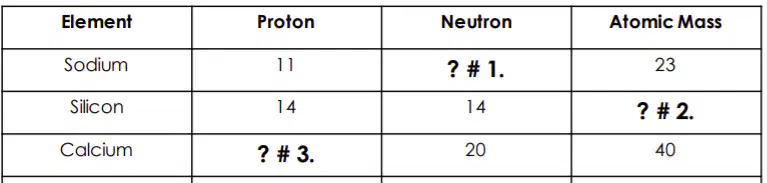
How many neutrons are present in Sodium?
12
34
14
10
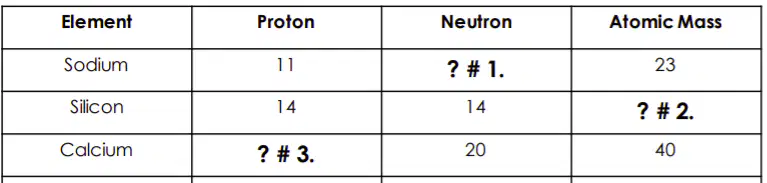
How many protons are present in Calcium?
60
20
80
17
Which of the following would be considered matter? Choose all that apply.
light from the sun
milk in a carton
heat from a candle
sound of booming thunder
pebble on a beach
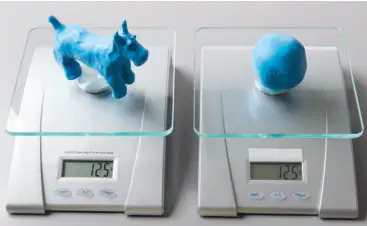
Two pieces of clay have been molded into two different shapes. The mass of clay can be measured using a scale, such as those shown here. What do the readings on the digital scales indicate about the two pieces of clay?
The two pieces of clay have the same mass.
The two pieces of clay do not have the same mass.
The two pieces of clay have the same amount of matter.
The two pieces of clay do not have the same amount of matter.
Which of the following statements is correct? Choose all that apply.
Acceleration due to gravity on the moon is greater than acceleration due to gravity on Earth.
The mass of an object on the moon is the same as it is on Earth.
The weight of an object on the moon is less than the weight of the same object on Earth.
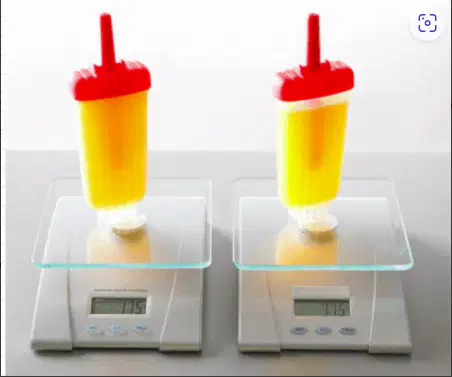
In the photo, the juice is shown in its solid state and in its liquid state. What appears to have changed about the juice when it changes state? Choose all that apply.
The volume of liquid changed.
The density of the volume changed.
The mass of the liquid changed.
Which of the following are requirements for something to be a physical property? Choose all that apply.
The property can be observed without changing the identity of the substance.
The property depends on the amount of the substance present.
The state of the substance changes when you measure the property.
The property can be observed or measured.
Which of the following properties are physical properties? Choose all that apply.
density
flammability
state at room temperature
melting point
reactivity with oxygen
Which of the following are chemical properties?
density
flammability
melting point
reactivity with oxygen
state at room temperature
Thermal conductivity is a property that describes how quickly a substance warms or cools. What type of property is thermal conductivity?
physical property
chemical property
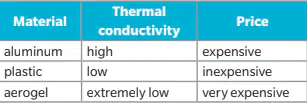
The walls of your refrigerator must keep as much heat as possible from getting inside the refrigerator. The refrigerator will use a lot of this material, so the cost must be low. Which material would you use to make the refrigerator's inner walls? Why?
aluminum
plastic
aerogel
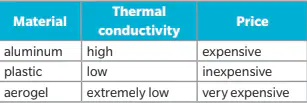
The refrigerator needs a thermometer to respond quickly to temperature changes and keep the food inside cold. The thermometer is small, so it can be made out of pricier materials. Which material would you use to make the thermometer?
aluminum
plastic
aerogel
Even though an iceberg and the water that surrounds it are made up of the same substance, the iceberg is able to float. Why is this?
The volume of the iceberg equals the volume of an equal mass of water.
The mass of the iceberg is greater than the mass of an equal volume of water.
The volume of the iceberg is greater than the volume of an equal mass of water.
A submarine is able to raise and lower itself underwater. A rock sinks when it is dropped in a pool because it is denser than water. A piece of wood floats in the pool because it is less dense than water. What could the submarine change in order to sink or float? Choose all that apply.
the submarine's volume
the submarine's mass
the state of the surrounding water
the mass of the surrounding water
A submarine fills a special storage area known as a ballast with water in order to increase its density. This allows it to dive deeper in the ocean. When a submarine needs to rise rapidly, compressed air is used to push the water out of the ballast. What effect does replacing the water in the ballast with air have on the submarine?
The submarine's volume increases, lowering its density.
The submarine's mass decreases, lowering its density.
The submarine's mass increases, raising its density.
The submarine's volume decreases, decreasing its density.
Chemists use the periodic table to organize the elements. What are some ways in which this organization is useful? Select all that apply.
It groups elements that have similar properties.
It identifies which elements are most common and which are rare.
It allows scientists to predict how a particular element will interact with others.
It arranges elements in order of usefulness for human activities.
A thermoacoustic generator transforms thermal energy into electrical energy. Thermal energy is transferred to a gas by a heat exchanger. The thermal energy causes the gas particles to vibrate rapidly and generate a sound wave. These vibrating gas particles are then used by an alternator to generate electrical energy. The gas used in this kind of generator must be nonreactive to avoid the danger of fire. Using heavier gases increases the amount of electrical energy generated. Which two elements on the table are most likely to be good choices for use as a gas in a thermoacoustic generator?
bromine
krypton
iodine
xenon
astatine
Early periodic tables organized elements based on their atom masses and their properties. Why might this not be the best way to organize a periodic table? Select all that apply.
Two elements might have similar atomic numbers.
Some elements are not very reactive.
Using different properties could lead to a different grouping.
Some elements do not have any properties.
Which properties do atoms of the same element share? Select all that apply.
atomic number
chemical reactivity
melting point
The three elements in the photos all belong to the same group, or column, of the periodic table. These elements all produce salts when they react with metals. What are some differences between these elements?
their colors
their atomic mass
the state of matter of each element
Imagine that you have a sample of a substance. You cannot physically separate that substance into components. You also cannot chemically separate that substance into components. Which of the following are true about your sample? Choose all that apply.
The sample is made up of one type of atom.
The sample is made up of multiple elements.
The sample is made up of a single element.
The sample is made up of several types of atoms.
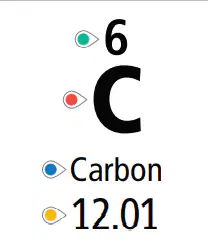
What is the atomic number of Carbon?
6
12.01
Chemists use the periodic table to organize the elements. What are some ways in which this organization is useful? Select all that apply.
It groups elements that have similar properties.
It identifies which elements are most common and which are rare.
It allows scientists to predict how a particular element will interact with others.
It arranges elements in order of usefulness for human activities.
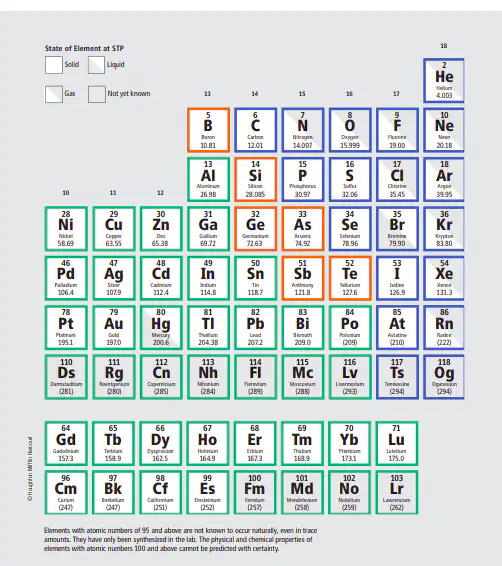
What is the lightest element in group 17?
fluorine
chlorine
bromine
iodine
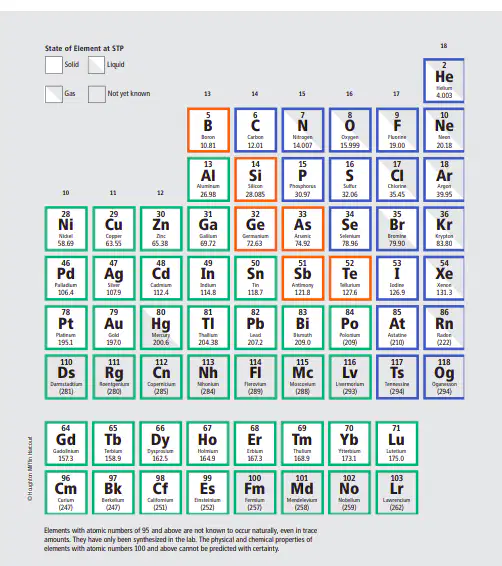
Which element has atomic number 6?
lithium
carbon
neon
nitrogen
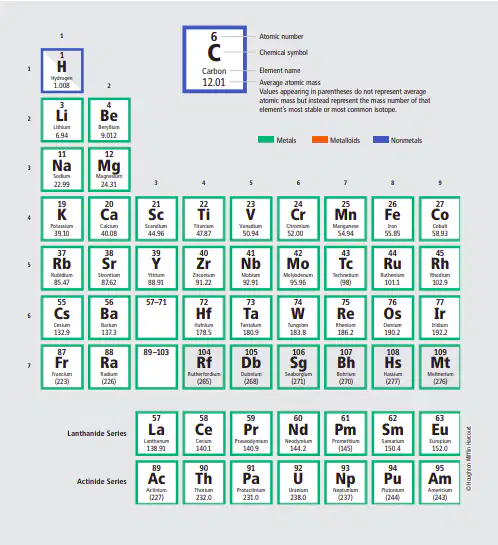
What is the second lightest element in group 2?
beryllium
magnesium
calcium
barium
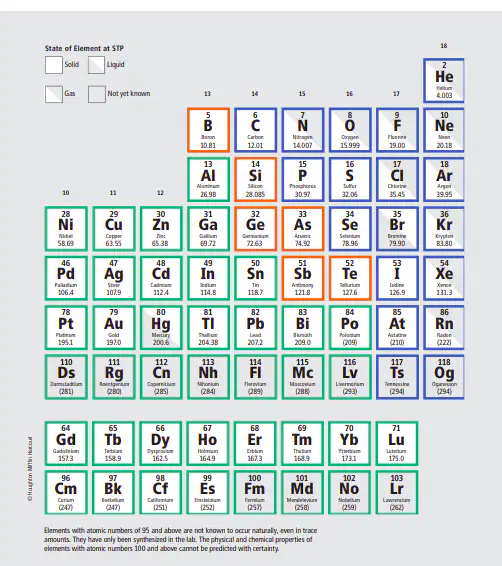
What property do all the elements in group 18 have in common?
They are all metalloids.
They are all metals.
They are all gases at stp.
They are all solids at stp.
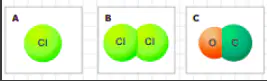
Which of these molecules show atoms that have joined together?
A
B
C
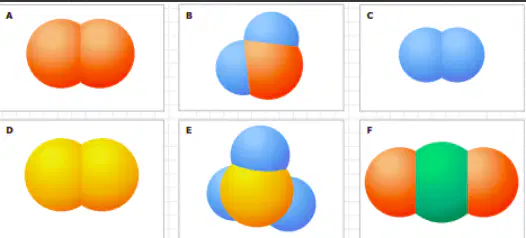
Which molecules are also compounds?
F
B
C
D
E
Which statements are true about molecules and compounds? Circle all that apply.
Molecules are made of one atom and compounds are made of two or more atoms.
Both molecules and compounds are pure substances.
The particles that make up compounds are molecules.
Hydrogen chloride is both a molecule and a compound

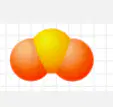
For every molecule of sulfur dioxide, the ratio of sulfur atoms to oxygen atoms is ____. (sulfur=yellow, oxygen=red, nitrogen=orange)
1:2
2:1
3:0
0:3
In a molecule of nitrogen dioxide, the ratio of nitrogen atoms to oxygen atoms is ____. (sulfur=yellow, oxygen=red, nitrogen=orange)
1:2
2:1
3:1
1:3
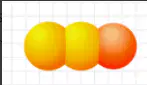
For every molecule of nitrous oxide, the ratio of nitrogen atoms to oxygen atoms is ____. (sulfur=yellow, oxygen=red, nitrogen=orange)
1:3
3:1
1:2
2:1
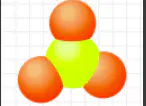
In a molecule of sulfur trioxide, the ratio of sulfur atoms to oxygen atoms is _____. (sulfur=yellow, oxygen=red, nitrogen=orange)
1:3
3:1
1:2
2:1
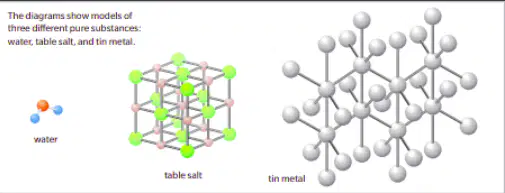
Water, table salt, and tin metal are all pure substances. Which of these pure substances are compounds?
water
table salt
tin metal
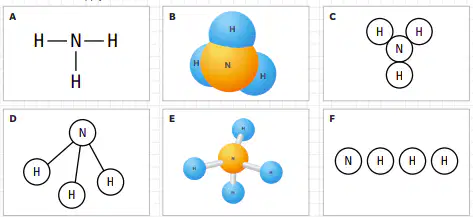
Molecules are atoms held together by attractive forces. Which could be a way to model a simple molecule of three hydrogen atoms joined to a nitrogen atom?
A
B
C
D
E
What might explain the differences in properties of the two pure substances: ice and copper metal? Choose all that apply.
The substances differ in the types of atoms they contain and how they are connected.
The chemical bonds that hold the atoms together may be stronger in one substance that the other.
There's a difference in the structure of the two substances.
Copper metal is stronger than all other substance, including ice.
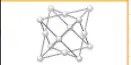
Which statement matches the model below?
Table sugar is a molecule made up of carbon, hydrogen, and oxygen atoms arranged as two rings joined together.
Silver metal is an extended structure made up of atoms of silver arranged in a regular pattern.
Table salt is an extended structure made up of sodium and chlorine atoms arranged in a repeating pattern.salt
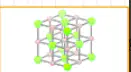
Which statement matches the model below?
Table sugar is a molecule made up of carbon, hydrogen, and oxygen atoms arranged as two rings joined together.
Silver metal is an extended structure made up of atoms of silver arranged in a regular pattern.
Table salt is an extended structure made up of sodium and chlorine atoms arranged in a repeating pattern.
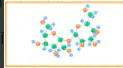
Which statement matches the model below?
Table sugar is a molecule made up of carbon, hydrogen, and oxygen atoms arranged as two rings joined together.
Silver metal is an extended structure made up of atoms of silver arranged in a regular pattern.
Table salt is an extended structure made up of sodium and chlorine atoms arranged in a repeating pattern.
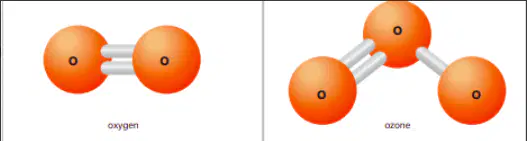
Which of the following might explain differences in properties between oxygen and ozone when both substances are made of the same type of atoms?
Oxygen and ozone are both made up of only oxygen atoms, but they are two different substances and have different properties.
A molecule of oxygen gas contains two oxygen atoms, while a molecule of ozone gas contains three oxygen atoms.
The atoms are connected and arranged in different ways in each substance.
Diamond and graphite are both made of carbon atoms. However, they have different properties because their atoms are arranged in different ways. Diamonds are very hard. Cut and polished diamonds bounce light in different directions. Graphite is a dark, dull gray and easily rubs off onto paper. What could explain the differences in diamond and graphite?
Both substances are made of the same atoms, but the atoms form different structures.
The substances are made of different atoms and the atoms are arranged differently in each substance.
The atoms have different types of bonds holding them together.
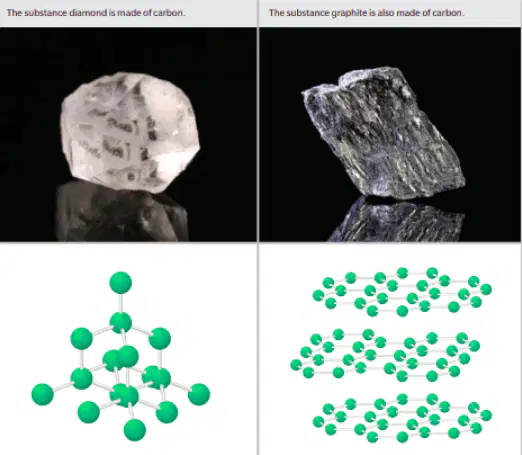
What does each green sphere represent?
a carbon atom
a bond between carbon atoms
an element
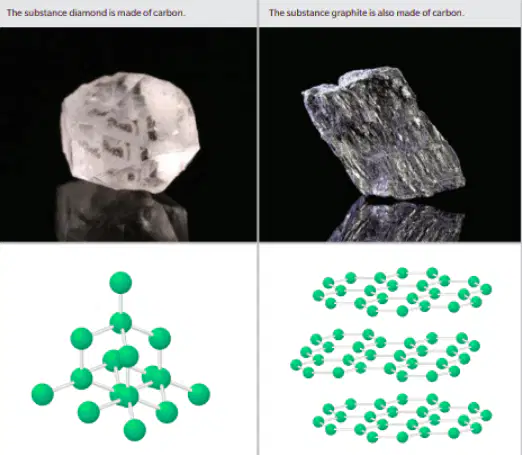
What does each gray line represent?
a carbon atom
a bond between carbon atoms
an element

Which of the following can be observed from the model of water?
Water is a molecule.
Water is a compound.
Water is made up of three types of atoms.

Another way to model water is with letters and lines like this H-O-H. What is one way that these models are different?
They show different types and numbers of atoms.
The atoms are connected in a different color.
The forces holding the atoms together are represented differently.
One model clearly shows a repeating pattern.
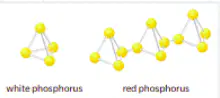
Based on the models of these structures, white phosphorous is a ________, red phosphorous is a ________, and both are examples of a(n) _______.
extended structure, simple molecule, compound
simple molecule, extended structure, compound
extended structure, simple molecule, element
simple molecule, extended structure, element
What subatomic particle is specifically responsible for combining the atoms together to form a new substance?
protons
neutrons
electrons
Which are ways to identify if a chemical reactions happened?
change in temperature
release of a gas
change in color
formation of a precipitate
energy released in the form of light or sound
Which of the following is NOT true of a chemical change?
Chemical bonds are broken.
The identity of a substance has changed.
The substance has only changed form or appearance.
It can be indicated by the presence of bubbles or rust.
Which of the following would not be evidence of a chemical change?
unexpected color change
unexpected temperature change
precipitate was formed
the size of the substance was changed
Atomic number is the number of _____ in an atom.
protons
neutrons
electrons
What are the two subatomic particles found inside the nucleus?
protons
neutrons
electrons
Which two subatomic particles have approximately the same mass?
protons
neutrons
electrons
What two subatomic particles are added up to make the atomic mass of an atom?
protons
neutrons
elctrons
Which subatomic particle changes the element's identity?
proton
neutron
electron
Which subatomic particle has a positive charge?
proton
neutron
electron
Which subatomic particle has a negative charge?
proton
neutron
electron
Which subatomic particle is neutral, or has no charge?
proton
neutron
electron
What does the atomic number represent on the periodic table?
number of protons
number of electrons
number of neutrons
number of atoms
Which number determines how the periodic table is arranged?
atomic number
atomic mass
number of neutrons
number of ions
All the elements in the same period have the same ____.
valence electrons
energy shells or orbitals
atomic mass
atomic number
All the elements in the same group have the same ______.
valence electrons
energy shells or orbitals
atomic mass
atomic number
Reactivity increases when moving from ________ and _______ on the periodic table.
right to left
left to right
top to bottom
bottom to top
What are the rows of the periodic table called?
groups
periods
What are the columns of the periodic table called?
periods
groups
_____ is a mixture, _____ is an element, and ______ is a compound.
H2O, Fe + S, H4
H2O, H4, Fe + S
Fe + S, H2O, H4
Fe + S, H4, H2O
______ are not chemically combined, whereas ______ are chemically combined.
mixtures, compounds
compounds, mixtures
How many elements have to be present for a compound to form?
only one
two or more
How many different elements are in C6H12O6?
3
6
12
24
Which of the following would not be a compound?
C6H12O16
(SO)4
H2O
Cl3
Which is true of pure substances?
They are not mixtures.
They are made up of one type of matter.
They can be atoms that are not joined together.
They can be atoms that are joined together in different ways.
In an element, all atoms are made of the same type.
false
true
______ can be broken down into simpler substance.
elements
atoms
_______ always form in a fixed ratio. An example is water. Another example is salt.
Mixtures
Compounds
Which of these substances is a compound?
carbon (C)
Chlorine (Cl)
uranium (U)
ammonia (NH3)
If you were to look at grains of table salt (sodium chloride, NaCl) with a magnifying glass, you would see that each grain is a little cube. Why are salt grains cubical?
All extended structure compounds form cubes.
Sodium and chlorine atoms both have cubical shapes.
In the extended structure of NaCl, atoms are arranged in a cubical pattern.
A molecule of NaCl contains eight atoms, each at one of the corners of a cube.
Sucrose is composed of carbon, oxygen, and hydrogen. Which statement best describes the properties of sucrose?
They are exactly like the properties of carbon (C).
They are exactly like the properties of oxygen (O).
They are exactly like the properties of hydrogen (H).
They are different from the properties of carbon, oxygen, and hydrogen.
A molecule of methanol is composed of carbon atoms connected to 3 hydrogen atoms and a hydroxide group. A hydroxide group is made up of an oxygen atom bonded to a hydrogen atom. How many different types of atoms make up one molecule of methanol?
3
4
5
6
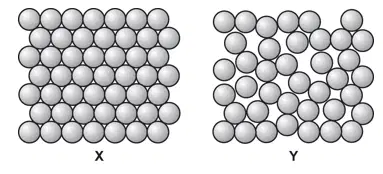
These models show the arrangement of particles in two solid materials. Which statement describes a basic difference between these materials?
X is a metal, and Y is a salt.
X is an element, and Y is a compound.
X is a crystal, and Y is made of separate molecules.
X is made of single atoms, and Y is made of molecules.
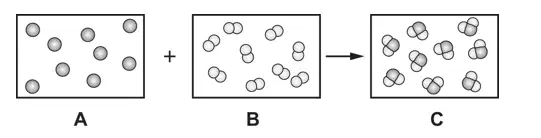
The diagram represents a chemical reaction. Reactant A and reactant B react to form product C. What type of substance is product C?
an atom
a mixture
an element
a compound
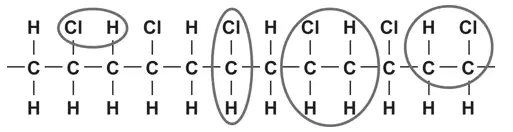
Polyvinyl chloride (PVC) is a polymer used to make water pipes and other products. Polymer molecules are made of groups of atoms that repeat many times in long chains as shown in the formula. Which circle, left to right, shows the repeating group of atoms that forms PVC?
first circle
second circle
third circle
fourth circle
A martian that has spent all of its life on Mars finally makes a trip to Earth. It finds it has a hard time getting around and that objects seem much heavier than on Mars. Why is this?
Mars has less mass than Earth, which gives it less gravity, so objects weigh less on Mars.
Mars has less mass than Earth, which gives it less gravity, so objects have less mas on Mars.
In space, objects have no weight, so the martian lost strength while traveling, and objects seem heavier.
The atmosphere is thicker on Earth than on Mars, which weighs down objects more and makes it harder to move them around.
Manganese (Mn) is a silver-colored metal. It reacts with oxygen to form manganese oxide (MnO2), which has two oxygen atoms for every manganese atom. Which statement describes the properties of manganese oxide?
It will be a gas because there are more oxygen atoms.
It will be a silver-colored metal because manganese is heavier than oxygen.
Its properties will be different from manganese and oxygen because it will have some properties of each of the atoms that make it up.
Its properties will be different from manganese and oxygen because the properties depend on the type of atoms and how they are arranged.
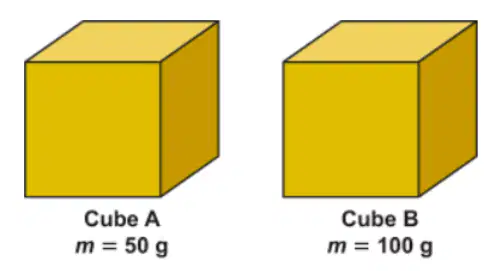
The volume of each cube in the diagram is 125 cm3. The mass of each cube is also shown. What can be concluded about the densities of the cubes?
Cube A is twice as dense as Cube B.
Cube B is twice as dense as Cube A.
The density of Cube A is equal to the density of Cube B.
The density of the cubes cannot be compared because their weights are not given.
A molecule of ethane is made of two carbon (C) atoms and six hydrogen (H) atoms. The carbon atoms are joined by a chemical bond. Each of the hydrogen atoms is joined to one of the carbon atoms by a chemical bond. Which is an accurate model of ethane?
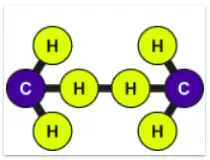
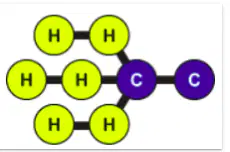
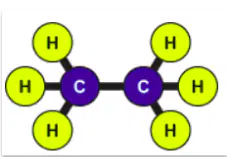
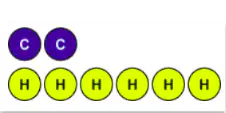
A chemist wants to build a model of an element using a box. What should the box be filled with to illustrate the relationship between atoms and elements?
red marbles because bonds form between atoms that are the same
red marbles because an element is made up of atoms that all have the same properties
an equal number of red and blue marbles because an element is made up of an equal ratio of atoms
an equal number of red and blue marbles because bonds form between atoms that have different properties
Plants use a process called photosynthesis to survive. What evidence proves this process is a chemical change?
Chloroplasts are green.
Chloroplasts change shape.
Sunlight is needed.
Chloroplasts produce a new substance.
Which element is strong and relatively nonreactive?
argon
copper
magnesium
Which element is a nonreactive gas?
argon
copper
magnesium
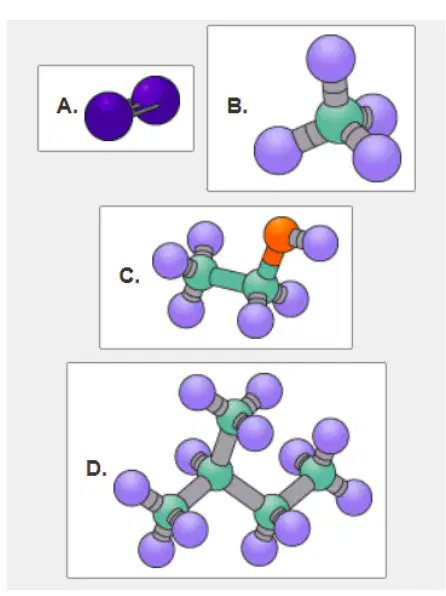
Which model above shows a flammable liquid with many branches of carbon and hydrogen atoms forming a complex molecule?
A
B
C
D
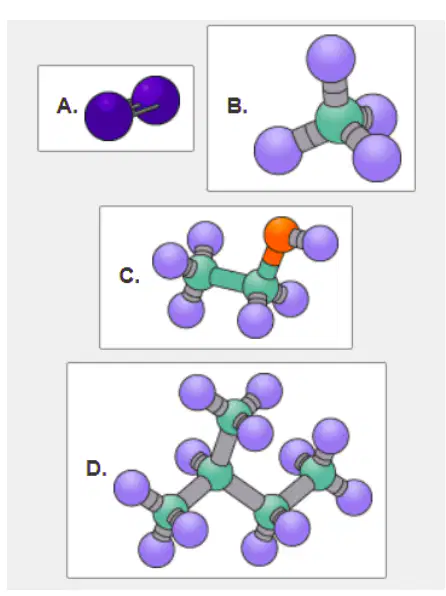
Which model above shows a simple molecule made of carbon and hydrogen that leads to a flammable gas?
A
B
C
D
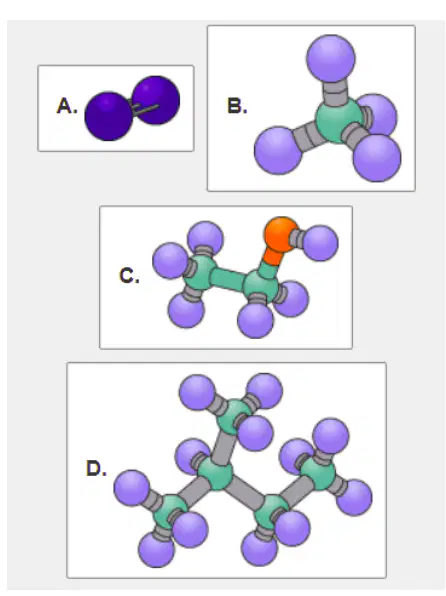
Which model above shows a stable gas made of simple molecules containing only nitrogen atoms?
A
B
C
D

