Wayground logo

Free Printable Worksheets

Font size

S
M
L
XL
Worksheets

Continental Drift Theory Assessment

Total questions: 20

Worksheet time: 11mins

Name
Class
Date
1.
Who is the scientist who proposed Continental Drift Theory?
a)
Albert Einstein
b)
Alfred Wegener
c)
Isaac Newton
d)
John Dalton
2.

What is the theory that states that parts of the Earth's crust slowly drifts on top a liquid core.

a)
Theory of Evolution
b)
Heliocentric Theory
c)
Geocentric Theory
d)
Continental Drift Theory
3.
What do you call the evidence of Wegener's Theory that tells about the remains of an organism that lived long time ago?
a)
Ashes
b)
Bones
c)
Follicles
d)
Fossils
4.
What do you call the supercontinent landmass formed million years ago?
a)
Pangea
b)
Asia
c)
Pantallasa
d)
Eurasi
5.
What causes the continents to move?
a)
Magma
b)
Tectonic Plates
c)
Earthquake
d)
All of the choices
6.

What are the two continents that fit together based on Wegener's Theory?

a)
Asia and Russia
b)
India and Asia
c)
South America and Africa
d)
Africa and Asia
7.
What are the remains of organism noticed by Wegener that are found the same in two continents?
a)
Leaves and flowers
b)
Ice and mountains
c)
Plants and animals
d)
Dinosaurs and reptiles
8.
What is a theory?
a)
An idea based on hypothesis and problems observed using five senses
b)
A belief, policy, or procedure that is not proposed or followed as the basis of action
c)
A supposition or a system of ideas intended to explain something, especially one based on general principles independent of the thing to be explained.
d)
A set of concepts that uses tests without evidences but uses the scientific method in order to prove a specific phenomena that happened on Earth or may happen to Earth
9.
What are the three types of Evidence that supports Alfred Wegener's Theory? 
a)
Fossils, Fish, and Land
b)
Sedimentary, Magma, and Climate
c)
Fossils, Land forms, and Climate
d)
Climate, Land forms, and Metamorphic rock 
10.
What is the force that moves the continents? 
a)
Conduction 
b)
Convection 
c)
Radiation 
d)
Conveyor belts 
11.
Originally the Continental drift theory was not well received by other scientist.  Why? 
a)
There was a competing theory at the time that was more believable. 
b)
There was no data showing the continents ever moved. 
c)
The scientists did not know the force responsible for moving the continents. 
d)
The scientist presenting the data was unreliable.  
12.
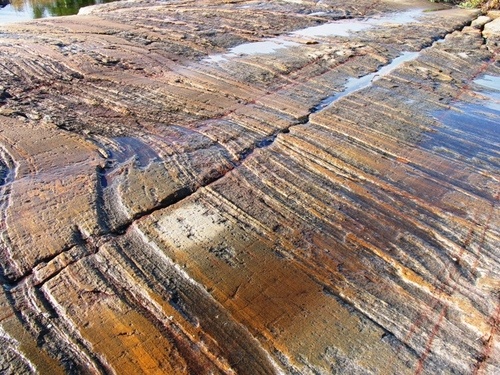
This is a picture of glacier scars found in Africa.  What are these evidence for?
a)
Africa has always been near the equator
b)
Africa was once in an area of the Earth that had a very cold climate
c)
The continents have not moved
d)
sea floor spreading
13.

Plates that move apart are called ____________.

a)

Convergent

b)

Divergent

c)

Transform

14.

Plates that slide, slip and grind past each other are called ____________.

a)

Convergent

b)

Divergent

c)

Transform

15.

Plates that push together are called ______________.

a)

Convergent

b)

Divergent

c)

Transform

16.

Where the plates touch is called the ____________.

a)

Fault

b)

Continental Drift

c)

Volcano

17.

The movement of tectonic plates is caused by

a)

earth's rotation

b)

movement in the mantle

c)

gravity

18.

Which is the correct order of the Earth's layers?

Outer most layer first.

a)

Crust, Outer Core, Mantle, Inner Core

b)

Crust, Mantle, Outer Core, Inner Core

c)

Inner core, Outer core, Mantle, Crust

19.

As you move deeper into the Earth's core, the temperature is:

a)

cooler

b)

hotter

20.

Why does subduction occur?

a)

Old crust is more dense and gravity helps pull the crust back into the mantle.

b)

Old crust is less dense and it sinks back into the mantle.

c)

Old crust is warm and melts back into the mantle.

d)

Old crust has no where else to go but through trenches.