Wayground logo

Free Printable Worksheets

Font size

S
M
L
XL
Worksheets

Properties of Water

Total questions: 15

Worksheet time: 11mins

Name
Class
Date
1.

Which of the following makes up a molecule of water?

a)

one atom of oxygen, two atoms of hydrogen

b)

one atom of hydrogen, two atoms of oxygen

c)

one atom of chlorine, one atom of sodium

d)

one atom of hydrogen, one atom of oxygen

2.

Ice floats on water because

a)

adhesion

b)

cohesion

c)

water expands when it freezes

d)

water shrinks when it freezes

3.

When salt is dissolved in water, water is the

a)

solvent

b)

solute

c)

solution

d)

reactant

4.

A solution is a(an)...

a)

chemical reaction

b)

breaking of a chemical bond

c)

combination of two or more liquids

d)

evenly distributed mixture of two or more substances

5.

Capillary action is....

a)

adhesion

b)

cohesion

c)

change in matter (heat of fusion)

d)

both adhesion and cohesion

6.

Oil and water don't mix because oil is

a)

hydrophilic

b)

hydrophobic

c)

an emulsifier

d)

a buffer

7.
Large bodies of water do not quickly fluctuate in temperature. Why?
a)
Water is a solvent.
b)
Water has a high heat capacity.
c)
Water acts as a buffer.
d)
Water is non-polar.
8.
Water striders can walk across the surface of calm water. Their feet push the surface of the water down slightly, but they do not break the surface. Why?
a)
The insects are light enough so they do not break the hydrogen bonds holding the water molecules together
b)
The insects actually use their wings to hover slightly above the water’s surface and they only skim it with their feet.
c)
The insect’s feet are non-polar, so they are repelled by the polar water molecules and are pushed away from the water’s surface.
d)
The insects are small enough to see the individual water molecules, so they are able to step carefully from one molecule to the next
9.
What word describes when water is attracted to other substances?
a)
cohesion
b)
adhesion
c)
capillary action
d)
surface tension
10.
Attractions between water molecules are called
a)
Covalent bonds
b)
Ionic bonds
c)
Polar bonds
d)
Hydrogen bonds
11.
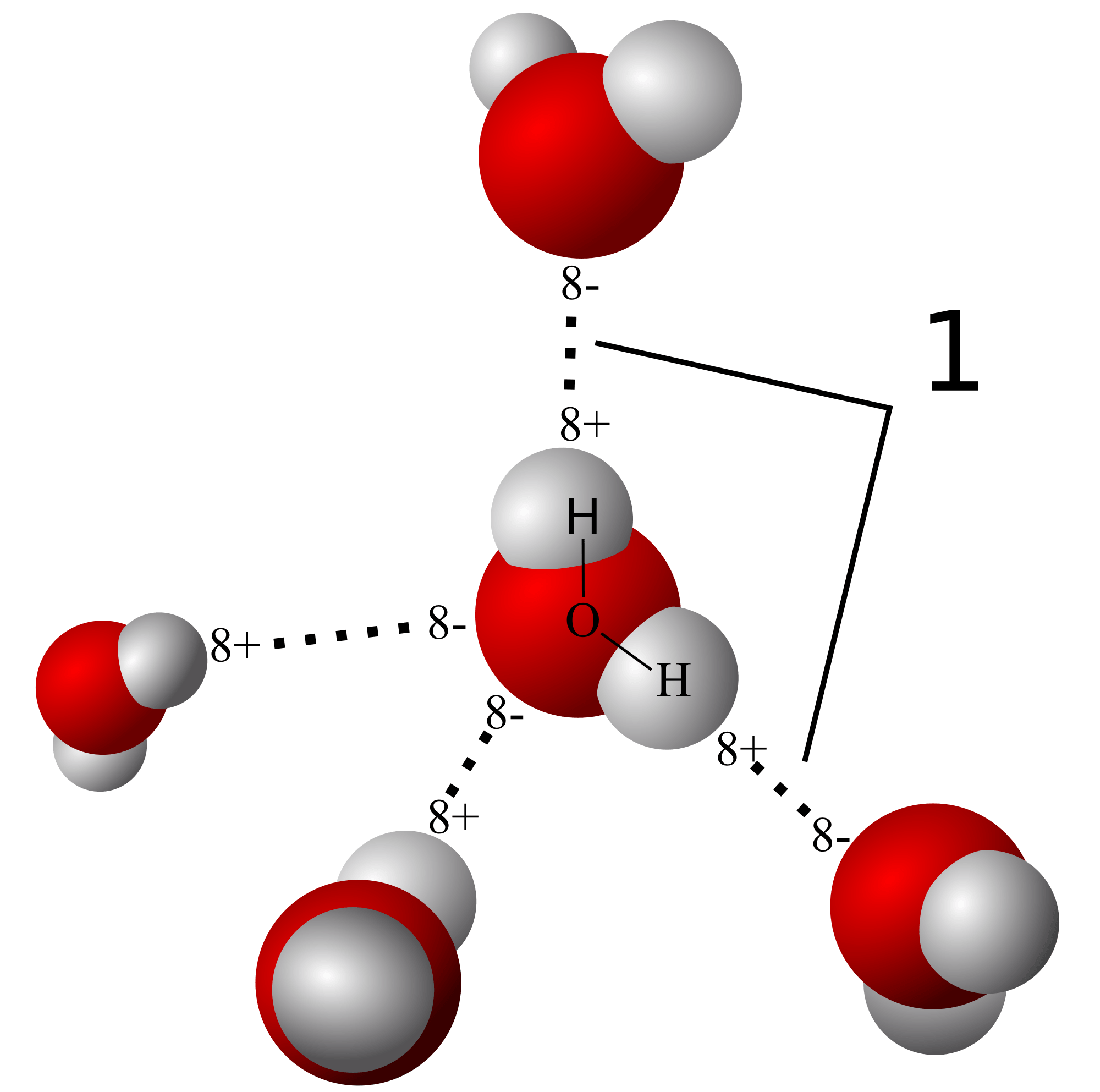
Water is polar because...
a)
The unequal sharing of electrons gives the water molecule a slight negative charge near its oxygen atom and a slight positive charge near its hydrogen atoms.
b)
The molecule has two poles, at which the it is colder than other regions of the molecule.
c)
The unequal sharing of electrons gives the water molecule a slight negative charge near its hydrogen atoms and a slight positive charge near its oxygen atom.
d)
The water molecule is neutral.
12.
Which types of compounds dissolve easily in water?
a)
Polar and Nonpolar
b)
Polar and Ionic
c)
Nonpolar and Ionic
d)
Covalent and Nonpolar
13.

The bond that holds the Oxygen and Hydrogen atoms together within a water molecule is a ________ bond.

a)

ionic

b)

Hydrogen

c)

Covalent

d)

Weak

14.
 Which of the following characteristics of water is not a result of hydrogen bonding?
a)
adhesive strength
b)
capillarity
c)
cohesive strength
d)
All of the above are a result of hydrogen bonding.
15.
What is the reason why oil and water don't mix?
a)
Oil is too heavy to mix with water
b)
Water can only mix with polar molecules 
c)
Water can only mix with non-polar molecules
d)
Oil is too light to mix with water