wayground logo

Free Printable Worksheets

Font size

S
M
L
XL
Worksheets

Density - Closing the Gap

Total questions: 31

Worksheet time: 27mins

Name
Class
Date
1.
Jack has a rock. The rock has a mass of 14g and a volume of 2cm3. What is the density of the rock?
a)
7 mL
b)
7 g/cm3
c)
28 g/cm3
d)
1/7 g/cm3
2.
What units are used to measure mass?
a)
g
b)
cm3
c)
g/cm3
d)
cm3/g
3.
What is the formula for density?
a)
density = mass x volume
b)
density = mass / volume
c)
density = mass + volume
d)
density = mass - volume
4.
Calculate the density of the cube.
a)
2 g/cm3
b)
4 g/cm3
c)
6 g/cm3
d)
8 g/cm3
5.
Which units of measurement are used for volume?
a)
grams
b)
centimeters
c)
grams/milliliter
d)
milliliter
6.
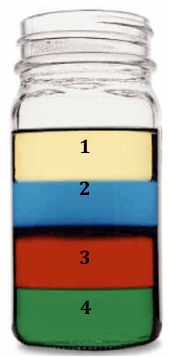
Put the liquids in order from most dense to least dense?
a)
4, 3, 2, 1
b)
1, 2, 3, 4
c)
3, 4, 2, 1, 
d)
4, 3, 1, 2
7.

How do you find the volume of a regularly shaped solid?

a)

Length x Width

b)

Length x Width x Height

c)

Height + Width + Height

d)

(Length + Height) x Width

8.

Which of the following is NOT a step in finding the volume of an irregular shaped solid object?

a)

Measure and record an amount of water in a graduated cylinder

b)

Add the object to a graduate cylinder with a known amount of water and record the new water level

c)

Use the formula to multiply the length by the width by the height

d)

Subtract the water level of the with the object in it from the amount of water before the object was introduced

9.
What is the volume of liquid in this graduated cylinder?
a)
40.0 mL
b)
40.3 mL
c)
43.0 mL
d)
44.0 mL
10.

Using the picture, tell me which object is the least dense and why?

a)

The fish because he is in the middle

b)

The cork because it is floating at the top of the water

c)

The rock because it is at the bottom

d)

The cork and the rock because they have the same about of atoms.

11.
Find the Volume
a)
428.4 cm3
b)
412.8 cm3
c)
404.2 cm3
d)
400 cm3
12.
Find the volume of the given figure.
a)
308.9 cm3
b)
308.2 cm3
c)
312.8 cm3
d)
302.9 cm3
13.
The mass of an object is 30 g.  The volume is 5 mL.  What is the density of this object?
a)
6 g/cm
b)
6 g/mL
c)
6
14.
What is the density of an object that has a volume of 30 mL and 120 grams?
a)
40 mL
b)
4 g/mL
c)
40 g/cm3
d)
4 g 3
15.
You are given the following information: mass = 48 g; volume = 24 cm3. What is the density of this substance? 
a)
2 g/cm3
b)
1,152 g/cm3
c)
0.5 g/cm3
d)
72 g/cm3
16.
A student knows the mass of an object. What other variable does the student need to know to calculate the object's density?
a)
Color
b)
Weight
c)
Volume
d)
Length
17.
Find the density of a 2 cm x 2 cm x 2 cm cube with a mass of 64 g.
a)
6 cm3
b)
12 g/cm3
c)
128 g/cm3
d)
8  g/cm3
18.
I have two objects with the same volume but different masses.  Which object will be more dense?
a)
The object with less weight.
b)
The object with more weight.
c)
The object with more mass.
d)
The object with less mass.
19.
What is the volume of Object X?
a)
10.0 cm3
b)
15.0 cm3
c)
20.0 cm3
d)
25.0 cm3
20.
What is the volume of the fish?
a)
18.0 cm3
b)
6.0 cm
c)
32.0 cm3
d)
38.0 cm3
21.

what is the volume of the cube?

a)

123

b)

144

c)

244

d)

150

22.

A student measured 3 objects made of different materials. The table shows each objects mass and volume. Which of the following lists the materials in order from least dense to most dense?

a)

glass \longrightarrow wood \longrightarrow rubber

b)

glass \longrightarrow rubber \longrightarrow wood

c)

rubber \longrightarrow glass \longrightarrow wood

d)

wood \longrightarrow rubber \longrightarrow glass

23.

What is water displacement used to find?

a)

volume

b)

mass

c)

density

24.
A piece of metal has a mass of 35.4 grams and a volume of 6cm3. According to the table what metal is it?
a)
Aluminum
b)
Scandium
c)
Radium
d)
Xenon
25.

What is the density of this liquid?

a)

100 g/cm3

b)

200 g/cm3

c)

2 g/cm3

d)

1 g/cm3

26.

What is the density of the steel rod if it has a mass of 40g? (Hint: use the water displacement method to find the steel rod's volume.)

a)

10 g/mL

b)

4 g/mL

c)

40 g/mL

d)

5 g/mL

27.

What can be predicted from the information given above?

a)

The liquids in each test tube will have the same density.

b)

The liquid in test tube #1 will float on top of the liquid in test tube #2.

c)

The liquid in test tube #1 will have a greater density than in test tube #2.

d)

The liquid in test tube #1 is water.

28.

What is the mass shown by the balance?

a)

48.5 g

b)

485 g

c)

480.5 g

d)

4805 g

29.

What is the volume of the water in the graduated cylinder?

a)

25 mL

b)

20 mL

c)

24 mL

d)

22 mL

30.

What is the volume?

a)

95

b)

25

c)

5

d)

11

31.

What is the Volume?

a)

165

b)

30

c)

25

d)

15