wayground logo

Free Printable Worksheets

Font size

S
M
L
XL
Worksheets

Unit 1 Review

Total questions: 30

Worksheet time: 30mins

Name
Class
Date
1.

Prokaryote Cells are most commonly called

a)

bacteria

b)

organelles

c)

amoebas

d)

plants

2.

What are the most basic units of life ?

a)

organisms

b)

Tissues

c)

Cells

d)

Organs

3.

What is the cell theory?

4 lines
4.

A cell with no nucleus is call a(n)

a)

eukaryote

b)

prokaryote

c)

endospore

d)

paramecium

5.

According to the cell theory ,

a)

all cells have cell walls

b)

cells can be created from nothing

c)

all cells come from existing cells

d)

all cells have a nucleus

6.

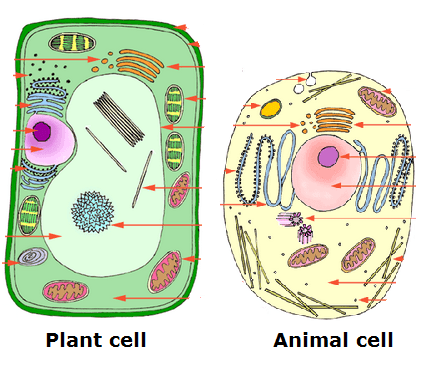
What distinguishes a plant cell from an animal cell? (How do you tell them apart) Hint: There's 3 ways (Check all 3)

a)

Central Vacuole

b)

Mitochondria

c)

Cell Wall

d)

Ribosomes

e)

Chloroplasts

7.
A rigid layer that lies outside the cell's  membrane is...
a)
Cytoplasm
b)
Cell membrane
c)
Cell Wall
d)
Flagella
8.
Robert Hooke, Anton van Leeuwenhoek, Theodor Schwann, Rudolf Virchow, and Matthias Schliden were all responsible for what theory?
a)
The Theory of Gravity
b)
The Theory of Relativity
c)
The Cell Theory
d)
The Theory of Continental Drift
9.
According to cell theory, where did this cell come from?
a)
another living cell
b)
energy from sun
c)
a multicellular organism
d)
the nonliving environment
10.

This part contains the lens you look through.

a)

nosepiece

b)

eyepiece

c)

low power objective lens

d)

high power objective lens

11.

If you want crispy lettuce for a salad, you need to fill up the lettuce's _________ with water .

a)

Endoplasmic reticulum

b)

vacuoles

c)

lysosomes

d)

ribosomes

12.
The powerhouse of the cell is the...It converts energy from food into energy the cell can use
a)
Mitochondrion
b)
Golgi body
c)
Nucleus
d)
Ribosomes
13.
Where are proteins made? These are small, grain-like or rod shaped organelles.
a)
Golgi body
b)
Mitoichondrion
c)
Chromosomes
d)
Ribosomes
14.
This cell part is in ALL cells. It is the gel-like substance that provides cell shape.
a)
Chloroplasts
b)
Chromosomes
c)
Cytoplasm
d)
Mitochondria
15.
This organelle is in all eukaryotic cells. It is the control center of the cell because it holds the DNA.
a)
Mitochondria
b)
Nucleus
c)
Chloroplasts
d)
Ribosomes
16.
This organelle is like a recycling center for the cell. It breaks down old materials. It is like a vacuum cleaner that cleans up the waste in cells.
a)
Ribosomes
b)
Lysosomes
c)
Mitochondria
d)
Chloroplasts
17.
Tiny cell structures that carry out specific functions within the cell.
a)
membranes
b)
nucleus
c)
organelles
d)
animalicules
18.
What is the main function of the cell membrane?
a)
Digestion
b)
Storage
c)
Protective Barrier
d)
INSANE IN THE MEMBRANE!
19.

Which part is A?

a)

body tube

b)

eyepiece

c)

objective lens

d)

stage clip

20.

What part is E?

a)

Diaphragm

b)

Eyepiece

c)

base

d)

Light source

21.

What part is #1?

a)

Base

b)

Mirror

c)

stage

d)

stage clips

22.
Which of the following is the correct order of organization in living things from most basic (simple) to most complex?
a)
a.  Organism, cell, tissue, organ, organ system
b)
a.  Organ system, organ, tissue, cell, organism
c)
a.  Cell, tissue, organ, organ system, organism
d)
a.  Cell, organ, tissue, organ, organism, organ system
23.
A group of similar cells that come together to perform a specific function is a/an
a)
organ
b)
organism
c)
organ system
d)
tissue
24.
When a group of organs work together to perform a particular function they create a/an
a)
organ system
b)
organism
c)
tissue
d)
organ
25.
The smallest level of organization of life in an organism
a)
tissue
b)
cell
c)
organ
d)
organ system
26.
A group of organs that work together to perform big jobs for your body is an organ system.
a)
True
b)
False
27.
The heart contains different types of tissue. What level is the heart?
a)
cell
b)
organ system
c)
organ
d)
tissue
28.

Which body system protects the organs of the body?

a)

digestive

b)

respiratory

c)

skeletal

d)

muscular

29.

Which body system includes the brain and spinal cord?

a)

digestive

b)

respiratory

c)

skeletal

d)

nervous

30.
The organ system that coordinates and regulates the responses of the other organ systems to maintain a constant internal balance is
a)
Circulatory System
b)
Nervous System
c)
Skeletal System
d)
Muscular System