wayground logo

Free Printable Worksheets

Font size

S
M
L
XL
Worksheets

Ecosystems 2

Total questions: 50

Worksheet time: 41mins

Name
Class
Date
1.

What are the 3 reactants of photosynthesis? The reactants are the things needed for photosynthesis to occur.

a)

oxygen, glucose, sunlight

b)

sunlight, oxygen, water

c)

water, oxygen, carbon dioxide

d)

carbon dioxide, sunlight, water

2.

What pigment captures/absorbs sunlight?

a)

stomata

b)

chlorophyll

c)

chloroplast

d)

phloem

3.

What is the tiny openings that let in the carbon dioxide needed for photosynthesis?

a)

stomata

b)

xylem

c)

phloem

d)

chloroplast

4.

How does water travel from the roots to the plan leaf? Name the structure that carries water.

a)

stomata

b)

phloem

c)

chloroplast

d)

xylem

5.

What are the 2 products of photosynthesis? The products are the things made in the process of photosynthesis.

a)

water, sunlight

b)

glucose, carbon dioxide

c)

oxygen, glucose

d)

sunlight, oxygen

6.

What is the main purpose of photosynthesis?

a)

To make food

b)

To create energy

c)

To release oxygen

d)

To absorb sunlight

7.

Which product is "waste" and mostly released by the producer (plant)?

a)

oxygen

b)

carbon dioxide

c)

sugar

d)

glucose

8.

How does oxygen get released by the producer (plant)? Name the structure in the leaf.

a)

stomata

b)

xylem

c)

phloem

d)

chloroplast

9.

How does glucose travel in a producer (plant)? Name the structure.

a)

xylem

b)

phloem

c)

stomata

d)

chlorophyll

10.

Which of the following are TRUE statements? (Select ALL that apply)

a)

Photosynthesis takes place in the chloroplasts of leaf cells

b)

Photosynthesis means "making food using sun"

c)

Photosynthesis can occur in the dark

d)

All plants, plant-like protists, and some bacteria go through photosynthesis

11.

What color is chlorophyll?

a)

Green

b)

Blue

c)

Red

d)

Purple

12.

Sunlight is the main source of energy that drives photosynthesis process.

a)

True

b)

False

13.

The plants gets its nutrients from sugar, called __________.

a)

Galactose

b)

Fructose

c)

Sugar

d)

Glucose

14.

Photosyntheis is the process in which humans, and animals use energy from sunlight to produce sugar.

a)

True

b)

False

15.

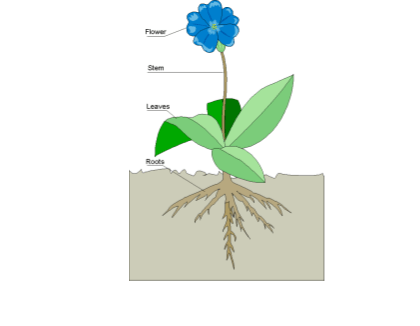
5. What part of the plant absorbs water for photosynthesis?

a)

leaves

b)

roots

c)

petals

d)

stem

16.
What is the pigment in chloroplasts that performs photosynthesis?
a)
Chlorosynthesis
b)
Chlorophyll
c)
ADP
d)
Electron Transport
17.
What are the products of photosynthesis?
a)
water and carbon dioxide
b)
oxygen and glucose
c)
oxygen and carbon dioxide
d)
oxygen and water
18.
Plants need ________ for photosynthesis
a)
oxygen
b)
soil
c)
carbon dioxide
d)
sugar
19.
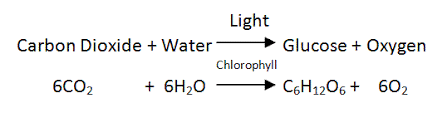
Which of the following is the correct equation for PHOTOSYNTHESIS?
a)
CO+ light + H2O --> O+ Sugar
b)
CO+ sugar + H2O --> O+ light
c)
O2 + light + H2O --> CO+ Sugar
d)
CO+ O2 + H2O --> Light+ Sugar
20.
Which plant part absorbs water and nutrients?
a)
Leaf
b)
Stem
c)
Roots
d)
Flower
21.
The leaf has a shiny, waxy cuticle around it to
a)
increase the rate of photosynthesis
b)
attract more light
c)
control water loss
d)
stop carbon dioxide and oxygen gases escaping
22.
Most of the chloroplast cells are found in the
a)
upper epidermis
b)
pallisade mesophyll layer
c)
lower epidermis
d)
stomata
23.
The water needed for photosynthesis comes into the leaves through the
a)
upper epidermis
b)
stomata
c)
guard cells
d)
xylem cells
24.
The important gases, carbon dioxide and oxygen, enter and leave the leaf through the
a)
upper epidermis
b)
phloem
c)
stomata
d)
guard cells
25.
The reactants needed for photosynthesis to occur are:
a)
carbon dioxide & water
b)
carbon dioxide & oxygen
c)
oxygen & water
d)
carbon dioxide, oxygen & water
26.
The role of the guard cell is to
a)
help control the temperature of the plant
b)
control how much water enters the leaf
c)
control how much glucose is stored
d)
control the movement of water vapour & gases 
27.
Plants need to take in oxygen gas for respiration
a)
only at night 
b)
only during the day
c)
both during the day & the night
28.

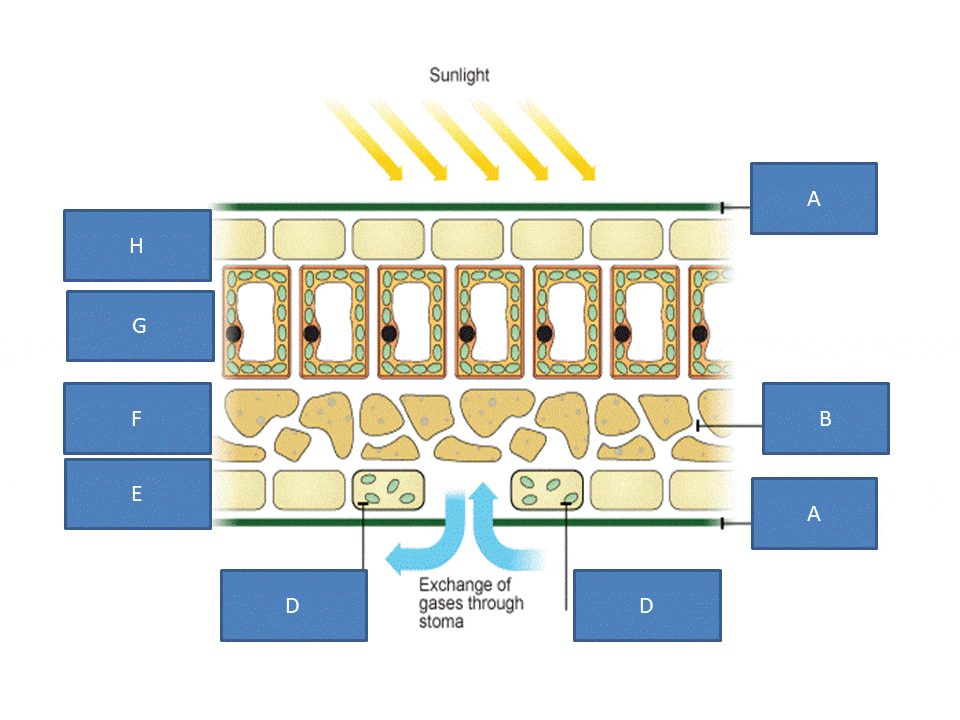
What is the name of the elongated, packed cells (part G) directly under the upper epidermis?

a)

Palisade cells

b)

Guard cell

c)

Spongy layer

d)

Lower epidermis

29.

The column-like cells that lie directly underneath the epidermis makes up the

a)

spongy mesophyll

b)

palisade mesophyll

c)

cuticle

d)

bundle sheath

30.

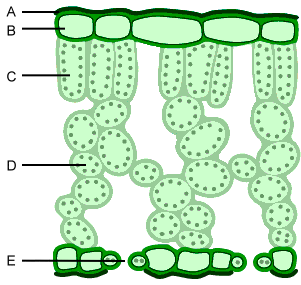
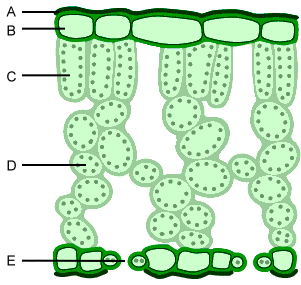
What is letter "A" pointing to?

a)

cuticle

b)

upper epidermis

c)

lower epidermis

d)

palisade mesophyll

31.

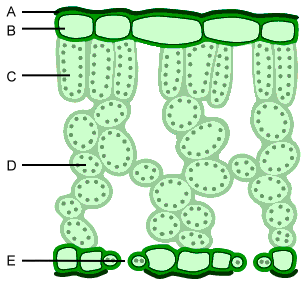
What is letter "D" pointing to?

a)

upper epidermis

b)

palisade mesophyll

c)

spongy mesophyll

d)

bundle sheath

32.

Which of the following is pointing to the "guard cell"?

a)

B

b)

C

c)

D

d)

E

33.

This layer of cells is where photosynthesis occurs within the leaf; there are air spaces within this layer

a)

spongy mesophyll

b)

palisade mesophyll

c)

chloroplast

d)

upper epidermis

34.

The cell organelle where photosynthesis occurs in plant cells is the

a)

chloroplast

b)

mitochondrion

c)

vacuole

d)

nucleus

35.

Is respiration the same as breathing?

a)

Yes

b)

No

36.
What type of respiration requires oxygen?
a)
Aerobic
b)
Anaerobic
37.
What are the products of anaerobic respiration?
a)
Glucose and oxygen
b)
Carbon dioxide and water
c)
Lactic acid
d)
Carbon monoxide
38.
What type of respiration does not require oxygen?
a)
Aerobic
b)
Anaerobic
39.
Which equation shows the reaction for anaerobic respiration
a)
carbon dioxide + water --> glucose and oxygen
b)
glucose + Oxygen --> lactic acid and energy
c)
glucose + oxygen --> carbon dioxide and water and energy
d)
glucose --> lactic acid and energy
40.

what body system exchanges O2 for CO2

a)

respiration

b)

excretion

c)

digestion

d)

nervous

41.
What process is the opposite of aerobic respiration?
a)
anaerobic respiration
b)
cellular respiration
c)
photosynthesis
d)
lactic acid fermentation
42.
What is cellular respiration?
a)
the breakdown of glucose  to release ATP
b)
the breakdown of glucose to release NADH
c)
the breakdown of glucose to release FADH
d)
the breakdown of glucose to release carbon
43.

Which of the following structure is where cellular respiration occurs in the cell?

a)

nucleus

b)

cytoplasm

c)

mitochondria

d)

vacuoles

44.
What does chlorophyll capture?
a)
Chlorophyll captures water from the air.
b)
Chlorophyll captures carbon dioxide from the air.
c)
Chlorophyll captures the energy of sunlight.
d)
Chlorophyll captures baseballs.
45.
Where does a plant get water from?
a)
Water is collected from the ocean.
b)
Water is taken up from the soil or the air.
c)
Water is stored when it rains.
d)
Water is bought from Costco.
46.
During photosynthesis, what form does the food take?
a)
The food takes the form of sugar.
b)
The food takes the form of carbon dioxide.
c)
The food takes the form of soil.
d)
The food takes the form of a ham sandwich.
47.
Where does a plant get carbon dioxide from?
a)
A plant gets carbon dioxide from the soil.
b)
A plant gets carbon dioxide from the air.
c)
A plant gets carbon dioxide from the water.
d)
A plant gets carbon dioxide at the Shell gas station.
48.
Leaves use the energy from the sun to change carbon dioxide and water into what?
a)
chlorophyll
b)
oxygen
c)
carbon dioxide
d)
sugar
49.
What is photosynthesis?
a)
The process plants use to turn carbon dioxide and water into food.
b)
The process plants use to chlorophyll and sunlight into air. 
c)
The process plants use to turn sunlight and chlorophyll into soil.
d)
The process plants use to turn chocolate and milk into chocolate milk.
50.
Where does photosynthesis take place?
a)
The leaves.
b)
The roots.
c)
The branches.
d)
The kitchen.