Wayground logo

Free Printable Worksheets

Font size

S
M
L
XL
Worksheets

Energy Quiz

Total questions: 23

Worksheet time: 15mins

Name
Class
Date
1.

What is potential energy?

a)

The energy an object has due to its atomic structure.

b)

The energy an object has due to its chemical composition.

c)

The energy an object has due to its motion.

d)

The energy an object has due to its position or condition.

2.

What is kinetic energy?

a)

The energy an object has due to its position or condition

b)

The energy an object has due to its motion

c)

The energy an object has due to its chemical composition

d)

The energy an object has due to its atomic structure

3.

When does an object have no kinetic energy?

a)

When it's at rest.

b)

When it's moving very slowly.

c)

When the only force that's acting on it is gravity.

d)

When it has no electrical charge.

4.

Which object has the most potential energy?

a)

A ball resting on the ground.

b)

A ball being thrown at 100 miles per hour.

c)

A ball on top of a refrigerator.

d)

A ball resting on the edge of a cliff.

5.

When does a yo-yo have the most potential energy?

a)

When it's at its highest point.

b)

When it's at its lowest point.

c)

When it's moving between its highest and lowest points.

d)

When it's moving at its top speed.

6.

Four cars are positioned at the top of a hill. Which car has the most potential energy?

a)

A

b)

B

c)

C

d)

D

7.

Why do objects at high elevations have more potential energy than objects at low elevations?

a)

Because the thinner air at higher elevations means objects have a greater potential to move very fast

b)

Because objects at high elevations are closer to the sun, which is the source of all energy on earth

c)

Because objects at high elevations tend to move slower than objects at low elevations

d)

Because gravity gives objects at high elevations the potential to fall much further
8.
How do materials change from one state of matter to another?
a)
They gain or lose energy
b)
They break appart
c)
The particles get stickyer
d)
They are magnetised to themselves
9.
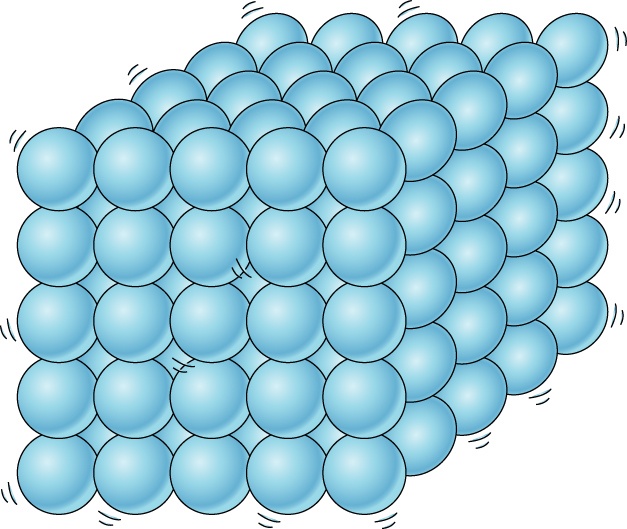
Which description best matches this particle model?
a)
Closely packed and can't move a lot. 
b)
Particles are close together but can move a little. 
c)
Particles have lots of energy and can move around. 
10.
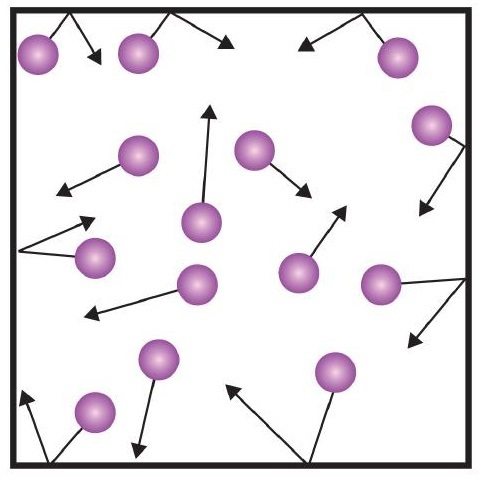
Which description best matches this particle model?
a)
Closely packed and can't move a lot. 
b)
Particles are close together but can move a little. 
c)
Particles have lots of energy and can move around. 
11.
How does friction affect speed?
a)
more friction decreases speed
b)
more friction increases speed
c)
less friction decreases speed
d)
less friction doesn't affect speed
12.
Friction is a force that acts in an ___________ direction of movement.
a)
similar
b)
opposite
c)
parallel
d)
west
13.
What does friction produce?
a)
light
b)
sound
c)
heat
d)
gravity
14.
A type of friction that occurs when air pushes against a moving object causing it to decelerate.
a)
surface area
b)
air resistance
c)
velocity
d)
gravity 
15.

The weight of an object varies with the:

a)

pull of gravity

b)

dimensions of the object

c)

volume of the object

16.
How would the absence of friction affect a marble traveling on a long, straight path?
a)
The marble’s speed would decrease.
b)
The marble’s speed would increase.
c)
The marble would stop immediately. 
d)
The marble would remain at constant speed.
17.

When a hand is placed under a hand boiler,

a)

nothing happens.

b)

energy is transferred to particles in the liquid speeding them up.

c)

energy is transferred to particles in the liquid slowing them up.

d)

electrical energy causes the liquid to boil.

18.

When liquid in a hand boiler boils, it is

a)

caused by liquid turning into a solid.

b)

caused by liquid turning into a gas.

c)

caused by evaporation.

d)

caused by sublimation.

19.
Friction is a force that acts in an ___________ direction of movement.
a)
similar
b)
opposite
c)
parallel
d)
west
20.
A ______ is a push or a pull acting upon an object
a)
Acceleration
b)
force
c)
friction
d)
energy
21.
Where is potential energy the GREATEST on a roller coaster?
a)
At the bottom of the first hill
b)
At the top of the first hill
c)
Half way down the first hill
22.
Where is kinetic energy the LEAST on a roller coaster?
a)
At the bottom of the first hill
b)
At the top of the first hill
c)
Halfway down the first hill
23.
When you push on an object and your friend pulls on the same object and the object does not move, this is an example of:
a)
Net forces
b)
Regular forces
c)
Unbalanced forces
d)
Balanced forces