
Font size
 Worksheets
Equilibrium of Force
Total questions: 15
Worksheet time: 29mins

The moment of a force causes an object to
move forward
move backward
stop moving
turn about a fixed point
The turning effect of a force on a door is greater when it is applied at
A point near the hinges and perpendicular to the door
A point near the hinges and parallel to the door
A point far away from the hinges and perpendicular to the door
A point far away from the hinges and parallel to the door
Jack has a weight of 300 N and sits 2.0 m from the pivot of see-saw. Jill has a weight of 450 N and sits 1.5 m from pivot. Who will move down?
Jack
Jill
Both of them
None of them

What is the force F needed to balance the bar shown?
3
4
6
8

A light metre rule is allowed to pivot freely at the zero end. The other end is supported by a spring balance. A weight of 200N is then hung at the 40cm mark. The metre rule stays horizontal. What is the reading on the spring balance?
80
40
8
4
Which one of the following activities does not apply the turning effect of a force?
swinging on a swing
sliding down a slide
moving up and down on the see-saw
rowing a boat
A nut has been tightened by a force of 180 N using 8 cm long spanner. What length of a spanner is required to loosen the same nut with 150 N force
11 cm
8.5 cm
9.6 cm
10.9 cm
A force of 120 N is applied perpendicularly on a spanner at a distance of 9 cm from a nut. The torque produced by the force will be
12 Nm
10.8 Nm
15 Nm
12.59 Nm
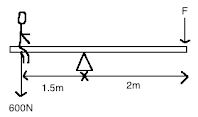
A boy of weight 600N sits on the see-saw as shown at a distance of 1.5m from the pivot. What is the force F required at the other end to balance the see-saw?
450 N
350 N
4.5 N
200 N

The figure shows a uniform metre rule pivoted at the 50cm mark. 125g and 200g weights hang from the rule as shown. Calculate where you would hang a 25g mass in order to balance the rule horizontally
20 cm from pivot on the side of 125 g mass
10 cm from pivot on the side of 125 g mass
40 cm from pivot on the side of 200 g mass
10 cm from pivot on the side of 200 g mass
When an object is in equilibrium, which equation is true?
Clockwise moment = anticlockwise moment
Clockwise moment + anticlockwise moment = 0
Clockwise moment / anticlockwise moment = 0
Clockwise moment + anticlockwise moment = resultant force

Calculate the tension force 1 (T1).
(a)

Look at the figure.
System is in static equilibrium. The tension of string is 80 N.
Determine the value of d.
(a)

