wayground logo

Free Printable Worksheets

NEW

Font size

S
M
L
XL
Worksheets

Atmosphere Unit Review

Total questions: 38

Worksheet time: 22mins

Name
Class
Date
1.

Which graph BEST represents the composition of the atmosphere?

a)

A

b)

B

c)

C

2.

Which is the correct order of the layers going from Earth to Outer Space?

a)

troposphere, exosphere, stratosphere, mesosphere, thermosphere

b)

exosphere, thermosphere, mesosphere, stratosphere, troposphere

c)

mesosphere, troposphere, exosphere, thermosphere, stratosphere

d)

troposphere, stratosphere, mesosphere, thermosphere, exosphere

3.

How did scientists determine when one layer of the atmosphere ends and when one begins?

a)

the air pressure changes

b)

the temperature changes

c)

every 100 miles the layers change

d)

based on the amount of nitrogen in the layer

4.

In which layer are the Northern Lights or Aurora Borealis located?

a)

thermosphere

b)

mesosphere

c)

exosphere

d)

troposphere

5.

Which of the following is a way that humans can IMPROVE the greenhouse effect/global warming?

a)

make sure to use more fossil fuels

b)

plant more trees

c)

build more houses on wetlands

d)

use more gasoline products

6.

This graph is showing the amount of carbon dioxide in the air. Why is there such a huge increase at the right side?

a)

more volcanos erupted

b)

it's a natural cycle of increasing carbon levels every 1000 years

c)

people started burning more fossil fuels

d)

more trees were planted so they released more carbon dioxide

7.

What causes wind?

a)

differences in air pressure

b)

differences in gravity

c)

difference in oxygen

d)

differences in the thermosphere

8.

What causes differences in air pressure?

a)

even heating of the Earth

b)

Even cooling of the earth

c)

uneven heating of the earth

d)

global warming

9.
Which statement correctly defines wind?
a)
Wind is the movement of air from areas of low pressure to areas of high pressure
b)
Wind is the movement of air to a colder area in the atmosphere.
c)
Wind is the movement of air from areas of high pressure to areas of low pressure.
d)
Wind is the movement of air pushed around and bouncing off Earth's surface.
10.
Why does warm air rise?
a)
Warm air is more dense than cooler air.
b)
Warm air has more pressure than cooler air.
c)
Warm air is less dense than cooler air.
d)
Warm air has a higher dew point than cooler air.
11.
The Coriolis effect is the curving of wind across Earth. What causes winds to curve?
a)
Earth's revolution
b)
Earth's magnetic field
c)
Earth's rotation
d)
Earth's gravitational pull
12.
Use the diagram to determine which statement is correct.
a)
The air at location 3 is more dense than the air at location 6.
b)
The air at location 2 is rushing in to take the place of the colder air at location 3.
c)
Location 1 heats up and cools down slower than location 7.
d)
High pressure air at location 2 is taking the place of the low pressure air at location 3.
13.
What kind of breeze is this & what time of day/night would it form?
a)
Land breeze - daytime
b)
Land breeze - nighttime
c)
Sea breeze - daytime
d)
Sea breeze - nighttime
14.
Which term is best described as the movement of air from land to sea?
a)
global winds
b)
sea breeze
c)
land breeze
d)
local winds
15.
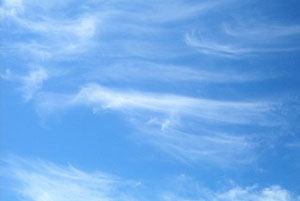
This type of cloud is thin, wispy, and made of ice crystals
a)
cumulus cloud
b)
stratus cloud
c)
cirrus cloud
d)
cumulonimbus cloud
16.
This type of cloud is thin and flat, and the edges are not clearly defined
a)
cirrus cloud
b)
cumulus cloud
c)
stratus cloud
d)
cumulonimbus cloud
17.
This type of cloud is thick and puffy on top, and generally flat on the bottom. It has well-defined edges and can change shape rapidly.
a)
cumulus cloud
b)
stratus cloud
c)
cirrus cloud
d)
cloud 9
18.
Nimbostratus and cumulonimbus clouds can signal what type of upcoming weather?
a)
fair skies
b)
hot, sunny weather
c)
windy weather
d)
rainy weather
19.

What is weather?

a)

The amount of moisture in the air

b)

The number of clouds in the sky

c)

The speed of the wind

d)

The state of the atmosphere at any particular time.

20.

Which of the following devices measures air pressure?

a)
b)
c)
d)
21.

What is the difference between absolute humidity and relative humidity?

a)

Absolute humidity represents how much water the air actually holds; relative humidity is how much water the air can hold

b)

Relative humidity makes the air sticky; absolute humidity makes the air dry

c)

Absolute humidity is how much water the air can hold; relative humidity represents how much water the air actually holds

d)

Absolute humidity is expressed as a percentage; relative humidity is expressed as a whole number

22.

What are the characteristics of a high-pressure system?

a)

Wind and rain

b)

Humidity and thunder

c)

Extremely hot temperatures

d)

Clear skies and sun

23.
The amount of water vapor present in the air is called ________________.
a)
weather
b)
humidity
c)
air mass
d)
dew point
24.
Rain, snow, sleet, and hail are all forms of _____.
a)
precipitation
b)
condensation
c)
evaporation
d)
climate
25.
Warm air rises because it is __________ dense then cold air.
a)
More
b)
Less
26.
Which weather tool measures air pressure?
a)
thermometer
b)
barometer
c)
anemometer
d)
psychrometer
27.
The layer of the atmosphere where weather occurs is the _.
a)
thermosphere
b)
stratosphere
c)
mesosphere
d)
troposphere
28.
In what areas of the world do hurricanes form?
a)
Warm ocean waters
b)
Polar ocean waters
c)
On lakes and rivers
d)
Over the central plains of the U.S
29.
Thunderstorm clouds are called - 
a)
Cirrus
b)
Stratus
c)
Cumulus
d)
Cumulonimbus
30.

What city will experience decreasing temperatures in the next day?

a)

Denver

b)

El Paso

c)

Memphis

d)

Los Angeles

31.

What city is most likely going to see temperatures rise?

a)

San Jose

b)

El Paso

c)

Jacksonville

d)

Chicago

32.

What does this symbol represent?

a)

Cold Front

b)

Warm Front

c)

Stationary Front

d)

Occluded Front

33.

What does this symbol represent?

a)

Cold Front

b)

Warm Front

c)

Stationary Front

d)

Occluded Front

34.

What does this symbol represent?

a)

Cold Front

b)

Warm Front

c)

Stationary Front

d)

Occluded Front

35.

What does this symbol represent?

a)

Cold Front

b)

Warm Front

c)

Stationary Front

d)

Occluded Front

36.

Low Pressures are associated with what type of weather

a)

fair weather

b)

cold weather

c)

warm weather

d)

rainy weather

37.

Warm Fronts bring

a)

rain followed by cool dry air

b)

hurricanes

c)

rain followed by hot humid air

d)

fair weather

38.

cold Fronts bring

a)

rain followed by cool dry air

b)

hurricanes

c)

rain followed by hot humid air

d)

fair weather