
 Worksheets
Brain Dump 4
Total questions: 40
Worksheet time: 36mins

Black bears roam over large forested areas. What effect would building shopping centers in these areas have on the bears?
Help increase the black bear reproduction
Reduce the black bears’ habitat (home)
Introduce a new bear population to the area

Which of the following is likely to be affected by a population of over 7 billion people?
amount of land for agriculture
amount of clean water
number of people who are unemployed
all of the above

What are some consequences of deforestation?
increased population in cities
building of more infrastructure
soil erosion, loss of biodiversity, loss of ability to remove CO2
more mercury and cyanide released into rivers

This graph shows the sources of the nitrogen entering the Gulf of Mexico as pollution. What is one conclusion you can make based on the information in the graph?
Nitrogen that comes from the atmosphere is more harmful than nitrogen that comes from crops.
Most nitrogen pollution found in the Gulf of Mexico comes from farming crops.
Corn and soybeans are the only crops associated with nitrogen pollution.
Nitrogen is not a problem in the Gulf of Mexico.

The diagram below shows the relationship between some of the organisms in a marine food web. Which of the following is MOST LIKELY to happen if a large number of phytoplankton are killed from runoff entering the ocean?
The number of porpoises would probably stay the same because porpoises are far removed from phytoplankton in the food web
The number of zooplankton would probably increase because they wouldn’t have to compete with phytoplankton for food.
The number of salmon would probably decrease because there would be less food available for zooplankton and herring.
The Sun would probably not emit as much energy because there would not be as many phytoplankton in the ocean.


Which of the following shows the symbiotic relationship between the Rodent and the Bird?
Mutualism
Commensalism
Competition
In an ecosystem, snakes feed on frogs, which feed on mosquitoes. Use of a bug spray has decreased the number of mosquitoes. What will probably happen to the number of frogs and snakes?
Frogs will increase, snakes will increase
Frogs will increase, snakes will decrease
Frogs will decrease, snakes will increase
Frogs will decrease, snakes will decrease
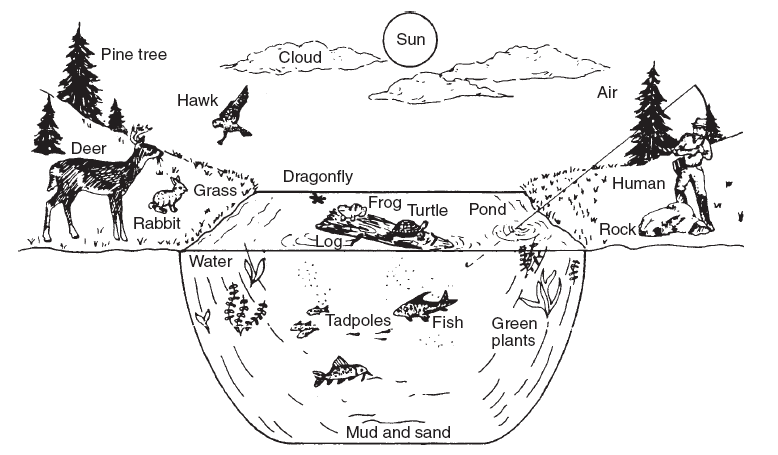
What is the primary source of energy for the ecosystem pictured above?
Grass and Green plants
Hawks and Deer
Tadpoles and Fish
Sun
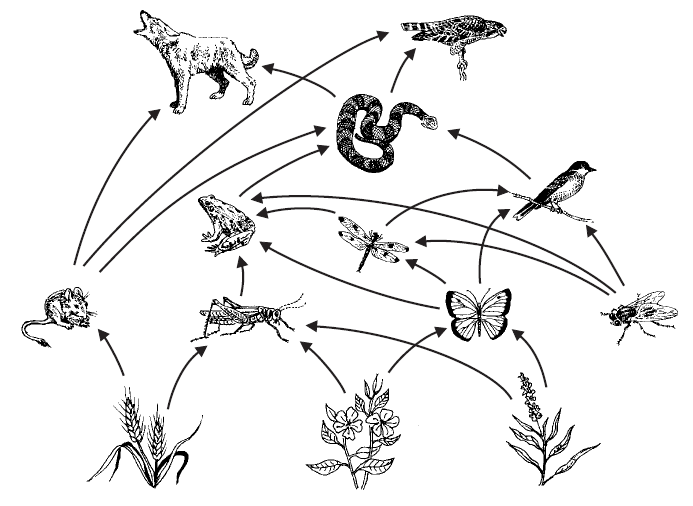
In this food web, which of the following organisms eats the largest variety of different producers?
Mouse
Grasshopper
Dragonfly
Butterfly
Yellowfin tuna, or Thunnus albacores, are large sport fish that are found in tropical and subtropical waters around the world. They typically school under objects such as boats or patches of driftwood for protection from predators. Schooling under these structures also provides yellowfin tuna with easy access to a food source such as smaller herbivorous fish that may be foraging for food around the structures. Which trophic level does yellowfin tuna fill in a food chain?
producer
primary consumer
secondary consumer
tertiary consumer
Food chains show energy transfer between organisms. The size of a food chain can vary, yet there is a limit to the number of levels that a food chain can reach. Why is there a limit to the number of levels that a food chain can reach?
Plants are not infinitely in the world
Producers can only eat what is available
Carnivores are too big to be eaten
Energy is lost when you move up a trophic level

How can you tell this is a tundra?
Temperatures are below zero most of the year
Temperatures go up and down
There is lots of precipitation (snow)
There is a wet season and dry season

How can you tell this is a grassland?
There are 4 Seasons
There is rain all year
It is dry all year
There is a wet and dry season

How can you tell this is a temperate deciduous forest?
There is lots of rain all year
The temperature is warm all year
There are 4 seasons
There is a wet and dry season

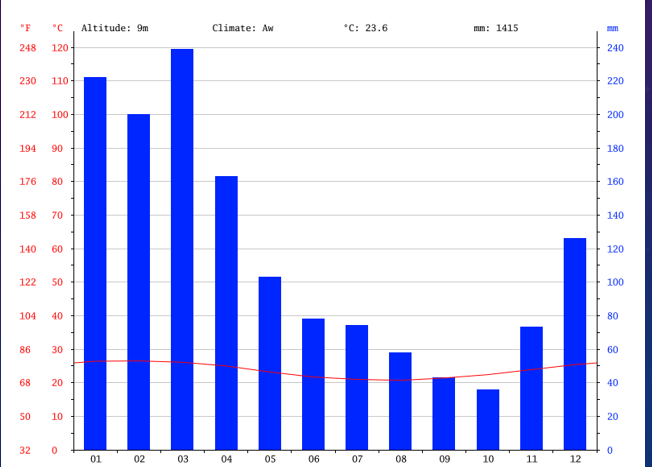
Which biome is represented by the climatograph?
Rainforest
Taiga
Grassland
Desert

A mandrill calling or growling to alert other mandrills that a predator is near is an example of _______ communication. Choose the best answer choice.
Visual
Auditory
Chemical
Tactile
A peacock displays his colorful feathers to attract a mate (a peahen). This is an example of __________________ communication.
Visual because the peahen is attracted to the beautiful colors.
Auditory because the peahen is listening for the mating call.
Visual because the peacock is ready to fight for his mate.
Auditory because the peahen is attracted to the beautiful colors.

To say "Warning! There's a predator!", the black-tailed prairie dog gives several short barks and whips their tail up and down. Who is the receiver in this situation?
The black-tailed prairie dog
The other prairie dogs in the area
The predator
The humans in the area
What are the advantages to animals living in groups?
Obtain food
Protect themselves
Cope with change
All of the above
What are some visual ways a bird would try to attract a mate? select two
A male bird showing off his colorful feathers
A female bird singing in a tree
A male bird doing a dance around the female
A male bird screeching loudly when a cat is near
A male bird flying really fast past the female


Which order shows how one change in an ecosystem can affect other parts?
Rain washed DDT into water, fish had DDT in bodies, DDT affected eagle eggs, farmers used DDT, eagles ate fish.
Farmers used DDT, eagles ate fish, fish had DDT in bodies, rain washed DDT into water, DDT affected eagle eggs.
DDT affected eagle eggs, farmers used DDT, fish had DDT in bodies, eagles ate fish, rain washed DDT into water.
Farmers used DDT, rain washed DDT into water, fish had DDT in bodies, eagles ate fish, DDT affected eagle eggs.
How can a species of mosquito become adapted to having pesticides in their ecosystem?
They have genes that allow it to live, while others die, and they pass along these genes.
They get bigger and can resist the pesticides.
The pesticides with color inside them kills less mosquitoes.
They move quickly and can escape the pesticide.
A student makes the following observations while looking at the classroom terrarium:
Observation 1 - Water dripped off of the African violet flower petal and was absorbed in the soil.
Observation 2 - The salamander climbed off of the rock and ate a leaf from the fern.
Observation 3 - The walking stick bug moved up the branch of the jade plant.
Observation 4 - The tree frog used its long tongue to catch and eat a flying insect.
Which observation demonstrates an organism interacting with ONLY NONLIVING elements of its environment?
Observation #1
Observation #2
Observation #3
Observation #4

In a desert habitat, many animals are nocturnal. They sleep in cool dens, caves, or burrows during the day. They hunt for food at night when the temperatures are cooler.
How do desert animals use NON-LIVING elements in their habitats to help them survive?
They are most active at night.
They sleep during the hottest part of the day.
They use dens and caves to stay out of the heat.
They hunt smaller animals that live in the desert.

The picture above shows a highway that was built through a wooded area. Some trees were cut down to create space for the road. The remaining woods line both sides of the highway.
Which of the following will most likely happen to the ecosystem as people begin DRIVING on the highway?
The highway will soon be overgrown by trees as new seedlings sprout in the road.
New animal populations will move to the area increasing the ecosystem diversity.
Animal populations will decrease in size because some individuals are struck by cars.
Animals that live in trees will decrease because they will have to move to a different forest.

Observe the “Food Sources of Texas Butterflies” table above.
Based on the information, which butterfly species would be least affected by a drought that reduces the amount of available nectar?
Pearl Crescent
Gulf Fritillary
Question Mark
Common Buckeye

This tree is losing its leaves during the fall. After all its leaves fall to the ground, the tree branches will be bare for the winter. Then new leaves will grow in the spring.
How can scientists predict these events will happen?
The climate is changing quickly.
The tree is going into hibernation.
Seasonal changes occur in a cycle.
An ecosystem disturbance has happened.
any factor that restricts the numbers, reproduction or distribution of organisms
limiting factor
tolerance
climax community
predator



