
 Worksheets
DNA Structure and Function
Total questions: 15
Worksheet time: 15mins
Name
Class
Date
1.
What are the nucleotides made of?
a)
Sugar, Phosphate, nitrogen base
b)
Phosphate, Adenine, nitrogen base
c)
Thymine, Adenine, Cytomine
d)
Phosphate, Nitrogen, Adenine
2.
Which of the following is not a component of DNA?
a)
5 Carbon Sugar
b)
Phosphate Group
c)
Carbon Base
d)
Nitrogen Base
3.
Which of the following is not a nitrogen base found in DNA?
a)
Thymine
b)
Uracil
c)
Guanine
d)
Adenine
4.
According to Chargaff's rule, Cytosine always pair with
a)
Adenine
b)
Uracil
c)
Thymine
d)
Gaunine
5.
What is the significance of the sequence (order) of the Nitrogen Bases in DNA?
a)
The order of the Nitrogen Bases determines the number of chromosomes present in an organism.
b)
The order of the Nitrogen Bases determines the traits that an organism will possess (have).
c)
The order of the Nitrogen Bases determines the gender of an organism.
d)
The order of the Nitrogen Bases determines whether an organism is abiotic biotic.
6.
The twisted ladder shape of DNA is known as a
a)
Double Helix
b)
Triple Helix
c)
Single Helix
d)
Triple Helix
7.
Which answer choice would by complementary (match up) with the DNA strand
ATGCATTCGA
ATGCATTCGA
a)
ATGCATTCGA
b)
TACGTAAGCT
c)
TACCTAAGGA
d)
ATGCCATGAA
8.
Adenine bonds with ______________.
a)
Guanine
b)
Thymine
c)
Cytosine
d)
Adenine
9.
Guanine bonds with ______________.
a)
Adenine
b)
Guanine
c)
Cytosine
d)
Thymine
10.
Which 2 molecules forms the sides (backbone) of the DNA ladder?
a)
deoxyribose and adenine
b)
deoxyribose and a hydrogen bond
c)
sugar and the nucleus
d)
deoxyribose (sugar) and phosphate
11.
Which organelle is DNA usually found in?
a)
cell membrane
b)
vacuole
c)
chloroplast
d)
nucleus
12.
Which sequence of DNA bases would pair with this partial strand
ATG TGA CAG
ATG TGA CAG
a)
ATG TGA CAG
b)
TAC ACT GTC
c)
GTA AGT GAC
d)
CAT TCA CTG
13.
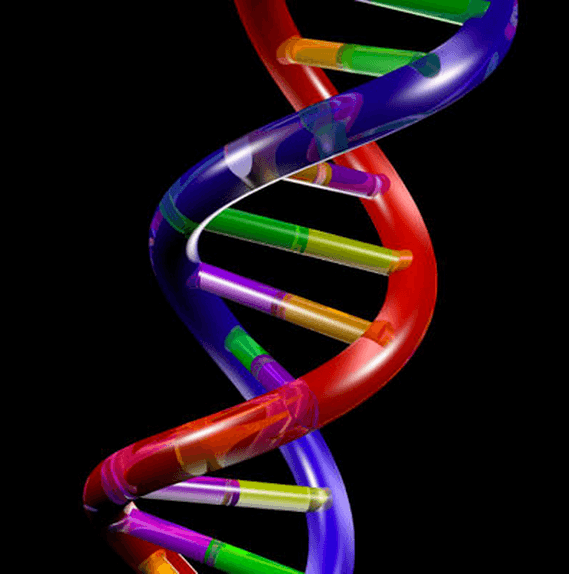
What determines the code, or information, of a DNA molecule?
a)
the shape (structure) of the nitrogen bases
b)
the order (sequence) of the nitrogen bases
c)
the color of the nitrogen bases
d)
the frequency (number) of nitrogen bases
14.
What does DNA stand for?
a)
Deoxyribonucleic acid
b)
Denitrogenous acid
c)
Deribonucleic acid
d)
Diribonucleic acid
15.
DNA holds the code for
a)
lipids
b)
carbohydrates
c)
protein
d)
sugar
100 %

