

wayground logo

Free Printable Worksheets

Font size

S
M
L
XL
Worksheets

Ch 2: Cell Structure and Function

Total questions: 40

Worksheet time: 28mins

Name
Class
Date
1.
This scientist was the first to identify cells and name them:
a)
Hooke
b)
Leeunwenhoek
c)
Schleiden
d)
Virchow
2.
All organisms are made of:
a)
organelles
b)
cytoplasm
c)
DNA
d)
cells
3.
This is the most basic unit of life
a)
atom
b)
cell
c)
nucleus
d)
DNA
4.
What kind of cell is this?
a)
Animal 
b)
Plant
5.
What kind of cell is this?
a)
Animal
b)
Plant
6.
Who are the three scientists credited with creating the Cell Theory?
a)
Schlieden, Schwann, Virchow
b)
Schindler, Schmeil, Vanderhoot
c)
Schwimmer, Shanazzek, Van Halen
7.

They are macromolecules needed by the cell (select all that apply):

a)

water

b)

proteins

c)

lipids

d)

carbohydrates

e)

nucleic acids

8.
Which of the following is NOT one of the basic points of Cell Theory?
a)
All living things are made of cells.
b)
The cell is the smallest living thing that can perform all the functions of life.
c)
Cells are too small to see without a microscope.  
d)
All cells must come from pre-existing cells.
9.
Osmosis is the movement of _____ across a membrane.
a)
food
b)
energy
c)
oxygen
d)
water
10.
This picture represents what type of cell transport?
a)
endocytosis
b)
exocytosis
c)
osmosis
d)
passive transport
11.
This picture represents which type of cellular transport?
a)
passive transport
b)
endocytosis
c)
exocytosis
d)
osmosis
12.
Which is true about active transport?
a)
It requires energy
b)
it does not require energy
c)
It moves substances down the concentration gradient
d)
it moves material from high to low concentration
13.
Cell membranes are found in
a)
Only animal cells
b)
Only plant cells
c)
Some plant and animal cells
d)
All plant and animal cells
14.
What makes the endoplasmic reticulum rough?
a)
Vessicles
b)
Vacuoles
c)
Ribosomes
d)
Chromosomes
15.

Packages proteins for delivery

a)
Endoplasmic reticulum
b)
ribosomes
c)
golgi bodies
d)
lysosomes
16.

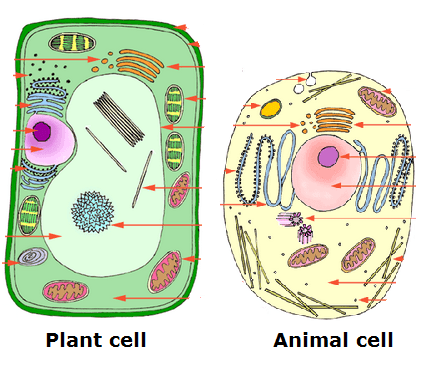
Break down (digest) worn out cell parts, mostly in animal cells
a)
cytoplasm
b)
lysosomes
c)
mitochondria
d)
vacuoles
17.
"Gatekeeper" Separates the cell from the rest of the environment and helps control what passes in and out of the cell.  Semi-permeable: allows some materials to pass through but not all
a)
Cell Wall
b)
Cytoplasm
c)
Mitochondria
d)
Cell Membrane
18.
Which organelle converts the energy in food into energy for the cell (cellular respiration)?
a)
Ribosomes
b)
Nucleolus
c)
Mitochondria
d)
Golgi Body
19.

What distinguishes a plant cell from an animal cell? (How do you tell them apart) Hint: There's 3 ways (Check all 3)

a)

Central Vacuole

b)

Mitochondria

c)

Cell Wall

d)

Ribosomes

e)

Chloroplasts

20.

The thick fluid region of a cell located inside the cell membrane or between the cell membrane and nucleus

a)
cytoplasm
b)
cell wall
c)
organelle
d)
golgi apparatus
21.
Produces hormones and lipid molecules for cells
a)
smooth endoplasmic reticulum
b)
rough endoplasmic reticulum
c)
nucleus
d)
ribosome
22.
Where are proteins made?
a)
Golgi body
b)
Mitoichondrion
c)
Chromosomes
d)
Ribosomes
23.
What is the name of the genetic material that is inside the nucleus?
a)
ER
b)
ATP
c)

RNA

d)
DNA
24.
What kind of transport does not require energy?
a)
Active 
b)
Vacuole 
c)
Passive 
d)
Na/K Pump 
25.
What structure of the cell forms a frame that holds the cell up in the cytoplasm?
a)
centrioles 
b)
cell wall 
c)
flagella 
d)
cytoskeleton 
26.
What is something that prokaryotic and eukaryotic cells have in common?
a)
They have a nucleus. 
b)
They are multi-cellular. 
c)
They have DNA. 
d)
They have organelles that are membrane-bound.
27.
What is facilitated diffusion?
a)
Transport that uses proteins to help move molecules across the membrane. 
b)
Movements of substances through a membrane. 
c)
When molecules spread from High to Low concentration on their own. 
d)
When pressure pushes something through a membrane. 
28.
All of the following statements are true about prokaryotic cells EXCEPT 
a)
No nucleus 
b)
They are simple and small 
c)
Have a cell wall 
d)
Have organelles 
29.
Molecules using simple diffusion move from 
a)
high to low concentrations 
b)
low to high concentrations 
c)
no concentrations  
d)
both concentrations  
30.

The cell membrane...

a)

is like a wall that blocks everything from going into the cell

b)

controls what can go into or out of a cell

c)

is hard and rigid, and gives the cell its shape, like an exoskeleton

31.

Where do cells come from?

a)

They come from eggs.

b)

They come from minerals in water.

c)

They come from other cells.

32.

Which cell part produces energy?

a)

mitochondria

b)

nucleus

c)

vacuole

d)

cytoplasm

33.

In PLANT cells, which part is the rigid outer layer that supports and protects the cell?

a)

cell membrane

b)

cell wall

c)

chloroplast

d)

nucleus

34.

Which parts do ONLY plant cells have? (Animal cells don't have them!)

a)

vacuoles and mitochondria

b)

nucleus and chloroplasts

c)

chloroplasts and cell membrane

d)

cell wall and chloroplasts

35.

Prokaryotic cells do NOT have membrane bound organelles or ______________________________.

a)

cytoplasm

b)

a nucleus

c)

ribosomes

d)

DNA

36.

In eukaryotic cells DNA is primarily contained within the:

a)

cytoplasm

b)

ribosomes

c)

vacuoles

d)

nucleus

37.

Diffusion & Facilitated Diffusion are both __________ transport.

a)

Passive

b)

Active

c)

Easy

d)

Free

38.

Passive Transport is the movement of particles across the membrane from an area of [ ___ ] to an area of [ ___ ]

a)

high to low

b)

low to high

c)

low to low

d)

high to high

39.
What is diffusion?
a)
when molecules move 
b)
when molecules move from a high concentration to a low concentration.
c)
no movement 
d)
molecules move everywhere
40.

Cells perform different functions. These 2 items help them to do that

a)

Cell Shape

b)

Cell Size

c)

Cell chemical composition

d)

Cell make up

e)

Cell organelles
