wayground logo

Free Printable Worksheets

Font size

S
M
L
XL
Worksheets

Solar system

Total questions: 40

Worksheet time: 7mins

Name
Class
Date
1.

6 x 10 = ?

a)

10100001111110010101010101010100101001010101001010101010101001010101110010101010

b)

60

c)

10298282828277272

d)

182

2.
The four terrestrial planets are known for their _________
a)
hot temps
b)
deep atmospheres
c)
rocky surfaces
d)
large size
3.
A force of attraction between any two objects is called _____________.
a)
static electricity 
b)
rotation
c)
gravity
d)
orbit
4.
The __________ has planets, moons, comets, and asteroids.
a)
solar system
b)
earth
c)
rotation
d)
United States
5.
Select the order from smallest to largest.
a)
Sun, Milky Way, solar system, universe
b)
Sun, Milky Way, universe, solar system
c)
Sun, solar system, Milky Way, universe
d)
Sun, solar system, universe, Milky Way
6.
One of the main differences between the outer and inner planets is __________.
a)
The inner planets all have water
b)
the inner planets are much bigger than the outer planets
c)
the outer planets are gas planets
d)
the inner planets have rings, and the outer planets don't
7.
Which factor makes Earth different from all the other planets in the solar system in its ability to support life? 
a)
The Earth is exposed to rays from the sun. 
b)
The Earth has only one moon that orbits around it. 
c)
The Earth rotates in an elliptical orbit around the sun. 
d)
The Earth has a breathable atmosphere. 
8.
Which planet is an INNER planet?
a)
Jupiter
b)
Mars
c)
Uranus 
d)
Neptune
9.
Which planet is an Outer planet?
a)
Earth
b)
Mercury
c)
Saturn
d)
Venus
10.
All of Earth experiences night at the same time.
a)
True
b)
False
11.
Which planet has the shortest orbit around the sun?
a)
Earth
b)
Mercury
c)
Saturn
d)
Neptune
12.
What is the correct order of the inner planets?
a)
Jupiter, Saturn, Uranus, Neptune
b)
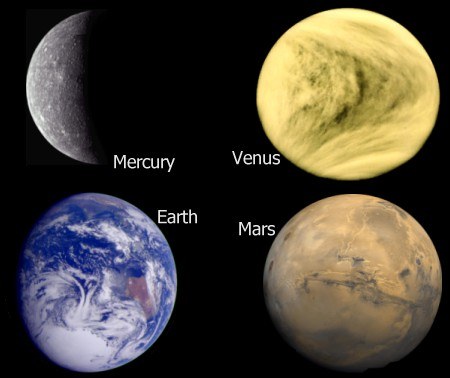
Mercury, Venus, Earth, Mars
c)
Mercury, Earth, Mars, Venus
d)
Jupiter, Mars, Uranus, Neptune
13.
Marc uses a softball to model moon phases in his darkened classroom by turning in a swivel chair placed next to a lamp.  At times, Marc's body is between the lamp and the softball.  At other times, the softball is between Marc and the lamp.  Based on this info, which of the following is true?
a)
Marc represents the sun and the chair represents the Earth.
b)
Marc represents Earth, the softball represents the moon, and the lamp represents the sun.
c)
Marc's turning represents Earth's orbit around the sun.
14.
When the solar system was young, new materials were added to the planets by...
a)
nuclear fusion.
b)
primitive life-forms.
c)
impacts of smaller objects.
d)
convection of planet layers.
15.
Put the planets in order, smallest to largest.
a)
Neptune, Jupiter, Uranus, Mars, Mercury, Saturn, Earth, Venus
b)
Jupiter, Saturn, Uranus, Neptune, Earth, Venus, Mars Mercury
c)
Mars, Mercury, Earth, Venus, Uranus, Neptune, Saturn, Jupiter
d)
Mercury, Mars, Venus, Earth, Neptune, Uranus, Saturn, Jupiter
16.
A small body that orbits a planet is a(n)
a)
comet
b)
moon
c)
asteroid
d)
exoplanet
17.
Nebula's are mixtures of gases and what?
a)
clouds
b)
stars
c)
tiny particles
d)
dust
18.

What is at the center of our Solar System and also the largest object in it?

a)

Earth

b)

Jupiter

c)

The Sun

d)

The Moon

19.

What is the closest planet to the Sun?

a)

Venus

b)

Mercury

c)

Earth

d)

Mars

20.

What four planets are gas planets?

a)

Mercury, Venus, Earth, Mars

b)

Mercury, Venus, Jupiter, Saturn

c)

Neptune, Uranus, Earth, Jupiter

d)

Jupiter, Saturn, Uranus, Neptune

21.

Which planet takes the longest to revolve around the Sun?

a)

Earth

b)

Jupiter

c)

Uranus

d)

Neptune

22.

Which planet is the largest?

a)

Saturn

b)

Jupiter

c)

The Sun

d)

Earth

23.

How big is the Sun compared to other stars?

a)

It is a small star.

b)

It is an average size star.

c)

It is a very large star.

24.

The Sun revolves around the Earth.

a)

True

b)

False

25.

Which one of the following is a dwarf planet?

a)

Mercury

b)

Venus

c)

Pluto

d)

Mars

26.

Click on all of the following planets that have at least 1 moon.

a)

Venus

b)

Earth

c)

Mars

d)

Mercury

27.

What is the order of the planets from the Sun?

a)

Venus, Mercury, Earth, Mars, Saturn, Jupiter, Uranus, Neptune

b)

Mercury, Venus, Earth, Mars, Neptune, Uranus, Saturn, Jupiter

c)

Neptune, Uranus, Saturn, Jupiter, Mars, Earth, Venus, Mercury

d)

Mercury, Venus, Earth, Mars, Jupiter, Saturn, Uranus, Neptune

28.

Other objects orbit the Sun besides the planets.

a)

True

b)

False

29.

How many planets are there in our Solar System?

a)

7

b)

8

c)

6

d)

9

30.

About how far away is the Earth from the Sun?

a)

62 million miles

b)

89 million miles

c)

93 million miles

d)

142 million miles

31.

Click on all of the planets that are rocky.

a)

Earth

b)

Saturn

c)

Mars

d)

Venus

e)

Neptune

32.

What is the main gas that makes up the Sun?

a)

Hydrogen

b)

Helium

c)

Oxygen

d)

Nitrogen

33.
Which is the largest object in our solar system?
a)
Sun
b)
Jupiter
c)
Earth
d)
Pluto
34.
Earth and the other planets closest to the Sun are made mostly of _______
a)
gas
b)
metal
c)
water
d)
rock
35.
One full orbit of an object around another object is called a ________.
a)
axis
b)
rotation
c)
revolution
d)
satellite
36.
The outer planets are...
a)
Rocky and small
b)
Very large and made of ice
c)
Small and made of ice
d)
Very large and made of gases
37.
Which object has the most gravity?
a)
Earth
b)
moon
c)
Jupiter
d)
sun
38.
What planet is eighth in the Solar System?
a)
Uranus
b)
Jupiter
c)
Neptune
d)
Mars
39.
Which planet is the largest in the solar system?
a)
Earth
b)
Venus
c)
Saturn
d)
Jupiter
40.

What's the order of the outer planets

a)

Jupiter, Pluto Saturn, Mars

b)

Jupiter, Saturn, Uranus, Neptune

c)

Mercury, Venus, Earth, Mars

d)

Pluto, Mars, Saturn, Jupiter