wayground logo

Free Printable Worksheets

Font size

S
M
L
XL
Worksheets

Dichotomous Key

Total questions: 40

Worksheet time: 38mins
Name
Class
Date
1.
What should you do when typing a scientific name?
a)
Capitalize the first word
b)
Capitalize the first word and underline the whole thing
c)
Capitalize the first word and italicize the whole thing
d)
Nothing
2.
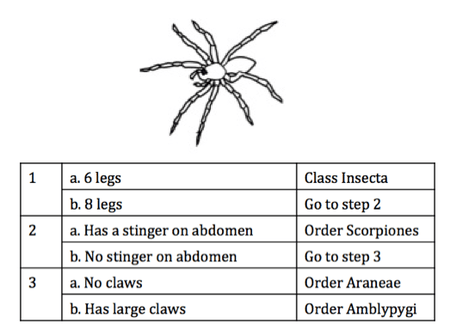
An illustration and a dichotomous key are given. What is the correct classification for this organism?
a)
Class Insecta
b)
Order Amblygygi
c)
Order Araneae
d)
Order Scorpiones
3.
A table of arachnid and insect characteristics is shown. Which characteristic could be used to distinguish between
arachnids and insects?
a)
Jointed legs
b)
Body segments
c)
Presence of eyes
d)
Presence of antennae
4.
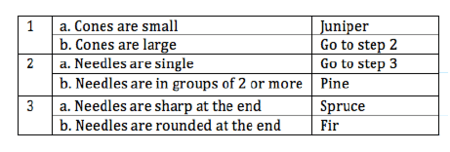
A dichotomous key for trees is provided. Hikers found a tree that has large brown cones and single sharp needles. What species of tree have the hikers found?
a)
Juniper
b)
Pine
c)
Spruce
d)
Fir
5.
What is the purpose of a dichotomous key?
a)
to find a common ancestor
b)
to show the evolution of organisms
c)
to show relationships between organisms
d)
to identify organisms
6.
From the table, which two animals are MOST CLOSELY related
a)
House Cate and Red Fox
b)
Red Fox and Dog
c)
Dog and Wolf
d)
Wolf and Gopher
7.
A dichotomous key for trees is provided. Hikers found a tree that has large brown cones and single sharp needles. What species of tree have the hikers found?
a)
Juniper
b)
Pine
c)
Spruce
d)
Fir
8.
What step do we always start with when using dichotomous keys?
a)
1
b)
2
c)
3
d)
4
9.
When using a dichotomous key to identify organisms, what do we look at?
a)
physical features
b)
weather patterns
c)
environment
d)
diet
10.
The 8 levels of classification, most broad to most specific.
a)
Domain, Genus, Family, Order, Class, Phylum, Kingdom, Species
b)
Domain, Species, Kingdom, Genus, Phylum, Family, Class, Order
c)
Domain, Kingdom, Phylum, Class, Order, Family, Genus, Species
d)
Order, Kingdom, Species, Domain, Phylum, Family, Class, Genus
11.
Term given to describe the 2 name naming system is:
a)
dichotmous key
b)
binomial nomenclature
c)
2 scientific names
d)
binomial key
12.
The first part of a scientific name is an organism's _______________ and the second part is its ________________.
a)
species, genus
b)
phylum, order
c)
class, spices
d)
genus, species
13.
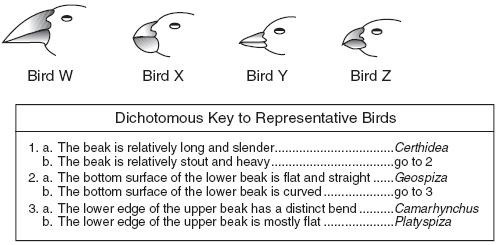
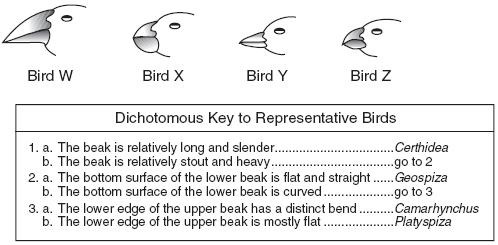
What is the name of bird W?
a)
Certhidea
b)
Geospiza
c)
Camarhynchus
d)
Platyspiza
14.
What is the name of bird Z?
a)
Certhidea
b)
Geospiza
c)
Camarhynchus
d)
Platyspiza
15.
Using this dichotomous key, identify the name of the circled Fish, J.
a)
peacock flounder
b)
band-tail puffer
c)
trumpet fish
d)
spotted goat fish
16.

What is binomial nomenclature?

a)

system of 3 names

b)

system of 2 names

c)

the names of the kingdoms

d)

the levels of classification

17.

Which animal is invertebrate?

a)
b)
c)
d)
18.

Which animal is a mammal?

a)
b)
c)
19.

Which animal is a reptile?

a)
b)
c)
20.
What are the 8 levels of classification of living things from most general to most specific?
a)
domain, kingdom, phylum, class, order, family, genus, species
b)
domain, kingdom, phylum, class, order, family, genius, species
c)
domain, kingdom, phamily, class, order, family, genus, species
d)
domain, king, phillip, class, order, family, genus, species
21.
A student discovers an arachnid with a segmented abdomen, long legs, and a tail with no stinger. The student uses the dichotomous key below to identify it. Which arachnid has the student found?
a)
Whip Scorpion
b)
Wind Scorpion
c)
Daddy long legs
d)
Scorpion
22.
An illustration and a dichotomous key are given. What is the correct classification for this organism?
a)
Class Insecta
b)
Order Amblygygi
c)
Order Araneae
d)
Order Scorpiones
23.

Which of the following is the correct way to show the scientific name for tiger?

a)

Panthera Tigris

b)

Panthera tigris

c)

panthera Tigris

d)

panthera tigris

24.

Which of the following is a reason scientists use scientific names as opposed to their common names?

a)

Scientists around the world use the same names so there is no language barrier

b)

No two species have the same name, so there is no confusion about which organism is being studied

c)

Scientific names can help you know which organisms are related if they share a common genus name

25.

Scientists group similar organisms together through a process called .....

a)

identification

b)

Estimation

c)

Classification

d)

Organization

26.

What is the genus name here:

Canis lupus

a)

Canis

b)

lupus

27.

Biologist group living things based on ____.

a)

Habitat

b)

Size

c)

Colors

d)

Shared Characteristics

28.
An organism that has cells that lack a nucleus are called:
a)
Eukaryote
b)
Heterotroph
c)
Prokaryote
d)
Autotroph
29.
This is a 
a)
bird
b)
fish
c)
mammal
d)
reptile
30.

Which of the following organisms is a vertebrate?

a)

insect

b)

sponge

c)

monkey

d)

earthworm

31.

Which term describes an animal without a

backbone?

a)

chordate

b)

invertebrate

c)

protozoan

d)

vertebrate

32.

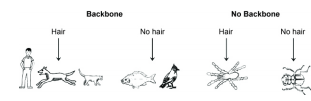
According to the classification key above, which pair of animals could be classified as mammals?

a)

humans and dogs

b)

birds and fish

c)

birds and fish

d)

cats and birds

33.

In a dichotomous key, organisms should be classified based on their

a)

diet

b)

habitat

c)

observable features

d)

sounds they make

34.

How many options should every branch in a dichotomous key have?

a)

1

b)

2

c)

3

d)

4

35.

Why do scientists use dichotomous keys?

a)

To arrange organisms based on habitat

b)

To determine evolutionary history

c)

To identify different organisms

d)

To analyse feeding habits

36.

Which of the following is a centipede?

a)
b)
c)
d)
37.

Identify leaf F

a)

Cydonia

b)

Magnolia

c)

Aesculus

d)

Fraxinus

e)

Ilex

38.

What feature does this dichotomous key use to identify organisms?

a)

Number of legs

b)

Body colour and pattern

c)

Presence of wings

d)

Surface features

39.

If you were to make a dichotomous key to identify this organism, which option would NOT be used?

a)

Presence of webbed feet

b)

Presence of tail

c)

Fur on the body

d)

Ability to swim

e)

Absence of wings

40.

Which of the following organisms is M. erminea?

a)

A

b)

B

c)

C

d)

D

e)

E