
 Worksheets
Chemistry Unit Review
Total questions: 99
Worksheet time: 1hrs 6mins

Identify the WHMIS symbol by choosing the description of the hazard.
organisms or toxins that can cause disease in people or animals
gases under pressure
may cause or suspected of causing serious health effects
can cause death or toxicity with short exposure to small amounts

Identify the WHMIS symbol by choosing the description of the hazard.
oxidizing hazards
fire hazards
corrosive damage to metals, as well as skin, eyes
explosion or reactivity hazards

This is used to store and mix chemicals during an experiment
graduated cylinder
thermometer
beaker
tongs
flammability of a substance
physical property
chemical property
freezing point
physical property
chemical property
density
physical property
chemical property
Ductility means
breaks easily
process of turning to liquid when heated
stretchable
able to be drawn out into a long thin wire without breaking
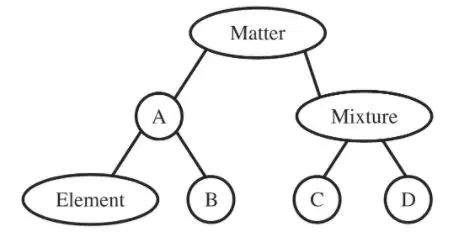
Match the following
Pure substance
A
Compound
B
Solution
C
Is the following a pure substance or mixture? Baking Soda ( NaHCO3 )
pure substance
mixture
Is the following a pure substance or mixture? Trimix (oxygen, nitrogen, and helium) found in a scuba tank
pure substance
mixture
Is the following an element or compound? hydrogen peroxide (H2O2)
element
compound
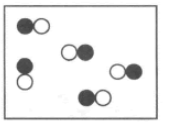
Classify the particle diagram.
element
compound
mixture
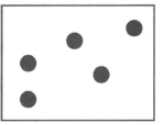
Classify the particle diagram.
element
compound
mixture

Classify the particle diagram.
element
compound
mixture
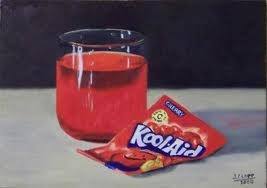
How would you classify this image?
homogeneous mixture
heterogeneous mixture
The Best Friend's Club uses "invisible ink" to write notes to each other. The invisible ink is actually lemon juice that is clear when it dries on paper, but turns brown when a club member holds a burning candle under the paper. Once it is heated, it is never invisible again.
What type of change is occurring when the paper is heated?
Chemical Change
Physical Change
Elemental Change
Temperature Change
A student mixes two clear liquids together. After a few minutes, a white powdery solid can be seen settling on the bottom of the test tube. Which of the following is a conclusion that the student can draw based on these observations? The two clear liquids-
were pure substances before they were mixed
are toxic and should be handled with extreme caution
have gone through a chemical change in which a new substance called a precipitate was produced
have been stored too long and are no longer good
Shredding paper is an example of a
chemical change
physical change
physical property
chemical property
A student added white crystals to a clear liquid. The crystals dissolved in the liquid. After a few seconds, the liquid became quite warm and then turned bright red in color. Indications that a chemical change was taking place could be observed when –
the white crystals were added to the clear liquid.
the crystals dissolved in the liquid leaving only the liquid visible
There are no indications of chemical change
the temperature of the liquid increased and an unexpected color change occurred.
JJ Thomson discovered what subatomic particle
nucleus
neutron
proton
electron
Rutherford discovered what part of the atom
nucleus
neutron
proton
electron
Who proposed the theory that atoms orbit the nucleus in specific orbits?
Bohr
Democritus
Rutherford
Chadwick
This particle balances the charges from the protons to make the atom neutral
proton
electron
neutron
nucleus
These particles are found in the nucleus
protons and electrons
nucleus and neutrons
protons and neutrons
electrons and neutrons

Which Scientist created this model
Democritus
Chadwick
Bohr
Rutherford
Subatomic particles with a negative charge
Electrons
Neutrons
Protons
Quarks

A) Ernest Rutherford
B) J.J. Thomson
C) John Dalton


Carbon has how many protons?
12
6
7
4

Bromine has how many Neutrons?
35
80
45
8
The atomic number tells you what?
number of electrons
number of protons
number of neutrons
both electrons and protons in an atom.
In which group would you find the Noble Gases?
15
16
17
18
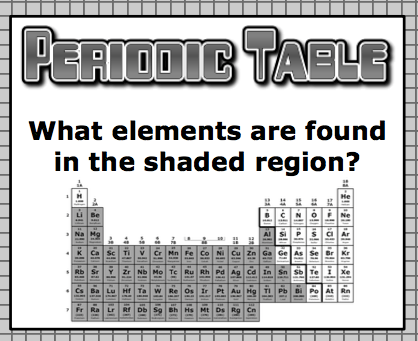

What is the name of the family that is highlighted?
Alkali Metal Family
Halogen Family
Noble Gas Family
Transition Metal Family
Which element is the most recative non-metal?
Sodium
Fluorine
Hydrogen
Helium

How many atoms are in CCl4 ?
5
4
2
6
How many different elements are in the chemical formula: CH3OH ?
6
4
5
3
How many Hydrogen atoms are in the chemical formula: CH3OH ?
6
4
5
3


molecular
Classify as ionic or molecular
made of non metals
form conducting solutions
low melting and boiling point
solid at room temperature
When dissolved in water, the solution is a good conductor of electricity.
ionic compounds
molecular compounds
Formula for phosphorus trichloride
What is the name of the following compound: NaCl
sodium chloride
sodium monochloride
sodium chlorine
sodium (I) chloride
Which below shows a CHEMICAL change?


Which of the following is a common sign that a chemical change has occurred?
new color, formation of gas or precipiate, energy change
A chemical has changed to a different state of matter, such as a liquid to a solid.
A chemical has changed size.
A chemical has become a different shape.

In an endothermic reaction, energy is _________.
absorbed
released
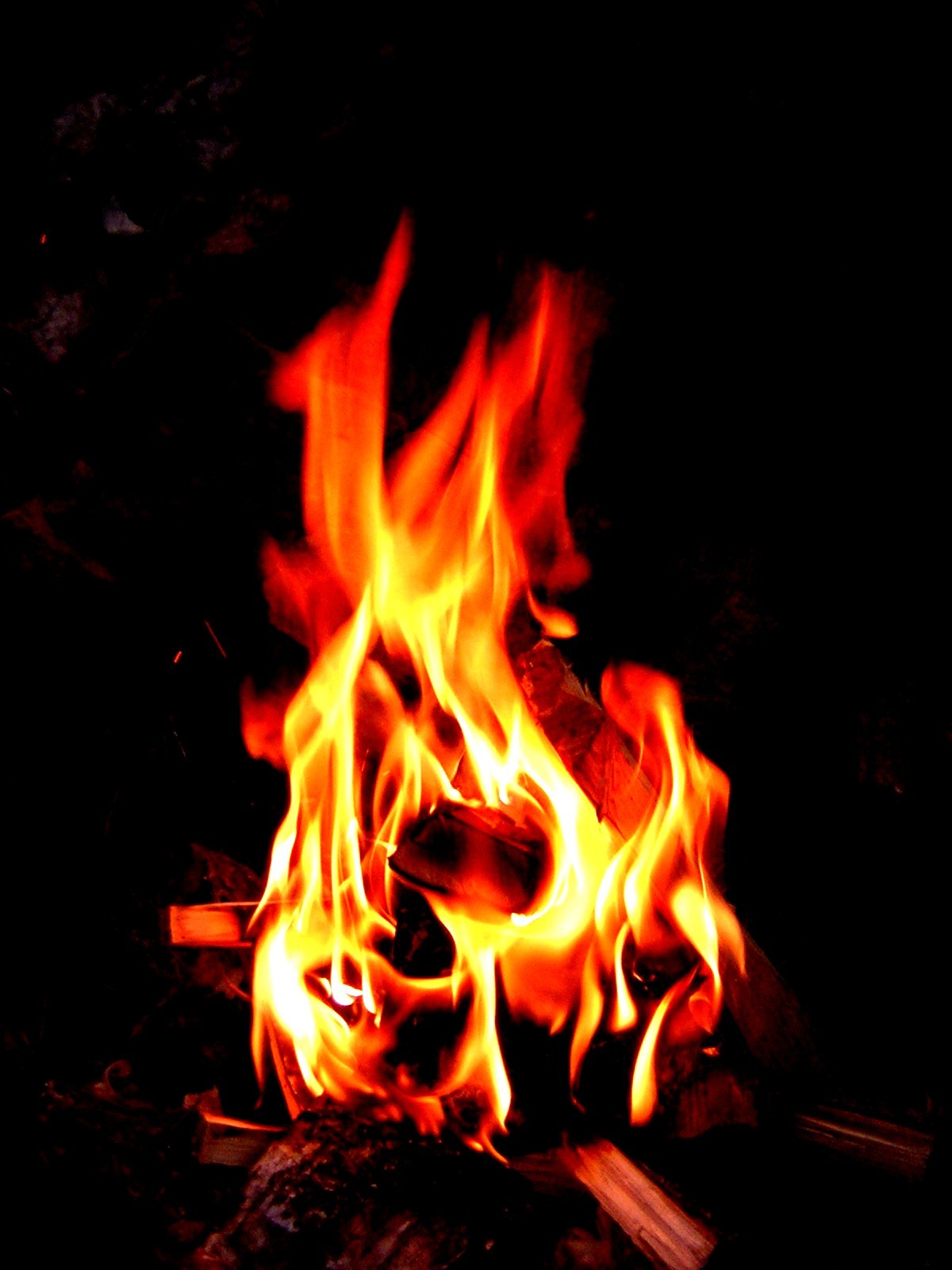
_____ reactions usually feel hot!
endothermic
exothermic

Baking pizza in the oven
endothermic
exothermic
When barium hydroxide and ammonium chloride react, the temperature of the mixture decreases. What kind of reaction is this?
Endothermic
Decomposition
Exothermic
Indothermic
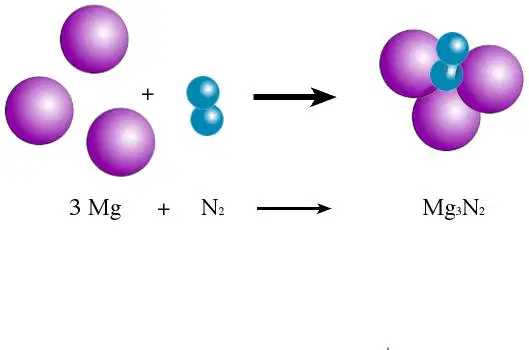
Word equation for the equation shown
magnesium + nitrogen = magnesium nitride
magnesium + nitrogen = trimagnesium dinitride
magnesium + nitride=trimagnesium dinitride
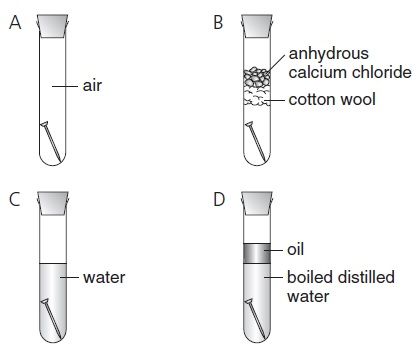
Which diagram shows the most favourable conditions for rust to appear on the nail?
A
B
C
D
What happens in a chemical reaction?
Bonds between atoms break and/or are formed
New atoms are created and/or removed
Protons move from one atom to another
Electrons change into protons

Which of the models of a chemical reaction best represents the Law of Conservation of Mass?
A
B
C
D
Which of the following is NOT a possible product for a reaction between the reactants listed here? 2HCl +CaCO3
CaCl2
H2O
NH3
CO2
According to the Law of Conservation of Mass, what happens to the wood and oxygen when it is burned?
The wood disappears.
It stays the same chemically.
The atoms in the wood and oxygen rearrange and form smoke and ash.
Nothing.


How many grams of OXYGEN would be needed to show conservation of mass in the example below?
100 g
93 g
7 g
0 g

How many kilograms of SMOKE are shown in the example of conservation of mass?
1 kg
30 kg
28 kg
3 kg
A temperature increase causes the particles ......
to slow down
move faster
collide higher
in the right order
Why does a higher concentration increase the rate of reaction?
it increases the amount of reactants
it lowers the activation energy
it increases the energy of particle collisions
it increases the frequency of particle collisions
Why does a higher temperature increase the rate of a reaction?
It increases both the frequency of collision and energy of reactant particles
It only increases the frequency of collision
It only increases the energy of reactant particles
It reduces the activation energy of the reaction
Four light sticks are placed in water baths of varying temperatures. At which temperature would the light stick glow the brightest?
0° C
20° C
30° C
40° C
Enzymes in your body act as catalysts. Thus, the role of enzymes is to___________.
inhibit chemical reactions.
increase the rate of chemical reactions.
decrease the rate of chemical reactions.

Which temperature had the highest reaction RATE?
52
42
32
22

What is the responding variable in this experiment?
temperature of the water
time to complete the reaction
reaction rate
amount of water
What trend is shown in the data?
When the temperature increases the reactione time increases
When the temperature increases the reactione time decreases
Temperature and reactiom time are the same
When the reactiontime decreases the temperature increases

