
Font size
 Worksheets
MODULE 4: EARTH'S MECHANICS
Total questions: 15
Worksheet time: 9mins
Which is TRUE about convection current?
the rising and cooling of molten materials in the crust
the rising and cooling of molten materials in the mantle
the rising and boiling of molten materials in the core
the rising and boiling of molten materials in the crust
Who is a scientist who discovered mantle and the process of seafloor spreading?
Alfred Wegener
Gregor Mendel
Isaac Newton
Harry Hess
These are CORRECT about subduction process EXCEPT?
It is the process when two continental plates move away from each other
It is the process when the oceanic plate goes down under continental plate
It is the process when the two oceanic collides towards each other causing to form another form of oceanic plate
It is the process when the two oceanic plates move towards each other causing to form mountains and volcanoes.
The process of seafloor spreading occur in what plate boundary?
transform boundary
convergent boundary
divergent boundary
slide-slip boundary
What do you think is the reason behind the formation of volcanic arcs or islands in the Philippines?
because of the two oceanic plates slide from each other
because of the two oceanic plates move away from each other
because of the two continental plates move away from each other
because of the two oceanic plates collide from each other
In which particular plate boundary where earthquakes occur?
convergent boundary
divergent boundary
transform boundary
none of the above
Why does the Philippines are prone to earthquakes and volcanic eruptions?
because of its geographical position towards "Pacific Ring of Fire" or pacific plate
because of its geographical position towards south american plate
because of its geographical position towards north american plate
both b and c
In what boundary does two plates move apart.
(a)
Before there was only one supergiant continent named (a) .
Which of the following are the possible driving forces of plate tectonics?
convection, slab pull, ridge push
conduction, convection, slab pull
conduction, radiation, ridge push
conduction, convection, ridge push
Which of the following figures best illustrate ridge push?


The process where oceanic crust slides under another plate and is melted is called ___________.
seafloor spreading
subduction
continental drift
recycling
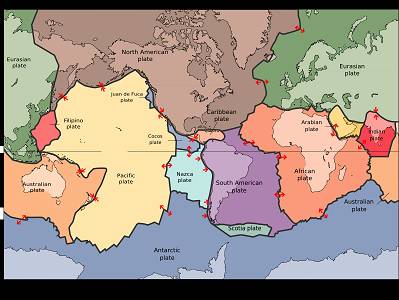
Continental plates are ______ dense and ________ than ocean plates.
more; thinner
more; thicker
less; thinner
less; thicker
Ocean plates are _______ dense and _______ than continental plates
less; thinner
more; thinner
more; thicker
more; thicker

