Wayground logo

Free Printable Worksheets

Font size

S
M
L
XL
Worksheets

Thursday week 6 grav forces/ fields and orbitals

Total questions: 22

Worksheet time: 14mins

Name
Class
Date
1.
The definition of gravitational field strength is:
a)
The region of space surrounding a body where other bodies will feel an attractive force due to it.
b)
The region of space surrounding a body where other bodies will feel an repulsive force due to it.
c)
The region of space surrounding a charge where other charges will feel an attractive force due to it.
d)
The region of space surrounding a charge where other charges will feel an repulsive force due to it.
2.
The closer together the gravitational field lines.....
a)
the weaker the gravitational field strength
b)
the stronger the gravitational field strength
c)
the more repulsive the gravitational field strength
3.
In this equation...
a)
G is the gravitational field strength
b)
r is the distance between the 2 masses
c)
F is the repulsive gravitational force
d)
m is the momentum of the mass
4.
If I double the distance between two objects, what happens to their gravitational Force?
a)
4x bigger
b)
4x smaller
c)
2x bigger
d)
2x smaller
5.
If the mass on Mars is 6.4 kg x 1023 kg and the mass on Earth is 6.0 kg x 1024 kg, which one would you weigh more on?
a)
Earth
b)
Mars
6.
Find the force due to gravity if the mass of the object is 2300 kg and the mass of the other object is 4000 kg. The distance between the two objects is 0.150 m.
a)
0.00409 N
b)
244 N
c)
0.027 N
d)
6.14x10⁻⁴ N
7.

We generally think of satellites of small mass in orbit around bodies of much larger mass. In the case of two bodies of equal mass is it proper to treat one as being at the centre and the other as its satellite?

a)

The two bodies can be treated as each being in orbit around a point in space equidistant between them.

b)

The equal bodies collide rather than orbit each other, so the situation does not arise.

c)

It is possible for a heavenly body to have a moon equal to its own mass, but the separation would need to be 2r for the system to be stable.

d)

If a 'moon's' mass is too large, gravitational attraction will exceed the centripetal force needed to keep it in orbit, therefore the situation is unstable in the long term.

8.

Which of the following statements is true about the gravitational field around a body?

a)

A gravitational field only exists around the body if there is a test mass nearby to be attracted to it.

b)

A gravitational field exists around the body even if there is no test mass nearby but the field has no direction.

c)

A gravitational field exists around the body even if there is no test mass nearby and the field points inwards towards the body.

d)

The direction of the gravitational field around the body depends on the position of a test mass placed nearby.

9.

What are the units of the gravitational constant, G?

a)

r3=GMT24π2r^3=\frac{GMT^2}{4\pi^2}  

b)

N kg m−2N\ kg\ m^{-2}

c)

N m kg−2N\ m\ kg^{-2}  

d)

N kg−2 m2N\ kg^{-2}\ m^2  

10.
How far out from a mass should the gravitational field lines go....
a)
to where the gravitational field becomes negligable
b)
to twice the diameter of the mass
c)
infinitely far
d)
to four times the diameter of the mass
11.
The gravitational field strength of Earth is...
a)
uniform far away from the surface and radial close to the surface
b)
uniform close to the surface and radial far away from the surface
12.

A body of mass 20 kg mass is placed 4 m above the Earth's surface. The value of g may be taken as 10 ms-2.


What are the gravitational field strength and gravitational force acting on the body?

a)

A

b)

B

c)

C

d)

D

13.

The radius of the Earth may be taken to be 5760 km. A satellite is in a circular orbit 144 km above the Earth's surface. What is the approximate value of the gravitational force on the satellite compared with that when it is at the Earth's surface?

a)

greater by 10%

b)

greater by 5%

c)

less by 5%

d)

less by 10%

14.

Each diagram below shows the variation of the gravitational potential energy U and the gravitational force F of a point mass with its distance r from another point mass.


Which one of the diagrams is correct?

a)
b)
c)
d)
15.

In an elliptical orbit, you will be travelling the fastest at the...

a)

Midpoint

b)

Vertex

c)

Apoapsis

d)

Periapsis

16.

In an elliptical orbit, the point farthest away from the object you are orbiting is called the...

a)

Apoapsis

b)

Pariapsis

c)

Directrix

d)

Hyperbola

17.
Kepler's 2nd Law deals with 
a)
the shape of the planets' orbits
b)
the speed/area the planet travels 
c)
the length of time it takes the planet to orbit the sun
18.
A planet moves __________ when it is farthest from the sun.
a)
faster
b)
slower
19.

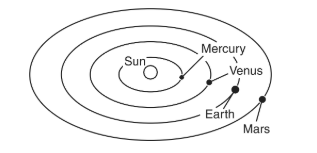
Which planet will take the least amount of time to revolve around the Sun?

a)

Mercury

b)

Venus

c)

Earth

d)

Mars

20.
According to Kepler's 3rd law, the square of the time it takes for an object to orbit, T, is directly related to the cube of the distance, r, between the object and what it is orbiting.    
What this means is that if a satellite moves away from what it is orbiting,
a)
the larger the constant k is.
b)
the smaller the constant k is.
c)
the longer the orbital period is.
d)
the shorter the orbital period is.
21.

Kepler's 3rd law tell us that __ would be dependent on __.

a)

orbital period ; distance

b)

distance ; orbital period

22.
Kepler’s 3rd law states the square of the orbital period is proportional to the cube of the orbital radius. (T2=r3)

If a planet's orbital radius is doubled, what happens to the length of a year on that planet?

a)
It will become twice as long
b)
It will become about 8 times as long
c)
It will become 2.8 times as long
d)
It will remain the same