
 Worksheets
Water and Its Properties
Total questions: 57
Worksheet time: 34mins
What percentage of water on Earth is salt water?
75 %
3 %
80 %
97 %
Water falls back down to Earth's surface in which ways...
clouds
rain
sleet
hail
snow
True or False: Water can reshape what a landscape looks like
True
False
True or False: Humans are 3% water
True
False
What two types of atoms are in a water molecule?
Carbon
Nitrogen
Oxygen
Hydrogen
Anything having a negative charge at one end and a positive charge on the opposite end.
This is the definition for...
Adhesion
Cohesion
Polarity
The three states of matter are:
Ice
Solid
Water
Liquid
Gas
Water in its solid form is...
Regular Water
Liquid
Ice
Water Vapor
Cohesion is...
The property that allow molecules to stick to something else
The property that allows molecules of the same substance to stick together
Molecules rolling around each other
Adhesion is...
The property that allows molecules to stick to something else
The property that allows molecules of the same substance to stick to each other
Anything having a negative charge at one end and a positive charge on the opposite end
Hydrogen has a partial ________________ charge.
Positive
Negative
Oxygen has a partial _______________ charge.
Positive
Negative
Matter is made up of tiny particles called...
Atoms
Polarity
Cohesion
Adhesion
A water molecule looks like....
A House
Mickey Mouse
A Star
In a water molecule there are 2 ___________ atoms.
Oxygen
Nitrogen
Hydrogen
Helium
In a water molecule, there is 1 ____________ atom.
Helium
Hydrogen
Oxygen
Nitrogen
Water falling through the air looks like...
A teardrop
A circle
A star
A triangle
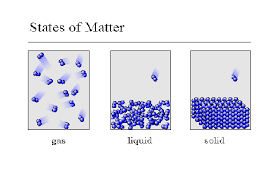
A gas
slow moving particles
close together particles
has fast-moving particles

Particles in a ______________________ move quickly and are far apart.
gas
solid
liquid

Particles of a liquid
are tightly packed together and stay in a fixed position.
are free to move around one another but still touch.

Definite shape and definite volume
Solid
Liquid
Gas
The three main states of matter are:
Solid and liquid
Solid, liquid and gas
Plasma, liquid and solid
Matter is anything that takes up space
True
False

What state of matter is sugar?
Liquid
Solid
Gas

What state of matter is an apple?
Liquid
Solid
Gas

What state of matter is milk?
Liquid
Solid
Gas
The oxygen is...
Gas
LIquid
Solid
Liquids take the shape of their container
False
True
A solid keeps its shape
False
True
In which state of matter are particles packed tightly together in fixed positions?
gas
solid
liquid
Particles of a liquid
are tightly packed together and stay in a fixed position
are free to move in a container but are in close contact with one another
move very fast and do not really touch each other
In which state of matter do particles spread apart and fill all the space available to them?
solid
liquid
gas

The smoke is...
Liquid
Solid
Gas

What state of matter does the picture below represent?
solid
liquid
gas
plasma
What is matter made up of?
particles that are too large to be seen
tiny water particles
particles that are too small to be seen

The diagram shows arrangement of particles in a
Solid
Liquid
Gas

The particles in the picture are tightly held together with very tiny movement. They have shape and fixed volume. Therefore, the picture represents _________.
solid
liquid
gas
plasma
In which state of matter will there be the LARGEST space between molecules?
Solid
Liquid
Gas

What state is represented in the gif?
Solid
Liquid
Gas

Surface tension is the property of water in which...
water molecules at the surface tend to stick together.
water spills easily.
water tends to be see-through.
Water is a universal solvent because it...
It can be found anywhere
It freezes when it gets cold
floats when frozen
Dissolves most substances
The amount of energy needed to heat a substance a particular amount is...
specific heat
polarity
atoms
molecules
Describe COHESION.
Water molecules attracted to other substances.
Water molecules climbing upwards against the force of gravity.
Water molecules dissolving many substances because of its polarity.
Water molecules attracted to other water molecules.
Describe ADHESION.
Water molecules attracted to other substances.
Water molecules climbing upwards against the force of gravity.
Water molecules dissolving many substances because of its polarity.
Water molecules attracted to other water molecules.
Describe SURFACE TENSION.
Water molecules climbing upwards against the force of gravity.
Water molecules dissolving many substances because of its polarity.
Measure of how difficult it is to break the surface of a liquid.
Water molecules attracted to other substances.
A water droplet sticking to a glass is an example of...
Cohesion
Adhesion
Surfactant
Meniscus


