wayground logo

Free Printable Worksheets

Font size

S
M
L
XL
Worksheets

Gas Properties

Total questions: 20

Worksheet time: 40mins

Name
Class
Date
1.
100 degrees Celsius is equal to _______ Kelvin. 
a)
0 K
b)
273 K
c)
173 K
d)
373 K
2.

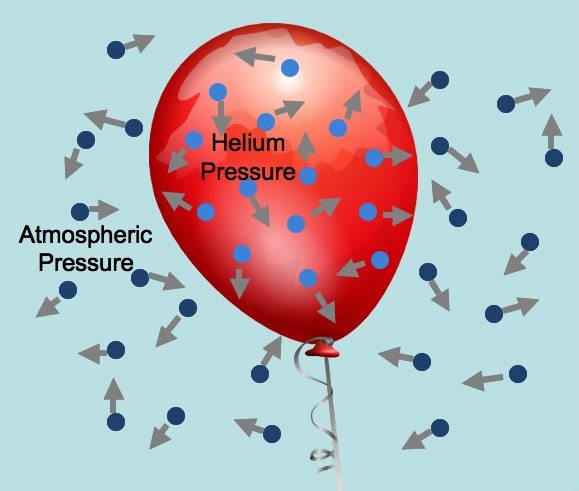
What will happen to the volume of a balloon if you put it into hot water?

a)

Volume will increase

b)

Volume will decrease

c)

Volume will not change

3.
Which of the following would increase the (gas) pressure of a system?
a)
Increase the Temperature
b)
Pump in more gas
c)
Decrease the volume
d)
All of these
4.
Gas laws involve what three variables?
a)
Solid Liquid Gas 
b)
Speed Velocity Acceleration 
c)
Elements Compounds Mixtures 
d)
Pressure Temperature Volume 
5.
When a cold tire is inflated to a certain pressure and then is warmed up due to friction with the road, the pressure increases. This happens because the
a)
air molecules hit the walls of the tire less frequently
b)
rubber in the tires reacts with oxygen in the atmosphere
c)
air molecules speed up and collide with the tire walls more often
d)
air molecules diffuse rapidly through the walls of the tire.
6.

The kinetic molecular theory of matter states that all of the particles that make up matter are constantly

a)

growing

b)

shrinking

c)

crying

d)

moving

7.
True or False: Gases can be compressed. 
a)
True
b)
False
8.

In an "inverse relationship", such as Boyle's Law, when one variable shows an increase the other variable...

a)

increases as well

b)

remains constant

c)

shows a flat line on a graph

d)

decreases

9.

Standard temperature and pressure are:

a)

25 degrees Celsius and 1.00 atm

b)

273 Celsius and 1000 mmHg

c)

Zero degrees Kelvin and 1.00 atm

d)

273 Kelvin and 1.00 atm

10.
Boyle's law :  The pressure and volume of a gas show a _____ relationship. 
a)
Inverse 
b)
Direct 
11.
The following graph shows ____ relationship. 
a)
Direct
b)
Inverse
12.

This graph shows:

a)

Boyle's Law

b)

Charles' Law

13.

Pressure is measured in (choose ALL correct answers)

a)

mL

b)

Litres

c)

kPa

d)

atmospheres

e)

Kelvin

14.
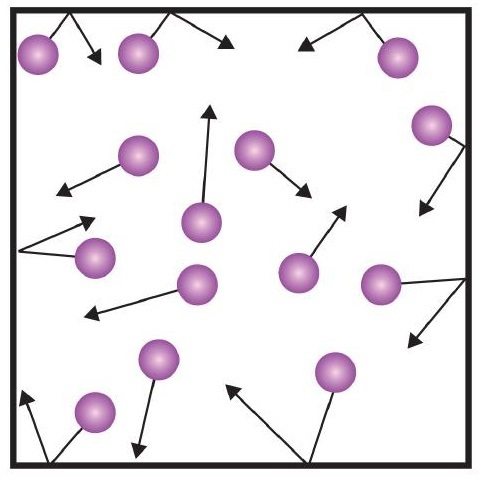
How do gas molecules move? 
a)
in an orderly fashion 
b)
constantly and randomly
c)
in straight line paths
d)
in a circular motion
15.
In Charles' Law the pressure remains constant.
a)
True
b)
False
16.
What causes pressure?
a)
The walls of the container
b)
The vacuum in the container
c)
The collisions of the particles
d)
Atmospheric pressure acting on the outside walls
17.

Each of the flasks shown above have different volumes (they are different sizes) but the temperature of each flask is the same. In which flask will the pressure be the highest?

a)

Flask 1

b)

Flask 2

c)

Flask 3

d)

Flask 4

18.
Which of the following is the measure of average kinetic energy of molecules?
a)
pressure
b)
heat energy
c)
volume
d)
temperature
19.

Which of these is under greater pressure?

a)
b)
20.
Which description best matches this particle model?
a)
Closely packed and can't move a lot. 
b)
Particles are close together but can move a little. 
c)
Particles have lots of energy and can move around.