
 Worksheets
code.org/vexVR
Total questions: 39
Worksheet time: 20mins
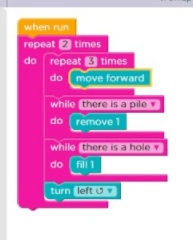
Using a "c" block to repeat one or more lines of code.
Looping
Bugging
Programming
The act of creating a program.
Artistic
Coding
Looping
What is a list of steps that the computer/device can follow to finish a task?
Programmer
Counter
Algorithm
What does run mean?
to make a code for a program
to make a computer/device complete an algorithm
to make a website show up on your screen
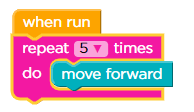
In code.org, what does this code do?
Moves forward 1 time
Moves forward forever
Moves forward 5 times
Moves left
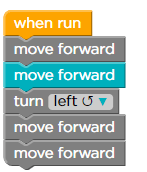
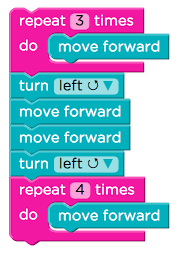
In code.org, what does this code do?
Moves forward, turns, moves forward
Moves forward 2 times, turns left, moves forward 2 more times
Moves forward 4 times and turns left
Moves and turns

In code.org, can this code be written better?
Yes, by using loops (repeat blocks)
No, this is the best way to right this code
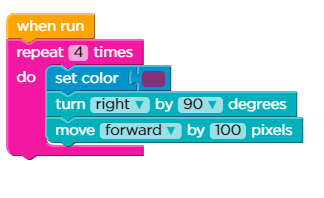
If I run this code.org program, what shape does this code make?
Rectangle
Triangle
Square
Circle

An error in a program that prevents the program from running as expected.
bug
debugging
for loop
binary
Finding and fixing errors in a program.
debugging
bug
nested loop
event

Look at the puzzle and the code below. What can you fix in the code to help the bird get to the pig?
Remove a move forward block
Add a move forward block
Change the first turn block to left
Change the second turn block to left
how we can move one step forward


Solve this code.org puzzle


Algorithm
Putting commands in correct order so computers can read the commands.
Finding and fixing problems in your algorithm or program.
An action that causes something to happen.
a step-by-step procedure for solving a problem

Which code will get the Angry Bird to the Pig in code.org?


What is wrong with the code to get Scrat to the acorn?
The first "move forward" is not needed.
The first "turn right" should be a "turn left"
The second "move forward" is extra
The last "turn right" should be a "turn left"

Which of the code below will complete this puzzle in code.org?


How long are the sides of this shape in this code.org program?
2 pixels
120 pixels
150 pixels
Purple pixels
The language that programmers create and use to tell a computer what to do
Code
Command
Run Program
BINARY
A block is
an instruction in a coding program that can be joined to other blocks to build code
visual elements on a screen that are not text, such as pictures, icons and symbols
something a computer program can react to, such as a key being pressed or mouse being clicked
place to store data that can change in a program
Coding can be used to
Program robots
Create websites, games & apps
Tell computers what to do
All of the above

For what the comment block is used ?
to write notes in the code that don't affect the way the code runs
to change the behavior of the robot
to make the sprite say something

What will this block do
change the color of the sprite
change the look of the background
move the background forward
In code.org, the move forward block tells the sprite to move forward a specific distance.
False. It does not specify distance.
True. The distance is 1 block.
One or more commands or algorithms designed to be carried out by a computer.
code
program
for loop
function
An instruction for the computer. Many of these together make up a program.
command
program
function
variable
A statement that a program checks to see if it is true or false. If true, an action is taken.
conditional
function
event
bug
A loop command that tells you to do something only up to the point that something becomes true.
until loop
conditional
nested loop
while loop
What is the first step in coding the VR Robot to move the VR Pen down to draw a black line?


What types of values can the [Repeat] block accept as parameters?
Decimal values.
Negative values.
Words or text.
Integers.

When will the VR Robot move the VR Pen up?
Before the [Repeat] block has repeated all of the blocks inside of it twice.
Before the VR Pen is set to the color red.
After all the blocks have been repeated six times.
After all the blocks have been repeated twice.

How can the following example be simplified by using a [Repeat] block?


Which of the following describes why a [Repeat] block would be used in a project?
To repeat certain blocks forever.
To save space and time for blocks that repeat more than once in a project.
To only run a stack of blocks one time.
To run an attached stack of blocks when the project is started.

What is the condition that will end this [Repeat] block?
After the VR Robot places the pen down.
After the VR Robot drives forward one time for 200 millimeters (mm).
After the [Repeat] block has repeated the blocks inside of it four times.
After the VR Robot has driven forward 200 millimeters (mm) then turned right 60 degrees six times.
Which of the following blocks is used to lift up the VEX VR Pen?


In VexVR, what type of block is this?
Operator
Sensor
C or repeat block
A graphic on the screen with a location, size, and appearance.
character
sprite
rendering
An action that a sprite/robot performs continuously until it’s told to stop
program
movement
behavior

