
 Worksheets
NGSS Physics IS2T1: Kepler's Laws
Total questions: 30
Worksheet time: 16mins
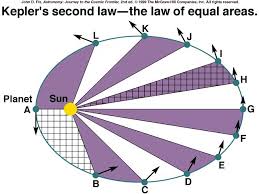


The diagram below shows a moon revolving around a planet in an elliptical orbit. At which position is the moon traveling fastest?
location 1
location 2
location 3
location 4

The diagram below shows a moon revolving around a planet in an elliptical orbit. At which position is the moon traveling slowest?
location 1
location 2
location 3
location 4
A year on Jupiter is 4,344 days long. This tells you how long it takes
Jupiter to orbit the sun.
Jupiter to rotate one time on its axis.
the sun to orbit Jupiter.
Earth to orbit Jupiter.
What causes Earth’s year to be shorter than Jupiter’s year?
the gravitational pull of Jupiter’s moons
the shape of Earth’s orbit around the Sun
the distance between Earth and the Sun
the mass and density of Jupiter
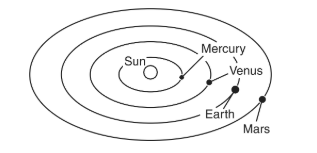
Which planet will take the least amount of time to revolve around the Sun?
Mercury
Venus
Earth
Mars

Which planet will take the most amount of time to revolve around the Sun?
Mercury
Venus
Earth
Mars
Which statement best describes Kepler’s 2nd Law of Planetary Motion?
Planets revolve around the sun over equal areas in equal time intervals.
Planetary orbits are in the shape of an ellipse.
A planet’s orbital period is proportionate to its distance from the sun.
Kepler's 3rd law tell us that __ would be dependent on __.
orbital period ; distance
distance ; orbital period
When a planet or moon travels once fully in its orbit around a largest celestial body, it is a(n):
Rotation
Revolution
A way of measuring distances in space. Equivalent to the distance from Earth to the Sun.
Elipse
Eccentricity
Astronomical Unit
Period
A measure of how round an orbit is.
Period
Eccentricity
Astronomical Unit
Vector
Planets travel faster when they are closer to the sun.
Kepler's 1st Law
Kepler's 2nd Law
Kepler's 3rd Law
The time it takes one object in space to fully orbit another.
Astronomical Unit
Vector
Orbital Period
Orbital Radius

The diagram explain about....
Kepler's First Law
Kepler's Second Law
Kepler's Third Law

The diagram is about....
Kepler's First Law
Kepler's Second Law
Kepler's Third Law

This formula is about
Kepler's First Law
Kepler's Second Law
Kepler's Third Law
Earth takes 1 year to make 1 complete orbit while Saturn takes 29.5 years.
True
False

