
 Worksheets
Magnetic Effect of Current - Electromagnets
Total questions: 26
Worksheet time: 2hrs 10mins
A _______________ is a current-carrying coil of wire with many loops.
electromagnet
solenoid
magnet
compass
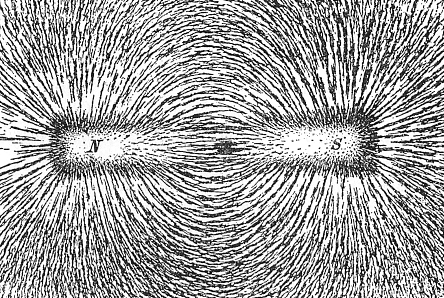
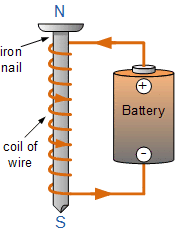

How do electromagnets differ from regular magnets?
They can be turned off and on
Their polarity can be reversed
Their strength can be changed
All of the above

A compass needle responds to a magnetic field, because the compass needle is a ___________ .
generator
motor
magnet
transformer
Who was the first to observe the magnetic effect of electric current?
Michael Faraday
Hans Christian Oersted
Alessandro Volta
André-Marie Ampère
The magnetic field lines due to a straight wire carrying a current are:
straight
circular
parabolic
elliptical

A wire carries a current, creating a magnetic field around itself as shown. The current in the wire is:
Directed to the right
Directed to the left
Equal to the magnetic field
In the same direction as the magnetic field
Magnetic field-lines do not cross each other.
TRUE
FALSE

Identify the poles of the magnet in the given figure.
NORTH
SOUTH
One is north and the other is south
Can't predict

Which of the following diagrams correctly shows the magnetic field produced by a current-carrying wire?
A
B
C
D
Which materials are magnetic?
Wood
Steel
Cobalt
Aluminium
Iron
The magnetic field lines are __________ .
closed curves
open curves
semi circular
The strength of the magnetic field is shown by how close the field lines are.
FALSE
TRUE

The strongest part of a magnet is...
the bars.
the force field.
the poles.
the middle.

Magnets can interact without touching.
TRUE
FALSE
Select the diagram with the weakest magnetic field
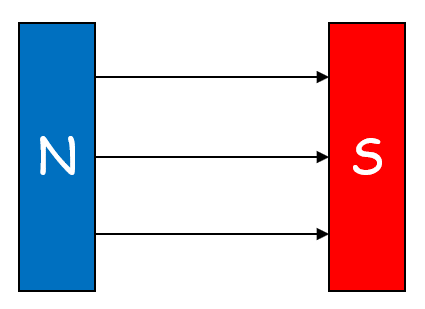
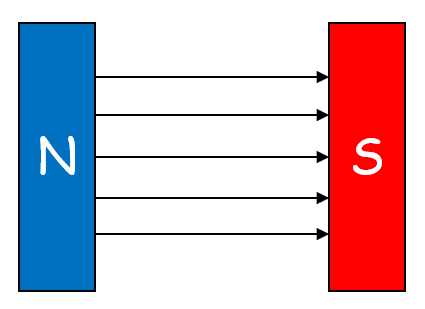

A compass points toward the south pole of Earth's magnetic field, located near the Earth's geographical ________.
north
south
east
west
In magnetic materials, all of the ________ are pointing in the same direction.
energy levels
electrons
domains
orbits
A permanent magnet is a material that produces a ___________________ field without any ___________________ magnetic field being present.
electronic, internal
magnetic, internal
magnetic, external
electronic, external
Permanent magnets can be demagnetized by ___________________ them past the Curie point (approximately 1,060 °F).
heating
freezing
shaking
solidifying
It is not possible to separate the North and South poles of a magnet.
TRUE
FALSE

Looking at the field lines in this picture, these two magnets are ________ .
Attracting
Repeling

Looking at the field lines in this picture, these two magnets are ________ .
attracting
repeling

